
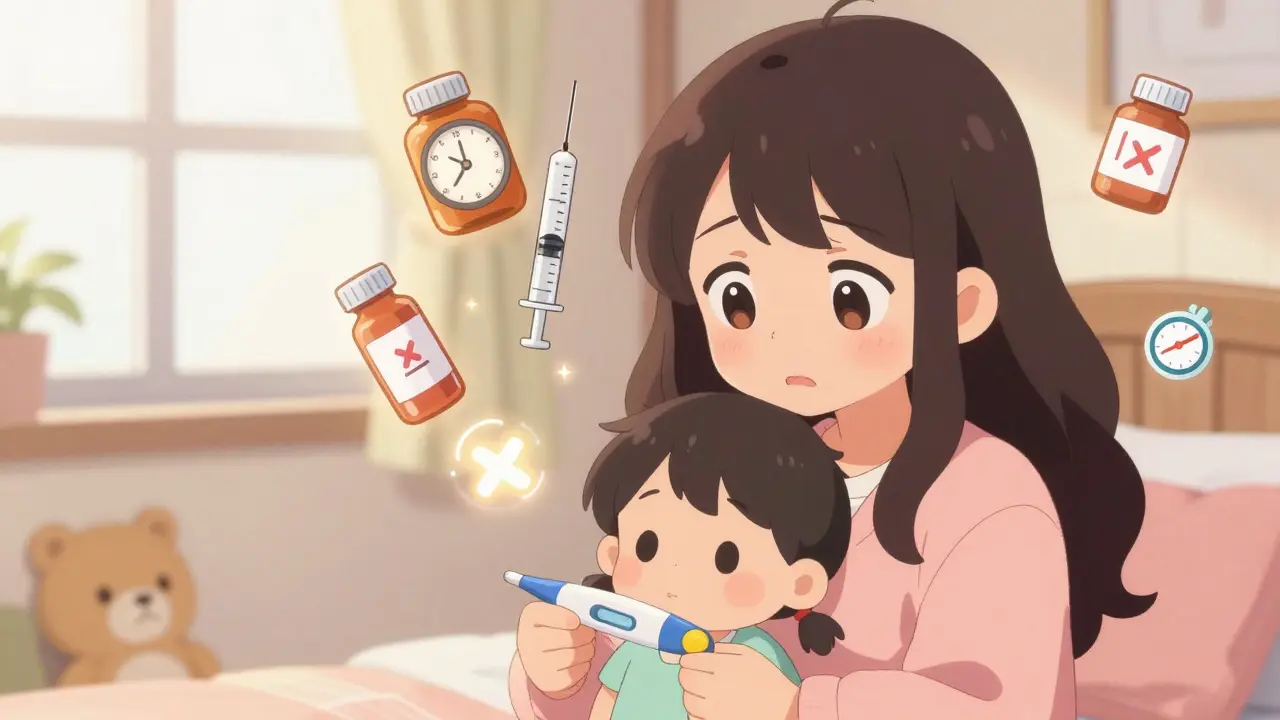
When your child misses a dose of medicine, panic is normal. But doubling up? That’s dangerous. Every year, medication errors cause avoidable harm to tens of thousands of children in the U.S. alone. The good news? Most missed doses can be handled safely-with the right rules.
Don’t Double the Dose. Ever.
The biggest mistake parents make is giving two doses to make up for one missed. This isn’t just risky-it’s life-threatening. Children’s bodies process drugs differently than adults. Their livers and kidneys aren’t fully developed, so they can’t clear extra medication fast enough. Dr. Sarah Verbiest’s 2023 review found that doubling doses increases the risk of severe reactions by 278% in kids under 12. For medications like antibiotics, seizure drugs, or pain relievers, even a little too much can cause vomiting, drowsiness, breathing trouble, or seizures.Time Matters More Than You Think
How long you wait before giving a missed dose depends on how often the medicine is supposed to be given. There’s no one-size-fits-all rule. Here’s what major children’s hospitals recommend:- Once daily: If you remember within 12 hours of the missed time, give it. After that, skip it. Don’t give it the next morning-just go back to the regular schedule.
- Twice daily (every 12 hours): If it’s been less than 6 hours since the missed dose, give it. If it’s more than 6 hours, skip it and wait for the next scheduled time.
- Three times daily (every 8 hours): Give the dose if it’s been less than 3 hours since it was due. If it’s been longer, skip it.
- Four times daily (every 6 hours): Only give the missed dose if it’s been less than 2 hours. Otherwise, skip it.
- Every 2-4 hours (like some asthma or pain meds): Skip it if it’s been more than 2 hours. These are often high-risk medications, and giving them too close together can cause overdose.
These time thresholds aren’t random. They’re based on how long the drug stays active in the body. Giving a dose too soon means drug levels build up dangerously. Skipping it when it’s too late avoids that buildup.
High-Risk Medications Need Special Rules
Some medicines are so sensitive that even one missed dose can hurt treatment. These include:- Chemotherapy drugs: Missing even one dose can reduce effectiveness. Call your oncology team immediately.
- Anti-seizure medications: Skipping doses can trigger seizures, even in kids who’ve been seizure-free for months.
- Heart or blood pressure meds: Sudden drops or spikes in levels can cause dizziness, fainting, or worse.
- Insulin or diabetes meds: Missing a dose can lead to dangerous blood sugar swings.
For these, never guess. Call your doctor or pharmacist right away. Don’t rely on general guidelines. Some hospitals keep special protocols for each child on high-risk meds, and you should too.
What If the Instructions Don’t Say Anything?
Here’s the scary part: 25% of high-risk pediatric medications don’t include missed dose instructions in their patient leaflets. That’s not a mistake-it’s a system failure. If your child’s medicine bottle or prescription label doesn’t say what to do when a dose is missed, call your pharmacy or pediatrician. Don’t assume. Don’t guess. Write down their answer and keep it with the prescription.Even if the label says “take as soon as remembered,” that’s not enough. For some meds, “as soon as remembered” could mean giving a dangerous dose hours too early. Always ask for the specific time window.

Use Tools to Avoid Missed Doses in the First Place
Prevention is better than fixing mistakes. Here’s what works:- Use an oral syringe, not a spoon. Household spoons vary in size. One study showed using syringes reduces dosing errors by 58%. The FDA warns that confusion between teaspoons and tablespoons causes thousands of pediatric overdoses each year.
- Set phone alarms. Label each alarm with the drug name and dose. Use different tones for different meds.
- Use color-coded charts. Hospitals like Boston Children’s use color-coded schedules for kids on multiple meds. Red for morning, blue for afternoon, green for night. Parents using these saw missed doses drop by 44%.
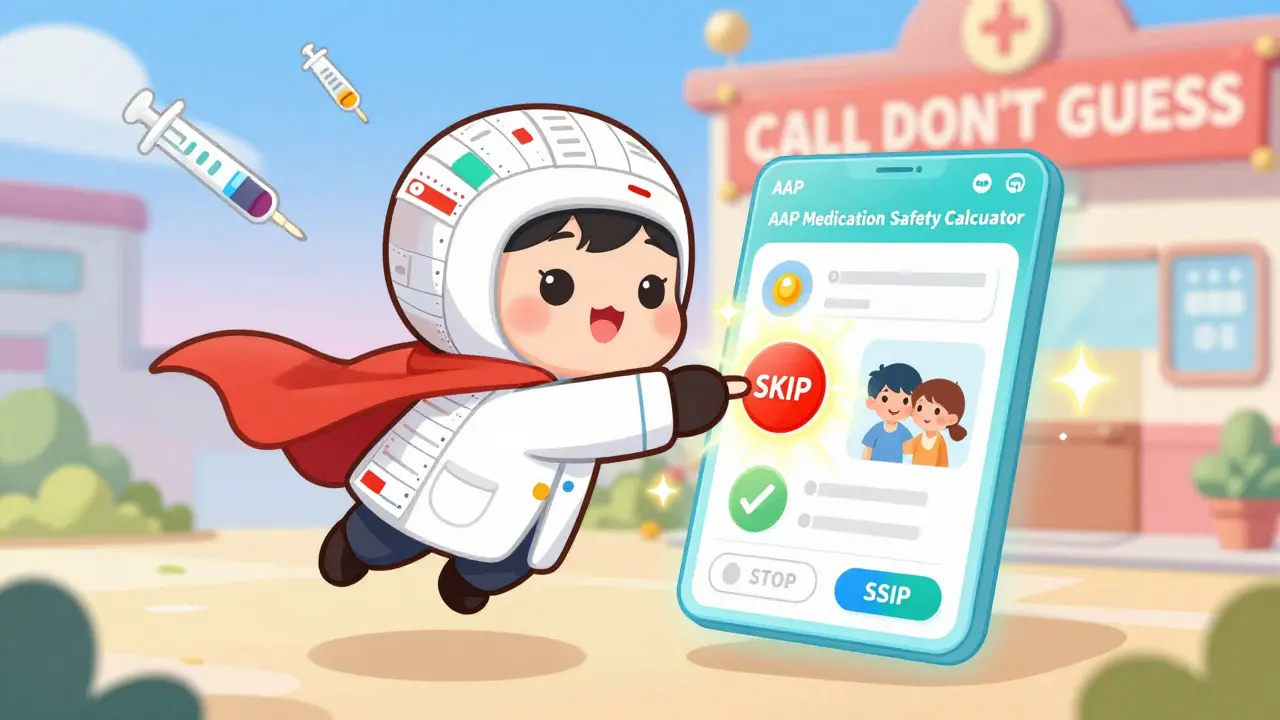
- Download the AAP Pediatric Medication Safety Calculator. This free app lets you enter the medicine name, frequency, and time missed. It gives you instant, evidence-based advice on whether to give the dose or skip it. Beta users improved their decision accuracy by 83%.
- Teach-back method. Before leaving the hospital, ask your nurse: “Can you show me how you’d give this medicine if I forgot?” Then do it yourself. Studies show this cuts errors by 37%.
Complex Cases Need Extra Support
Children with chronic illnesses-like cerebral palsy, cystic fibrosis, or cancer-often take four or more medications daily. These families face 300% higher risk of medication errors, according to the Canadian Pediatric Society. For them:- Keep a printed, updated list of every medicine, dose, time, and purpose.
- Use a pill organizer with separate compartments for each time of day.
- Ask for a home visit from a pediatric pharmacist. Many hospitals offer this for complex cases.
- Train a backup caregiver-grandparent, aunt, neighbor-so someone else knows what to do if you’re sick or away.
Don’t try to manage this alone. You’re not failing-you’re facing a system that wasn’t built for families like yours.
What About Liquid Medicines and Weight-Based Dosing?
Most pediatric meds are dosed by weight, not age. But estimating weight is hard. One study found 73.8% of morphine dosing errors in emergency rooms came from wrong weight guesses. Hospitals now use length-based resuscitation tapes-measuring a child’s length to estimate weight-which cut guessing errors by 42%.At home, if you don’t know your child’s exact weight:
- Ask your doctor for a weight chart to track at home.
- Use a baby scale if you have one.
- If you’re unsure, call the pharmacy. They can help you calculate the dose based on last known weight.
Never use a kitchen spoon. Never eyeball it. Always use the syringe that came with the medicine.
When to Call the Doctor
Call your pediatrician or go to urgent care if:- You gave two doses by accident.
- Your child shows signs of drowsiness, confusion, trouble breathing, or seizures after a missed or extra dose.
- You’re unsure what to do and it’s after hours.
- Your child takes high-risk meds and you missed a dose.
Don’t wait to see if they get worse. Pediatric emergencies move fast. It’s better to be safe.
Why This Is So Hard-and What’s Changing
Parents aren’t careless. The system is messy. Only 75% of pediatric medication labels include missed dose instructions. In rural areas, where specialist access is limited, medication errors are 3.2 times higher than in cities. The FDA is pushing for new rules requiring all pediatric meds to include clear missed-dose guidance by 2027. AI tools like the NIH’s PediMedAI project are being tested to send alerts 30 minutes before a dose is due-and early results show missed doses dropping by 68%.But right now, you have to be the expert. Write down the rules. Use the tools. Ask questions. Your child’s safety depends on it.
What should I do if I realize I missed a dose an hour after it was due?
If it’s been less than the recommended time window for that medication’s frequency (e.g., less than 6 hours for twice-daily, less than 3 hours for three-times-daily), give the missed dose right away. Then return to the normal schedule. Don’t adjust the next dose.
Can I give the missed dose the next morning instead?
Only if it’s a once-daily medication and you missed it by less than 12 hours. For all other frequencies, giving it the next morning disrupts the drug’s rhythm in the body and can cause side effects or reduce effectiveness. Always follow the time-based rules, not the calendar.
My child vomited right after taking the medicine. Should I give another dose?
If your child vomited within 15-20 minutes of taking the dose, it’s likely the medicine didn’t get absorbed. Call your doctor before giving another dose. If it’s been more than 30 minutes, assume the dose was absorbed and don’t repeat it. Giving a second dose risks overdose.
Is it safe to use a kitchen measuring spoon if I don’t have the syringe?
No. Kitchen spoons are not accurate. A teaspoon can hold anywhere from 3 to 7 milliliters. The FDA estimates this confusion causes thousands of pediatric overdoses each year. Always use the oral syringe that came with the medicine. If you lost it, ask your pharmacy for a free replacement.
My child takes 5 different medicines. How do I keep track?
Use a color-coded chart: assign one color to each time of day (e.g., red for morning, blue for afternoon, green for night). List each medicine under its time with dose and purpose. Post it on the fridge. Use phone alarms labeled with drug names. Ask your pharmacist for a printed schedule. Many hospitals offer free custom charts for complex cases.
What if I’m not sure whether to give the dose or skip it?
When in doubt, skip it. It’s safer to miss one dose than to risk an overdose. Call your doctor or pharmacist the next day to confirm the plan. Don’t rely on memory or internet searches. Use the AAP Medication Safety Calculator app for real-time guidance.
Final Tip: Keep a Medication Log
Every time you give a dose, write it down. Date, time, medicine, dose, and whether it was given or skipped. This helps you spot patterns, tells your doctor what’s really happening, and prevents double-dosing. A simple notebook or phone note works. But don’t rely on memory.Medication safety isn’t about being perfect. It’s about being prepared. You’re not alone. Millions of parents face this every day. Use the tools. Ask for help. And never, ever double a dose.





Kunal Majumder
January 10, 2026Man, I wish I had this when my kid was on antibiotics last year. I panicked and doubled up because I thought I missed it by 2 hours - turns out it was only 45 minutes. She threw up for 12 hours straight. Lesson learned the hard way. This guide is gold.