
Why some drug patents last longer than 20 years
Most patents expire 20 years after the first filing. But if you look at the expiration dates on popular brand-name drugs like Humira or Enbrel, you’ll see they’re often protected for 25, 30, even 35 years. That’s not a mistake. It’s patent term restoration - a legal loophole built into U.S. law to make up for time lost waiting for the FDA to approve a new drug.
Here’s the problem: Drug companies file patents early - sometimes before a single human trial. That’s smart. It locks in protection while the long, expensive process of clinical trials and regulatory review drags on for 10 to 15 years. By the time the FDA says yes, the patent might have only five years left. That’s not enough to recoup the $2.6 billion it typically costs to bring a drug to market, according to Tufts Center for the Study of Drug Development.
Patent Term Restoration (PTE) fixes that. It doesn’t give new patents. It doesn’t extend every patent. It gives back time - but only time lost during FDA review. And it’s tightly controlled.
How PTE actually works: The formula behind the extension
The math isn’t simple, but here’s the basic version:
PTE = Regulatory Review Period − Pre-Grant Review Period − Days of Applicant Delay − ½ (Total Patent Term − Pre-Grant Patent Term)
Let’s break that down:
- Regulatory Review Period (RRP): The total time from when the FDA receives the application until it approves the drug.
- Pre-Grant Regulatory Review Period (PGRRP): The time between when the patent was filed and when the FDA got the application.
- Days of applicant’s due diligence: If the company sat on data or missed deadlines, those days get subtracted.
- Total Patent Term: 20 years from the first filing date.
There are hard limits: No extension can be longer than five years. And even with the extension, the total time the drug can be sold without generics is capped at 14 years after FDA approval.
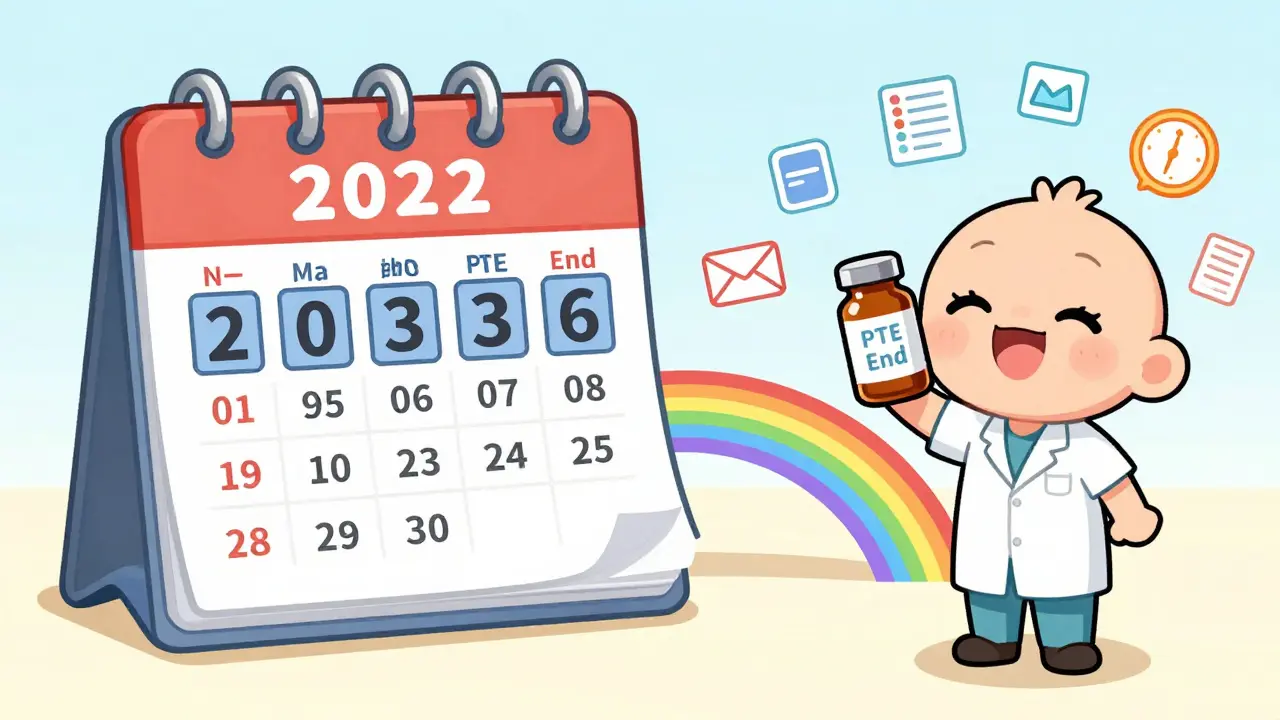
For example: A drug filed in 2010, approved in 2022. That’s 12 years of FDA review. If the company proved they moved fast and didn’t delay, they could get up to five years added - pushing the patent out to 2035 instead of 2030. But if the drug was approved in 2022, the clock stops at 2036 - no matter how long the extension is. That’s the 14-year cap.
Who qualifies? Not everyone gets a second chance
PTE isn’t for every invention. It’s only for:
- Human drugs
- Medical devices
- Food additives
- Color additives
- Animal drugs
And only one patent per product can get extended. That’s critical. If a company has 15 patents on a single drug - covering the molecule, the pill shape, the delivery system, the manufacturing method - only one of them can get extra time. The others? They expire on schedule.
That’s why companies fight over which patent to extend. They pick the one that covers the core active ingredient - the one generics can’t copy without infringing. If they pick the wrong one, the extension is useless.
Biologics - complex drugs made from living cells - are now eligible too. In 2023, 34% of PTE applications were for biologics, up from just 19% in 2018. That’s a big shift as more advanced therapies hit the market.
The application process: A ticking clock and a mountain of paperwork
Applying for PTE isn’t filling out a form. It’s a legal marathon.
First, you have 60 days after FDA approval to file. Miss that window? You lose the chance forever. No extensions. No exceptions.
Then comes the paperwork. The FDA requires day-by-day proof that your team was moving forward - not sleeping on data, not waiting for a meeting, not ignoring a request. Emails, lab logs, submission dates, FDA correspondence. Everything. One pharmaceutical patent attorney on Reddit said their team once spent six months digging through old servers just to prove they didn’t delay a single day.
The USPTO denies about 12.7% of applications. The main reason? Inadequate proof of due diligence. It’s not about whether the drug worked. It’s about whether you can prove you didn’t waste time.
And here’s a trick: Companies can ask the USPTO to pause the PTE review for up to six months. Why? Maybe they’re waiting for a reissue patent to be approved. Or they’re in litigation. That pause gives them time to strategize without losing the clock.

Why PTE is controversial - and how it affects your medicine prices
On paper, PTE makes sense. It rewards innovation. It helps recoup R&D costs. But in practice, it’s become a tool for extending monopolies far beyond what Congress intended.
A 2022 Yale study found that 91% of drugs that got PTE kept their market dominance for years after the extension ended - not because they were better, but because they stacked on secondary patents: new dosages, new delivery methods, new combinations. These aren’t new drugs. They’re tweaks. But they block generics anyway.
And it’s expensive. The Congressional Budget Office estimates PTE adds $4.2 billion a year to U.S. drug spending. When a drug gets a five-year extension, it keeps 92% of its market share - meaning patients and insurers pay brand prices instead of generic prices for years longer than expected.
Some critics call it a scam. James Love of Knowledge Ecology International says 78% of PTE applications now involve secondary patents, not the original molecule. That means the system meant to help innovators is being used to delay competition.
The FDA’s 2024 guidance tried to tighten up what counts as “due diligence.” A 2024 court case (Eli Lilly v. USPTO) made it harder to claim credit for time spent waiting on FDA requests. That could shrink extensions by 8-12 months on average.
What’s next? Digital shifts and possible reforms
The FDA plans to launch a digital submission platform for PTE applications in Q2 2026. That’s a big deal. Right now, companies email PDFs, fax forms, and mail paper copies. It’s slow. It’s messy. A digital system could cut processing time from 217 days to under 100.
But bigger changes might be coming. The proposed Preserve Access to Affordable Generics and Biosimilars Act would ban some of the most aggressive PTE tactics - like extending patents on minor changes to existing drugs. The Government Accountability Office is set to release a full review of PTE’s impact on drug pricing in December 2025. If they find it’s inflating prices too much, Congress could rewrite the rules.
For now, PTE remains a powerful tool - but one that’s under fire. It’s not broken. But it’s being stretched thin.
What you need to know if you’re a patient or a business
If you’re a patient: Don’t assume your drug will go generic after 20 years. Check the Orange Book (FDA’s official list of approved drugs and their patents). If you see a patent with an extension date beyond 14 years after approval, that’s PTE at work.
If you’re a startup or biotech company: PTE isn’t optional. It’s essential. But don’t wait until the last minute. Start tracking every FDA interaction from day one. Assign someone to manage the PTE timeline - not just your patent attorney. Your regulatory team and your legal team need to talk every week.
If you’re a generic manufacturer: Look for drugs that didn’t get PTE. Those are your best targets. And watch for PTE denials - they’re rare, but when they happen, generics can move in faster than expected.
Key facts to remember
- PTE is only for products that went through FDA review - not for software, devices without approval, or non-regulated products.
- Maximum extension: 5 years.
- Maximum total exclusivity: 14 years after FDA approval.
- Only one patent per product can be extended.
- Application must be filed within 60 days of FDA approval - no exceptions.
- Due diligence is everything. Document everything.
- Biologics now make up over a third of PTE applications.
Common mistakes that kill PTE applications
- Waiting until after FDA approval to start tracking documents.
- Letting your regulatory team and patent team work in silos.
- Trying to extend a patent that doesn’t cover the active ingredient.
- Missing the 60-day filing window.
- Assuming the FDA will tell you what to submit - they won’t.
Can a patent be extended more than once for the same drug?
No. Only one patent per product can receive a patent term restoration. Even if a company holds multiple patents on the same drug - for example, covering the chemical structure, the delivery system, and the manufacturing process - only one can be extended. The others expire on their original date. Companies strategically choose the patent that gives them the strongest legal barrier against generics.
What happens if I miss the 60-day deadline to apply for PTE?
You lose the chance forever. There are no extensions, no exceptions, no appeals. The 60-day window starts the day the FDA approves the product. Many companies lose out because their legal team didn’t coordinate with their regulatory team. If your drug gets approved on March 1, your application must be filed by April 30. Set reminders. Assign responsibility. This is one deadline you cannot afford to miss.
Does PTE apply to generic drugs?
No. PTE only applies to the original innovator drug - the one that went through full clinical trials and received FDA approval as a new chemical entity. Generic manufacturers don’t file for PTE because they don’t need it. Their business model relies on entering the market after the original patent expires - with or without an extension.
Can I get PTE for a medical device?
Yes. Medical devices that require premarket approval (PMA) from the FDA are eligible for PTE. This includes complex implants, diagnostic tools, and life-supporting equipment. However, devices cleared through the faster 510(k) pathway are not eligible. Only those that went through the full, lengthy PMA process qualify.
How long does it take to get a PTE approved?
The FDA takes an average of 217 days to process a PTE application, according to their 2023 annual report. But the timeline can vary widely. If your documentation is incomplete or unclear, the FDA may request more information, which can add months. The USPTO then reviews the FDA’s recommendation and issues the final extension. Total processing time is often between 7 and 10 months.
Is PTE available outside the United States?
No. Patent Term Restoration is a U.S.-specific program created by the Hatch-Waxman Act. Other countries have different systems. The European Union uses Supplementary Protection Certificates (SPCs), which serve a similar purpose but have different rules. Canada, Japan, and Australia have their own versions. But if you’re filing a patent in the U.S., PTE is the only way to extend patent life for FDA-regulated products here.
What to do next
If you’re in the pharmaceutical or medical device industry: Start documenting your FDA interactions today. Even if your drug is still in Phase 2 trials, begin saving every email, meeting note, and submission confirmation. The clock starts ticking the moment you file your patent - and you won’t get a second chance to rebuild that record later.
If you’re a patient or insurer: Check the FDA’s Orange Book before your next prescription. If your drug has a patent extension, ask your doctor if a generic alternative exists - even if it’s not on your formulary yet. Sometimes, generics enter the market just weeks after an extension ends.
PTE isn’t going away. But its future is uncertain. The next few years will decide whether it stays a tool for innovation - or becomes a tool for profit.







April Williams
January 26, 2026This is such a blatant scam. Companies file patents before they even have a working drug, then sit on their hands for 12 years while the public pays for their R&D, and then they get FIVE EXTRA YEARS? That’s not innovation, that’s corporate theft. And don’t even get me started on the biologics loophole. We’re being robbed blind and no one’s doing anything about it.