
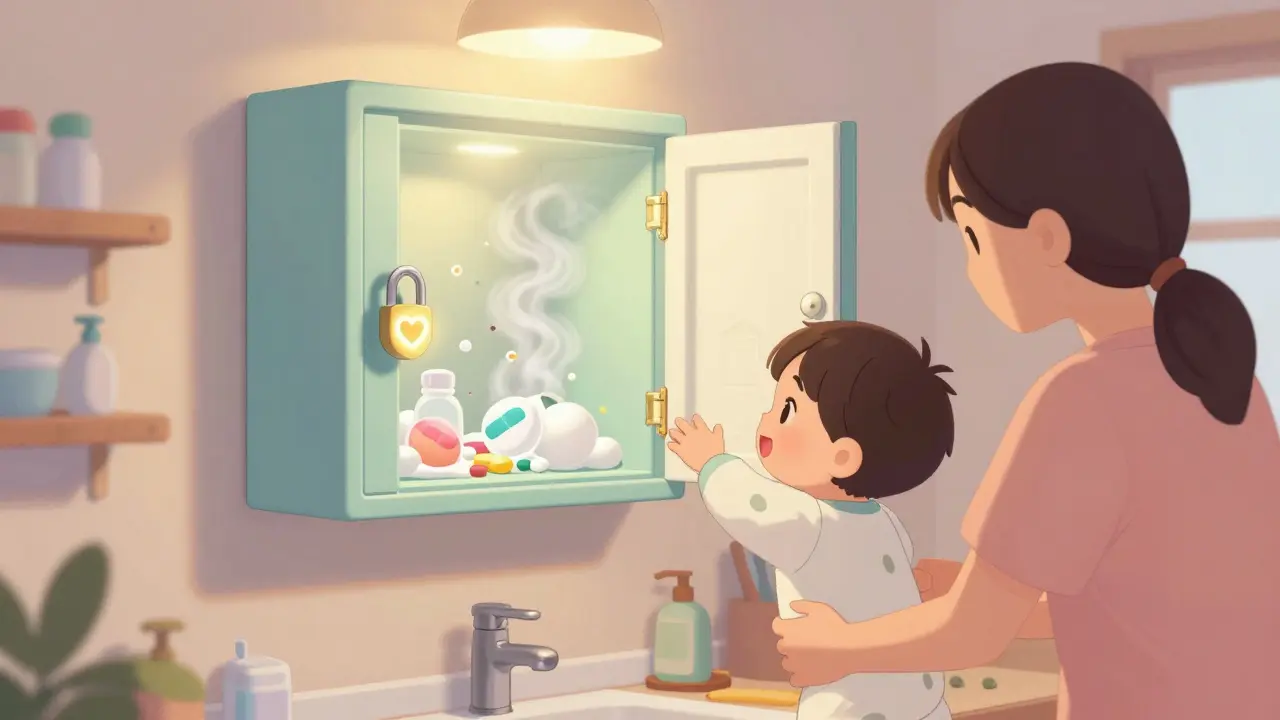
Every year in the U.S., 60,000 children under 5 end up in emergency rooms because they got into medications left within reach. It’s not just kids - grandparents, teens, and even visitors can accidentally take the wrong pill, or worse, misuse drugs left in plain sight. The truth? Most homes store medicines dangerously. You might think a high shelf or a locked bathroom cabinet is enough. It’s not. Here’s exactly where and how to store your medications safely - based on real data from health experts, not guesswork.
Stop Storing Medicines in the Bathroom
The bathroom is the most common mistake. Why? It’s convenient. You brush your teeth there. You take your pills after. But humidity from showers and baths turns that cabinet into a steam room. MedlinePlus a U.S. National Library of Medicine service found that 68% of households store medicines in the bathroom. That’s a problem. Humidity above 60% breaks down pills. Insulin, thyroid meds, and even aspirin lose effectiveness in just 30 days. The FDA U.S. Food and Drug Administration says humidity over 80% during showers degrades 67% of common medications. That means your painkiller might not work when you need it. And if it’s expired or degraded, it could make you sick.
The Locked Cabinet Rule
There’s one rule that experts agree on: lock it. Not just close it. Not just put it on a high shelf. Lock it. A Washington State Department of Health state public health agency study found that 73% of accidental poisonings happened because meds were left in unlocked cabinets, purses, or on countertops. Even if you think your child can’t reach it, toddlers as young as 24 months can climb onto chairs and pull down items from 48-inch shelves. The Centers for Disease Control and Prevention U.S. federal public health agency says the biggest risk is in homes with children under 5 - and 45% of those cases happen at grandparents’ houses where storage isn’t consistent.
So where do you lock it? A locked cabinet a secure storage unit with a lock mechanism in a bedroom, home office, or closet works. If you have a fireproof document box a secure container designed to protect important papers from fire and theft, use it. Some families use a gun safe a heavy-duty locked storage unit originally designed for firearms - yes, really. The CDC Centers for Disease Control and Prevention reports that 18% of rural households already do this. It’s sturdy, locked, and out of sight.
Keep Original Containers - And Check the Labels
Never dump pills into random jars or containers. Why? You’ll forget what’s inside. The Food and Drug Administration U.S. Food and Drug Administration requires every prescription to have a label with the National Drug Code a unique 10-digit identifier for all medications in the U.S., dosage, expiration date, and patient name. That label is your safety net. If you lose it, you risk giving the wrong dose - or worse, giving someone else’s medicine. A 2023 MedlinePlus a U.S. National Library of Medicine service survey found that 32% of households had unlabeled pills in drawers. That’s a recipe for disaster.
Also, make sure the cap is child-resistant. The Poison Prevention Packaging Act U.S. federal law requiring child-resistant packaging says caps must take 17.5 pounds of force to open. But here’s the catch: 50% of kids can open them by age 5. That’s why locking the container matters more than the cap.
Special Cases: Insulin, Opioids, and Elderly Users
Not all medicines are the same. Insulin a hormone medication used to treat diabetes must be refrigerated between 36-46°F (2-8°C). But don’t put it in the fridge door - temperature changes there can ruin it. Put it on a middle shelf, and lock the fridge. Seattle Children’s Hospital a pediatric healthcare provider in Washington says storing insulin with food increases contamination risk. Use a separate locked container inside the fridge if possible.
Opioids a class of powerful painkillers including oxycodone and hydrocodone are a major risk for teens and young adults. The National Institutes of Health U.S. federal agency for biomedical research found that 92% of adolescent opioid misuse starts at home. That’s why the EPA U.S. Environmental Protection Agency now partners with over 7,200 pharmacies to give free lockable containers with opioid prescriptions. If you have these meds, use them. Don’t leave them in a pill organizer.
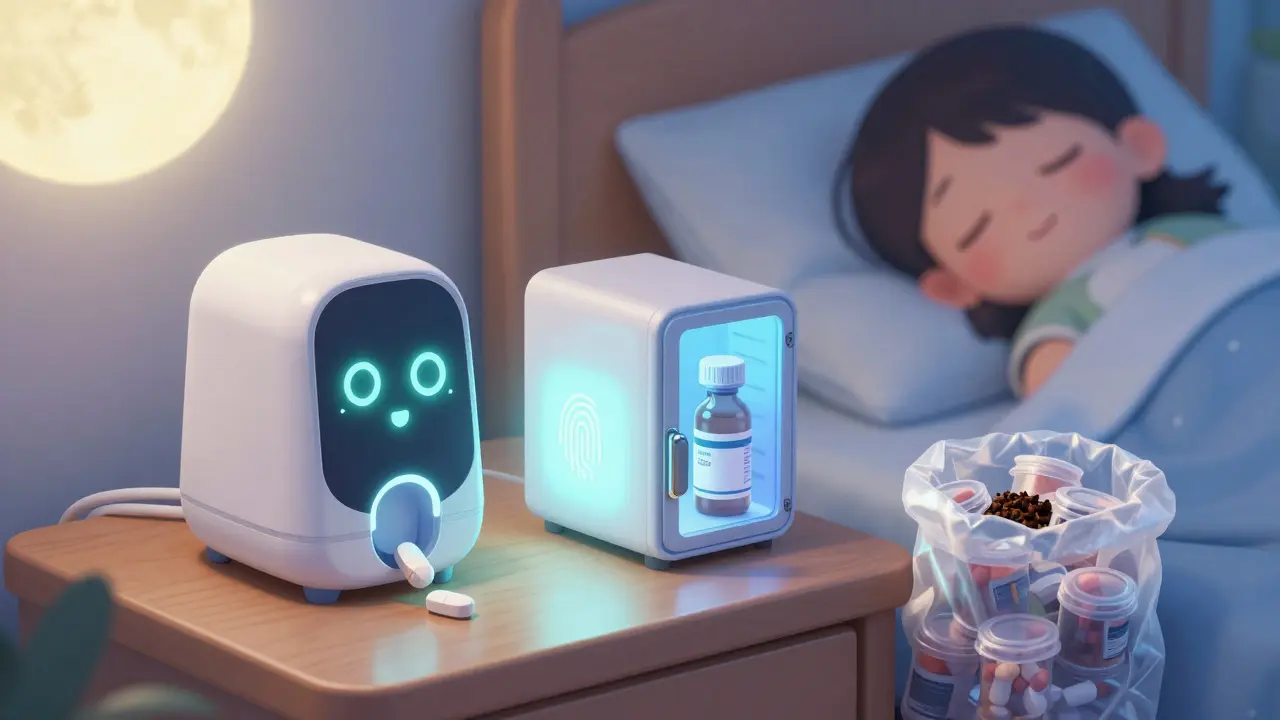
For elderly parents with dementia, locking everything away isn’t always safe. If they need daily meds, a smart medication dispenser an electronic device that dispenses pills at set times with access controls might be better. The University of Michigan a public research university in Ann Arbor found these devices are 78% effective at preventing misuse. They beep, lock, and only open at the right time. But they cost $50-$150. Talk to your doctor - some insurance plans cover them.
What About the Car? Or Your Purse?
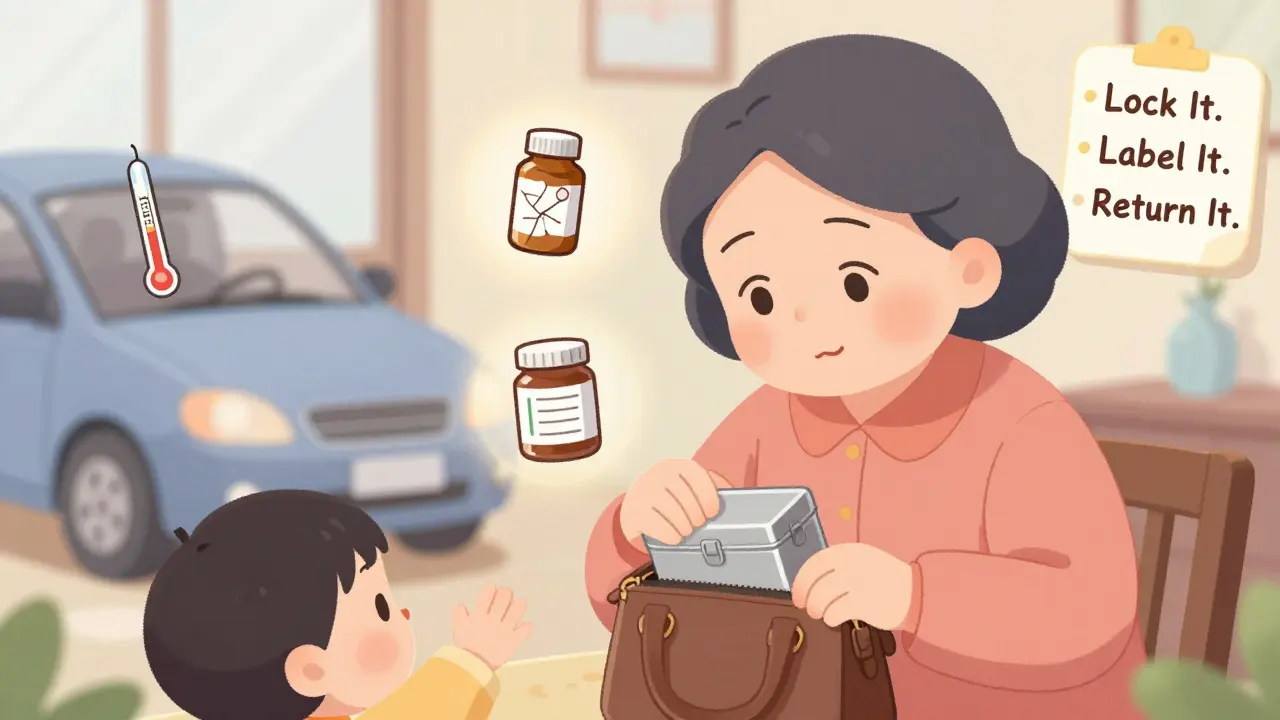
Leaving pills in your car or purse is common - and dangerous. The AAA Foundation a nonprofit focused on traffic safety found that 32% of households keep medications in vehicles. Heat in summer can hit 120°F inside a car. That destroys medicine. Cold in winter can freeze liquids. And if someone breaks into your car? They might take your painkillers.
Same with purses. A NACoA National Association for Children of Alcoholics report says 27% of poisonings happen in grandparents’ homes because meds were left in coats or purses. If you’re visiting someone with kids, never leave your meds unattended. Put them in a locked bag or take them with you.
How Much Does a Medicine Safe Cost?
You don’t need to spend a fortune. Consumer Reports a nonprofit product testing organization tested 15 models in 2023. The cheapest, at $19.99, has a key lock and holds 20+ bottles. It’s made of steel, resists 50 pounds of force, and fits under a sink or in a closet. More expensive ones have biometric locks (fingerprint), but those are overkill for most homes. The EPA U.S. Environmental Protection Agency says any locked container that meets Underwriters Laboratories standards is enough. No need for a safe like in a bank.
What to Do With Old or Expired Medicine
Don’t flush them. Don’t toss them in the trash. The EPA U.S. Environmental Protection Agency warns that flushing meds contaminates water supplies. Instead, use a drug take-back program a government-approved collection system for unused medications. Most pharmacies - including CVS, Walgreens, and local independent ones - have drop boxes. Some cities host annual collection days. Check your local health department’s website. If you can’t get to one, mix pills with coffee grounds or cat litter, seal them in a bag, and throw them in the trash. Keep the original label on the container.
One Habit That Changes Everything
The biggest cause of accidents? Leaving meds out after use. NACoA National Association for Children of Alcoholics found that 42% of poisonings happen in the 5-10 minutes after someone takes a pill. You open the cabinet, give the dose, put the bottle down to grab water… and forget. That’s all it takes. The fix? Make it a rule: Put it back, locked, immediately. No exceptions. Even if you’re tired. Even if you’re alone. That habit cuts risk by more than half.
Final Checklist: Your Home Medication Safety Plan
- Store all meds - prescription, OTC, vitamins - in one locked place.
- Use a cabinet, drawer, or box with a real lock - not just a latch.
- Keep original containers with labels intact.
- Never store in the bathroom, car, or purse.
- Refrigerate insulin separately, locked inside the fridge.
- Use a take-back program to dispose of expired pills.
- Return meds to storage within 10 seconds after use.
- Teach kids that medicine isn’t candy - even if it tastes good.
Can I store my medications in a drawer if it’s locked?
Yes - as long as it’s a real lock, not just a sliding latch. A metal drawer with a key or combination lock works fine. The goal is to make it hard for a child or visitor to open without permission. Avoid plastic drawers or ones that are easy to pry open.
What if I have a grandchild visiting? Should I move my meds?
Absolutely. Even if your meds are locked at home, kids visiting grandparents’ houses often get into medicines left out. If you’re hosting, store your pills in a portable locked container - like a small safe or lockbox - and keep it with you. Or ask the host if they have a secure storage spot. The CDC says 45% of pediatric poisonings happen in homes where the child doesn’t live.
Do I need a smart medicine dispenser?
Only if someone in your home has dementia, memory issues, or takes multiple pills daily. For most people, a simple locked cabinet is enough. Smart dispensers cost $50-$150 and are useful for tracking doses, but they’re not necessary unless there’s a medical need. Talk to your doctor if you’re unsure.
Is it safe to keep my child’s medicine in their room?
No. Even if your child is old enough to take their own meds, they shouldn’t store them in their room. That’s where friends come over, and curiosity grows. Keep all medications - including children’s - in a central, locked location. Only give out doses as needed, under supervision.
How often should I check expiration dates?
Every 3 months. Set a reminder on your phone for the first day of each season. Throw out anything expired, discolored, or smelling odd. Don’t wait until you run out. Expired antibiotics can be dangerous. Painkillers lose strength. Even aspirin can turn into vinegar over time.




Kathy Leslie
March 12, 2026I never thought about humidity ruining meds. My bathroom cabinet is full of stuff I forgot about. Time to move everything out. 🙃