
When a nurse prepares to give a patient a shot of insulin or start an IV drip of heparin, they’re not just following a routine. They’re handling a medication that, if given wrong, could kill that patient in minutes. These are called high-alert medications - drugs where even a small mistake leads to serious harm or death. Identifying which ones need a second set of eyes isn’t optional. It’s the last line of defense before a preventable tragedy happens.
What Makes a Medication High-Alert?
A high-alert medication isn’t necessarily more dangerous than others. It’s the consequences of an error that make it deadly. A typo in a dose of antibiotics might cause nausea. A typo in a dose of IV insulin could send a patient into a coma. The Institute for Safe Medication Practices (ISMP) first defined this category in 2001, and they update their list every two years. The latest version, released in January 2024, lists 19 categories of medications that require special safeguards.
These include:
- Insulin (all forms - especially IV infusions and pushes)
- Neuromuscular blocking agents (like succinylcholine or rocuronium)
- Potassium chloride concentrate (1 mEq/mL or higher)
- Potassium phosphate concentrate (1 mEq/mL or higher)
- Sodium chloride solutions above 0.9%
- IV heparin (including flushes over 100 units/mL)
- Direct thrombin inhibitors (argatroban, bivalirudin)
- Injectable narcotic patient-controlled analgesia (PCA) pumps
- Chemotherapeutic agents (all types)
- Total parenteral nutrition (TPN) and lipids
- Continuous renal replacement therapy (CRRT) solutions
- Ketamine infusions
- All controlled substances (especially IV opioids)
These aren’t random picks. Each one has a narrow therapeutic window - meaning the difference between a helpful dose and a lethal one is tiny. A 10% miscalculation in insulin? That’s not a mistake. That’s a code blue waiting to happen.
The Double Check: Not Just Two People Looking
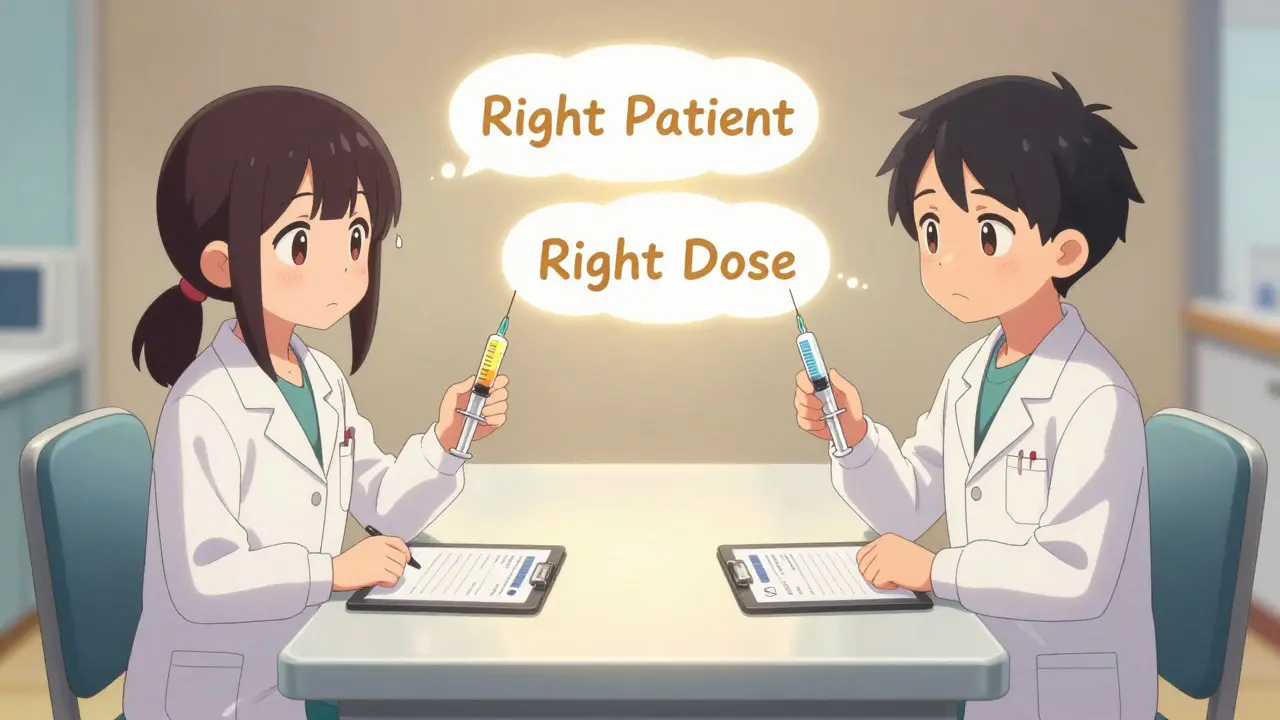
Just having two people look at a medication doesn’t cut it. If they’re standing side by side, talking through it, comparing notes - that’s not a double check. That’s a single check done twice. True independent double checks (IDCs) require two licensed clinicians to verify everything alone and apart from each other.
The Veterans Health Administration (VHA) defines it clearly in Directive 1195 (October 2024): each clinician must independently review the patient, the drug, the dose, the route, and the time. They don’t talk. They don’t show each other their notes. They don’t say, “I think it’s 10 units.” They just check - then compare results after both are done.
Why? Because if one person expects to see 10 units and the other says 100, the first person might unconsciously ignore the red flag. But if they check separately, the error jumps out. ECRI Institute found that properly done IDCs stop 95% of errors. Poorly done? That number drops to 40%. The difference isn’t effort - it’s method.
What Exactly Do You Check?
There’s no guessing. Every double check must verify five critical elements - the “Five Rights” - and more:
- Right patient: Two forms of ID - name and date of birth, scanned or spoken aloud.
- Right medication: Match the drug name on the label to the eMAR. No abbreviations. No “the insulin.”
- Right dose: Calculate the dose yourself. Don’t trust the prescriber’s math. Check the concentration. Is that 10 mL of 100 units/mL insulin? Or 1 mL of 1,000 units/mL? Big difference.
- Right route: IV? Subcutaneous? Oral? If it’s supposed to go into a vein and you’re holding a syringe for a shot in the belly - stop.
- Right time: Is this dose due now? Or is it scheduled for 2 hours from now? Administering it early can be just as dangerous as giving it late.
For infusions, you also check the pump settings - rate, volume, duration. For PCA pumps, you verify the lockout interval, bolus dose, and basal rate. For chemotherapy, you check the protocol number, weight-based calculation, and allergy history. Every step matters.
Who Should Do the Check?
It’s not about titles. It’s about training and accountability. Both people must be licensed clinicians - nurses, pharmacists, or in some cases, physicians. A nursing assistant or tech can’t be the second checker. They don’t have the legal or clinical authority to verify dosing or recognize a dangerous interaction.
At many hospitals, the first person is the nurse preparing the med. The second is another nurse - ideally from the same unit. In some ICUs, pharmacists do the second check for high-risk infusions. At VHA facilities, it’s mandatory for both to sign off electronically on the eMAR. No signature? The med doesn’t go.
Why Some Hospitals Skip the Double Check - and Why That’s Dangerous
Not every facility does this the same way. Some use technology instead. Smart pumps with dose error reduction systems (DERS) can block dangerous doses before they’re infused. Others rely on barcode scanning, automated alerts, or AI-assisted verification tools.
But here’s the problem: technology fails. A barcode scanner can miss a label. A pump can glitch. A software update can wipe out a safety alert. Human verification is the backup that catches what machines miss.
A 2023 study from Johns Hopkins showed that after implementing strict IDCs for IV heparin, dosing errors dropped from 12.7% to 2.3% in just 18 months. Nurses were resistant at first - each check added 2-3 minutes. But once they saw how many errors they’d caught - including one where a patient was supposed to get 5 units/hour but the pump was set to 50 - resistance turned into pride.
Meanwhile, emergency departments struggle. In a trauma bay, there’s no time. A 2021 survey of 850 ER nurses found 68% said they bypassed double checks during resuscitations because no second nurse was available. That’s not negligence - it’s system failure. When staffing is thin, safety protocols break.
How to Make Double Checks Work - Not Just Check the Box
Most double check failures aren’t because people are lazy. They’re because the system is broken.
- Training is mandatory: Cleveland Clinic requires a 2-hour competency module with a 95% pass rate. Nurses don’t just learn the steps - they practice catching errors in simulated scenarios.
- Time is built in: Mayo Clinic includes double-check time in staffing calculations. No more “just do it fast.”
- Documentation is locked: eMAR systems must require two electronic signatures. No signature, no med.
- Leadership enforces it: If managers don’t audit and reinforce the process, staff will cut corners. A 2022 survey found 38% of errors came from unclear instructions - “What exactly do we check?”
And here’s the hardest truth: you don’t need to double-check every high-alert med. ISMP says so. Overuse weakens the system. If you’re doing it for everything, people start rushing. Focus on the top 5-7 highest-risk items - insulin, heparin, potassium, neuromuscular blockers, chemotherapy, PCA, and TPN. Let technology handle the rest.
What’s Changing in 2026?
Regulations are tightening. The Joint Commission’s National Patient Safety Goal (NPSG.01.01.01), effective January 2024, requires every accredited hospital to have a formal list of high-alert meds and safeguards in place. Medicare and Medicaid now tie reimbursement to safety metrics. If you have a preventable error with a high-alert med, you could lose funding.
Technology is catching up. 65% of large hospitals now have smart pumps synced with eMAR systems. AI tools are being piloted at 12% of academic centers - they can flag mismatched doses before the nurse even picks up the syringe. But none of this replaces the human eye.
The future isn’t about doing more double checks. It’s about doing the right ones, the right way.
What medications absolutely require an independent double check?
The highest-risk medications include IV insulin, heparin infusions (especially above 100 units/mL), potassium chloride concentrate (1 mEq/mL or higher), neuromuscular blocking agents, chemotherapy agents, total parenteral nutrition (TPN), and injectable narcotic PCA pumps. These are the top 7 identified by ISMP and VHA as needing mandatory independent double checks due to their narrow therapeutic window and potential for rapid, fatal harm if dosed incorrectly.
Can a nurse and a pharmacist do the double check together?
No. A true independent double check requires the two clinicians to verify the medication separately and without communication. If they’re discussing it, comparing notes, or looking at the same screen, it’s not independent. The goal is to catch errors one person might miss - including cognitive bias. The second person must verify without knowing what the first person concluded.
Why don’t all hospitals require double checks for every high-alert medication?
Because overuse reduces effectiveness. If every single high-alert med requires a double check, staff get fatigued, rushed, and start doing “simultaneous checks” instead of true independent ones. The Institute for Safe Medication Practices recommends focusing on the highest-risk 5-7 medications and using technology (like smart pumps and barcode scanning) for others. This creates a more reliable safety culture.
What happens if there’s no second nurse available during an emergency?
In true emergencies like cardiac arrest, safety protocols are temporarily adjusted. However, the goal is to have backup systems in place - like pre-filled syringes, smart pumps with dose limits, and rapid pharmacist response. Many hospitals now have dedicated safety pharmacists on call for ICU and ER resuscitations. If a second clinician isn’t available, the med should be held until one is - unless the patient’s life depends on immediate administration. In those cases, documentation must clearly state why the double check was skipped.
Is an electronic signature enough for a double check?
Yes - but only if the system requires two separate logins and the two clinicians verified the medication independently before signing. If one person signs for both, or if the system allows one person to enter both signatures, it’s not a valid double check. The electronic record must reflect true independent verification, not just two clicks.





Tommy Chapman
February 21, 2026Let me get this straight - we’re still talking about DOUBLE CHECKS like they’re some revolutionary idea? In 2024? We’ve had barcode scanners, smart pumps, and AI alerts for a decade. The only reason people still die from insulin errors is because nurses are too lazy to use the tech we already paid for. Stop pretending human eyes are magic. If you’re not using DERS, you’re not just negligent - you’re a liability.
And don’t even get me started on pharmacists doing ‘checks.’ Half of them can’t tell the difference between a vial and a syringe. This isn’t safety culture - it’s theater.
USA leads the world in healthcare innovation. Stop clinging to 1980s protocols. Automate. Or get out.
PS: If your hospital still uses handwritten eMARs, please send me your address. I’ll send a box of fire extinguishers.