
By 2025, nearly 92% of all prescriptions filled under Medicare Part D are generics. That’s not just a statistic-it’s the backbone of how millions of seniors and people with disabilities manage their monthly drug costs. If you’re on Medicare and take any kind of medication, understanding how generic coverage works isn’t just helpful-it’s essential to avoid surprise bills and maximize your benefits.
What Is a Medicare Part D Formulary?
A formulary is simply a list of drugs your Medicare drug plan covers. Every Part D plan-whether it’s through a standalone prescription drug plan (PDP) or a Medicare Advantage plan with drug coverage-has its own formulary. But they don’t just pick drugs randomly. The Centers for Medicare & Medicaid Services (CMS) sets strict rules: each plan must cover at least two different generic drugs in every major therapeutic class, like blood pressure meds, diabetes drugs, or antidepressants. And for six protected classes-immunosuppressants, antidepressants, antipsychotics, anticonvulsants, antiretrovirals, and antineoplastics-plans must cover every single FDA-approved generic version.How Generics Are Organized in Tiers
Part D plans use a tier system to guide you toward the most affordable options. Generics almost always land in the lowest tiers:- Tier 1: Preferred Generics - These are the cheapest. Most plans charge $0 to $15 for a 30-day supply. Examples include metformin for diabetes or lisinopril for high blood pressure.
- Tier 2: Non-Preferred Generics - These are still generics, but they cost more-usually $15 to $40 per month. Your plan may cover one generic blood pressure drug in Tier 1 but require you to pay more for another generic in the same class.
How Much You Pay for Generics in 2025
Your out-of-pocket cost depends on what phase of coverage you’re in. Here’s how it breaks down for generics in 2025:- Deductible Phase: You pay 100% until you hit the $615 deductible. Not all plans have one-52% of stand-alone Part D plans in 2025 have a $0 deductible for generics.
- Initial Coverage Phase: After you meet the deductible, you pay 25% coinsurance. The plan pays 75%. This applies whether you’re on Tier 1 or Tier 2 generics.
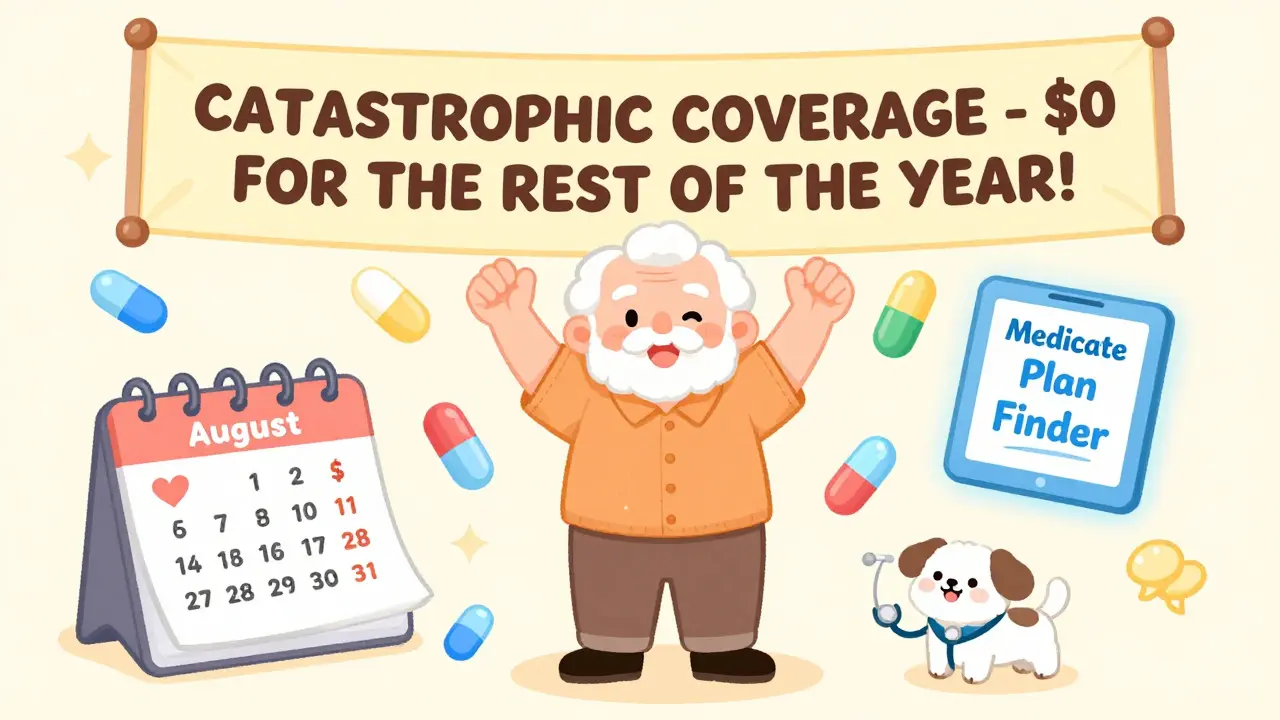
- Catastrophic Coverage Phase: Once your out-of-pocket spending hits $2,000 (up from $1,900 in 2024), you pay $0 for the rest of the year. That includes all generics, no matter the tier.
Why Generics Cost So Much Less Than Brands
Generics work the same way as brand-name drugs-they have the same active ingredients, dosage, and effectiveness. But they cost less because they don’t need to recoup billions in research and marketing. In 2023, generics made up 92% of prescriptions but only 18% of total drug spending under Part D. Here’s the kicker: when you pay for a brand-name drug, 70% of the drug’s total cost (including manufacturer discounts) counts toward your $2,000 out-of-pocket cap. But for generics, only what you actually pay counts. That means if you take mostly generics, you reach the cap faster-and get $0 costs sooner.What to Watch Out For
Even with all the benefits, there are traps:- Therapeutic substitution: Your pharmacist might swap your generic for another one in the same class. If your plan doesn’t cover that specific generic, you could get stuck paying full price. One Reddit user reported being charged $120 for a generic blood pressure pill because his plan only covered a different version-even though both worked the same.
- Formulary changes: Every fall, plans send an Annual Notice of Change. About 37% of plans adjust which generics are covered or move them to a higher tier. Don’t assume your $0 generic will stay $0.
- Authorized generics: These are brand-name drugs sold as generics by the same company. They’re not always listed clearly on formularies, and some plans treat them like brands. Check the details.
How to Save Money on Generics
You don’t have to guess your way through this. Here’s what works:- Use the Medicare Plan Finder: Enter your exact medications, including generic names. Compare plans side by side. People who use this tool save an average of $427 a year.
- Check the Formulary Finder: CMS’s tool lets you search for specific generics and see which plans cover them. 28% of people end up with coverage gaps because they picked a plan without checking.
- Ask for a coverage determination: If your generic isn’t on the formulary, you can request an exception. In 2023, 83% of these requests were approved.
- Choose a $0 deductible plan: If you take multiple generics, skipping the deductible can save you hundreds.
- Look for $0 copays: By 2027, 95% of beneficiaries will have access to $0 copays for at least half of commonly used generics. Start looking for those plans now.
What’s Changing in 2026 and Beyond
The rules keep evolving:- In 2026, the out-of-pocket cap rises to $2,100.
- Starting in 2026, every Part D plan must include a generic price comparison tool in their member portal. You’ll be able to see which generic version of your drug costs the least.
- In 2029, the Medicare Drug Price Negotiation Program will kick in. Insulin glargine (generic Lantus) is already on the list. More generics will follow.
- Some lawmakers are pushing to require plans to cover all generics in a class if they cover any one. That could end the “therapeutic substitution” problem for good.
Real Stories, Real Savings
One beneficiary in Ohio switched plans in 2025 after her $5 generic heart medication moved to Tier 2 and cost $35. She found a new plan that covered the same drug in Tier 1 for $0. She saved $420 a year. Another in Florida takes three generics for heart disease and diabetes. With the $2,000 cap, she hit it by August. Since then, her monthly drug costs are $0. “I used to stress every month,” she said. “Now I don’t even think about it.”Final Thoughts
Medicare Part D’s generic coverage system works-because it’s designed to. Generics are cheaper, safer, and just as effective. The tiers, caps, and rules exist to steer you toward the best value. But you have to be active. Don’t wait for a bill to come in. Review your plan every fall. Use the tools CMS gives you. Ask questions. The difference between $0 and $100 a month isn’t luck-it’s knowledge.Are all generic drugs covered under Medicare Part D?
Almost all FDA-approved generic drugs are covered, but not every plan covers every version. Plans must cover at least two generics per drug class, and 100% of generics in six protected classes. But if your plan only covers one generic for high blood pressure, and your doctor prescribes another, you may need to request an exception or switch plans.
Why is my generic drug not on my plan’s formulary?
Plans choose which generics to include based on cost, effectiveness, and agreements with manufacturers. Sometimes, a plan will cover a cheaper version of the same drug and leave others off. This doesn’t mean the drug is unsafe-it just means your plan didn’t include it. You can request a coverage determination to ask for an exception, or switch to a plan that covers your preferred generic.
Does the $2,000 out-of-pocket cap include what I pay for brand-name drugs?
Yes. The $2,000 cap includes everything you pay for both brand-name and generic drugs during the year. But here’s the catch: for brand-name drugs, 70% of the total drug cost (including manufacturer discounts) counts toward the cap. For generics, only your actual out-of-pocket payment counts. So if you take mostly generics, you reach the cap faster.
Can I switch plans if my generic drug gets moved to a higher tier?
Yes. Every fall, during the Annual Enrollment Period (October 15 to December 7), you can switch to a different Part D plan. If your generic drug is moved to a higher tier or removed from your plan’s formulary, use the Medicare Plan Finder to compare plans that still cover your medication at a lower cost. You can also request a Special Enrollment Period if your drug is removed mid-year.
What if my pharmacist gives me a different generic than what’s on my formulary?
Pharmacists can substitute one generic for another if they’re therapeutically equivalent-but only if your plan covers that specific version. If your plan doesn’t cover the substitute, you’ll pay full price. Always ask your pharmacist: “Is this the exact generic my plan covers?” If not, you can ask them to contact your doctor or request a coverage determination from your plan.
Do Medicare Part D plans cover authorized generics?
Some do, some don’t. Authorized generics are brand-name drugs sold under a generic name by the same manufacturer. They’re chemically identical to the brand but often cost less. However, some plans treat them like brand-name drugs for cost-sharing purposes. Always check your plan’s formulary to see how it classifies them. If you’re unsure, call your plan’s customer service.
How often do Part D plans change their generic coverage?
Every year. About 37% of Part D plans change the tier placement, copay, or coverage status of at least one generic drug each fall. That’s why reviewing your Annual Notice of Change is critical. Don’t wait until you get a bill-check your plan’s updates before the enrollment period ends.



Ayodeji Williams
January 6, 2026bro i got hit with a $120 generic copay last month and my plan said "it's not the one we cover" like wtf am i supposed to be a pharmacist now? 🤡