

When your hip hurts every time you stand up, walk, or even roll over in bed, it’s not just about aging. It’s often osteoarthritis - and if you’re carrying extra weight, it’s making things worse. Unlike knee osteoarthritis, where weight loss is widely accepted as a game-changer, the story for the hip is messier. But new research is changing the game. Losing weight isn’t just about fitting into jeans anymore. For many people with hip osteoarthritis, shedding pounds can mean the difference between living with constant pain and moving freely again.
What Exactly Is Hip Osteoarthritis?
Hip osteoarthritis happens when the smooth cartilage that cushions the ball-and-socket joint of your hip wears down. Bone starts to rub on bone. Inflammation kicks in. Bone spurs form. The joint swells. You feel stiffness in the morning, sharp pain when you climb stairs, or a dull ache that lingers after walking. It’s not just a "wear and tear" issue - it’s a whole-body problem. And weight is a huge part of it.
The hip joint is designed to bear your full body weight. Every step you take puts three to six times your body weight through that joint. If you weigh 200 pounds, that’s 600 to 1,200 pounds of pressure with each stride. Over time, that load breaks down the joint faster. And if you have obesity - defined as a BMI over 30 - you’re not just adding weight. You’re also adding inflammation. Fat tissue releases chemicals that irritate joints, even if they’re not directly under pressure.
Why Weight Loss Matters - Even for the Hip
You’ve probably heard that losing weight helps with knee arthritis. That’s true. But the hip? For years, doctors weren’t so sure. Some studies said weight loss didn’t help much. Others said it did. The confusion came from small studies, short timeframes, and not looking at the right outcomes.
A major 2024 study in Nature changed that. Researchers followed 65 people, mostly women over 65, with hip osteoarthritis and obesity. They tracked not just pain, but quality of life, ability to move, and function in daily activities using the Hip disability and Osteoarthritis Outcome Score (HOOS). What they found was clear: the more weight people lost, the better they felt.
- Those who lost 5% of their body weight saw modest improvements.
- Those who lost 7-10% saw major gains - especially in quality of life, which jumped by 31%.
- People who lost more than 10% showed the biggest improvements across all areas: pain, stiffness, walking, sports, and daily function.
This wasn’t just a numbers game. These were real changes. People could get out of bed easier. Walk to the store without stopping. Sleep through the night. One participant, a 68-year-old woman from Bristol, told researchers she hadn’t been able to play with her grandchildren in years - after losing 13% of her weight, she could chase them around the garden again.
What the Numbers Don’t Tell You
Not every study agrees. A 2023 trial compared a very-low-calorie diet plus exercise to exercise alone in 101 people with hip OA. At six months, there was no difference in pain levels. That’s what led NEJM Journal Watch to declare, "Osteoarthritis of the Hips Is Unaffected by Weight Loss."
But here’s the catch: they looked too soon. At 12 months, the group that lost weight showed clear improvements - in pain, function, and overall hip condition. The benefits just took longer to show up. That’s because joint repair doesn’t happen overnight. Cartilage doesn’t regrow, but inflammation drops, muscles strengthen, and movement improves. It’s a slow burn.
Compare that to knee OA. In the knee, weight loss often cuts pain in half within 3-6 months. The hip? It’s deeper, more stable, and less sensitive to mechanical changes. But that doesn’t mean it’s immune. It means you need more time - and more weight loss - to see results.
How Much Weight Should You Lose?
There’s no magic number. But the data points to a clear trend:
- Less than 5%: Minor or no improvement.
- 5-7%: Noticeable, but not life-changing.
- 7-10%: Clinically meaningful improvement in pain, function, and daily life.
- 10% or more: Best outcomes across all measures - including reduced need for pain meds and delayed need for surgery.
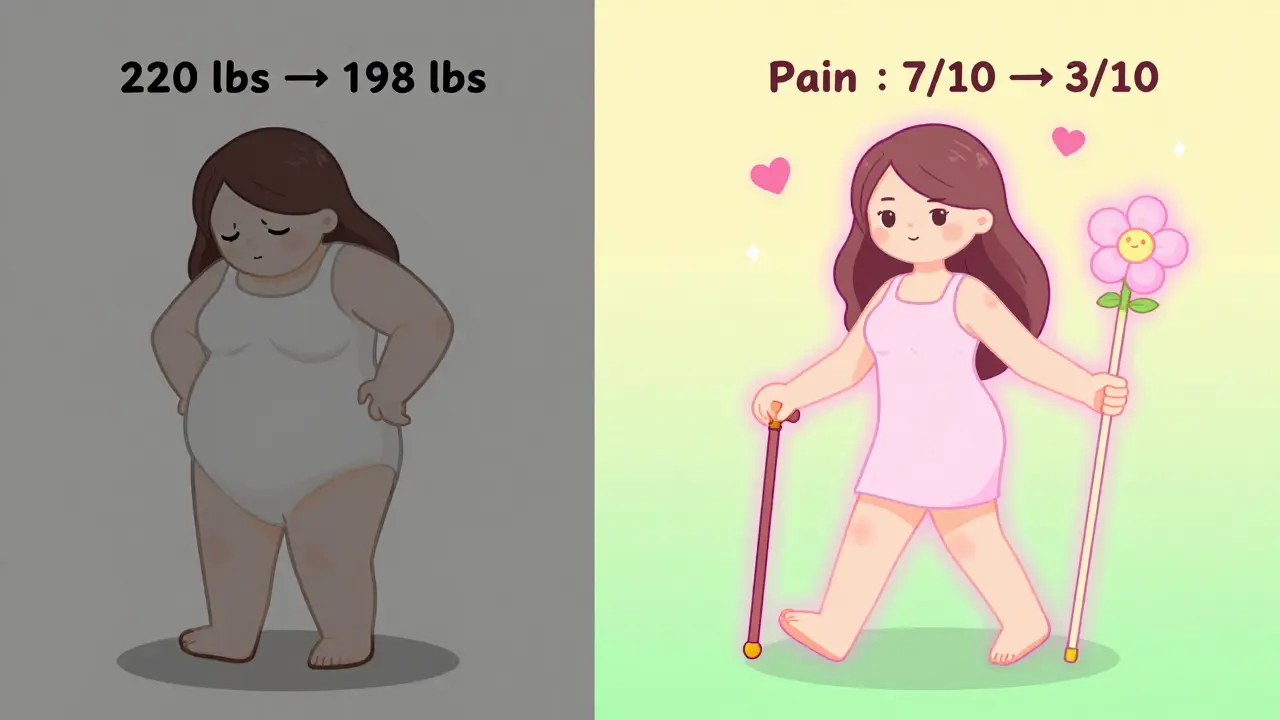
That doesn’t mean you have to become skinny. It means you need to cross a threshold. For someone who weighs 220 pounds, that’s 22 pounds. For someone at 180, it’s 18 pounds. That’s not a huge amount - but it’s enough to change how your hip feels.
And here’s something most people don’t realize: you don’t have to lose all the weight at once. The Osteoarthritis Healthy Weight For Life (OAHWFL) program, originally designed for knee OA, was adapted for hip OA with great results. It’s an 18-week plan that combines diet, movement, and support. People lost an average of 7-10% of their body weight. Many kept it off. The key? Structure. And patience.
It’s Not Just Diet - Exercise Is Non-Negotiable
Weight loss alone isn’t enough. If you drop weight but don’t strengthen the muscles around your hip, you’re still at risk. The gluteus medius, the muscle on the side of your hip, weakens with OA. When it’s weak, your hip wobbles. That increases joint stress. That’s why exercise is part of every successful program.
You don’t need to run marathons. You need:
- Low-impact cardio: Walking, cycling, swimming - 30 minutes, 5 days a week.
- Strength training: Focus on hips, glutes, and core. Squats (supported by a chair), clamshells, leg lifts. Twice a week.
- Mobility work: Gentle stretches for the hip flexors and hamstrings. 10 minutes a day.
A 2012 study of 35 people with hip OA showed that after 8 months of combined diet and exercise, participants improved their physical function by 32.6%. That’s not a fluke. That’s science.
What About Weight Loss Medications?
Drugs like semaglutide (Wegovy) or tirzepatide (Zepbound) are approved for weight loss in people with obesity and certain health conditions. The American College of Rheumatology says these can be considered for people with hip OA who have a BMI over 30 and haven’t responded to lifestyle changes after 6 months.
But here’s the catch: these aren’t magic pills. They work best when paired with diet and movement. And they’re expensive. Most insurance won’t cover them unless you’ve tried everything else first. For most people, food and movement are still the most effective, sustainable, and affordable tools.
Why This Matters More Than You Think
Every pound you lose reduces pressure on your hip. But it also reduces inflammation. That’s huge. Chronic inflammation doesn’t just hurt your joint - it wears down your whole body. It raises your risk of heart disease, diabetes, and even depression.
And if you delay action? You’re not just in pain. You’re accelerating joint damage. Studies show that people with hip OA who are overweight are more likely to need a hip replacement within 5-7 years. But those who lose 10% or more? Their risk drops. Their surgery gets delayed. Some never need it at all.
This isn’t about aesthetics. It’s about preserving your independence. Being able to walk to the bus. Standing to cook dinner. Playing with your grandkids. That’s the real goal.
Where to Start - A Simple Plan
You don’t need a personal trainer. You don’t need a strict keto diet. You need a plan that fits your life.
- Set a goal: Aim for 7-10% of your current weight. Write it down.
- Track food: Use a free app like MyFitnessPal. Don’t count calories obsessively - just notice patterns. Are you eating out too much? Snacking late at night?
- Move daily: Start with 15 minutes of walking. Add 5 minutes each week. When you can walk 30 minutes without stopping, add light resistance bands.
- Get support: Talk to your doctor. Ask about a weight management program. Many clinics now offer free or low-cost options.
- Be patient: It takes 3-6 months to see real changes in your hip. Don’t quit because you don’t feel better in a week.
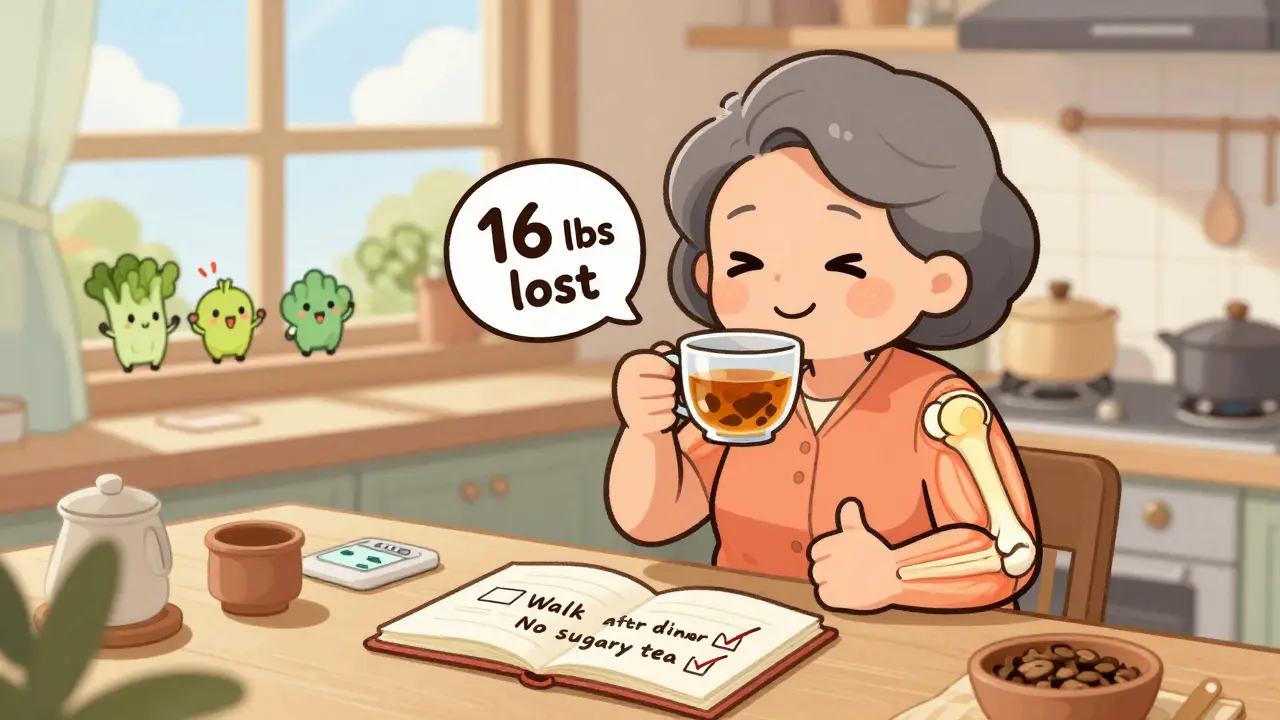
One woman in her 70s from Bristol lost 16 pounds over 6 months. She didn’t change her whole diet. She just stopped drinking sugary tea and started walking after dinner. Her pain score dropped from 7/10 to 3/10. She started gardening again. That’s all it took.
Can losing weight reverse hip osteoarthritis?
No, weight loss won’t reverse cartilage damage. But it can stop it from getting worse. It reduces pain, improves movement, and lowers inflammation. Many people avoid surgery entirely by losing weight and staying active.
Is walking good for hip osteoarthritis?
Yes - if done correctly. Walking is low-impact and helps strengthen the muscles around the hip. Start slow. Use supportive shoes. If it hurts more than a 3/10 during or after, stop and try swimming or cycling instead.
How long does it take to see results from weight loss for hip pain?
Most people notice small changes in 6-8 weeks. But meaningful improvement in function and pain usually takes 3-6 months. The 2023 study showed the real benefits didn’t show up until 12 months. Patience is key.
Do I need to lose a lot of weight to help my hip?
Not as much as you think. Losing 7-10% of your body weight - for example, 15-20 pounds if you weigh 200 - can make a big difference. You don’t need to be at a "normal" weight. Just enough to reduce pressure and inflammation.
What if I can’t lose weight on my own?
You’re not alone. Many clinics offer structured weight management programs for arthritis patients. These include nutrition counseling, exercise coaching, and support groups. Ask your GP or rheumatologist - they often have referrals. Telehealth options are now widely available and just as effective.
Final Thought: Your Hip Can Still Work
Hip osteoarthritis doesn’t have to mean the end of movement. It doesn’t mean you’re stuck with pain forever. The science is clear: weight loss, even moderate, combined with smart movement, gives you back control. It’s not about perfection. It’s about progress. One step. One meal. One day at a time. Your hip will thank you.







Devin Ersoy
March 15, 2026Look, I get the whole 'weight loss fixes everything' narrative, but let's be real - hip OA isn't some cartoon villain you can punch out with a kale smoothie. I've seen patients lose 25 pounds and still be on the couch because their joint architecture is shot. The real magic isn't in the scale, it's in the gait analysis. And nobody talks about the fact that fat tissue inflammation doesn't magically vanish when you drop pounds - it just hides behind a tighter waistband. This isn't a lifestyle hack. It's a biomechanical reality check.