
Every year, sepsis kills more people than breast cancer, prostate cancer, and HIV/AIDS combined. It doesn’t discriminate by age, income, or health status. One moment you might feel like you’ve got the flu; the next, your body is shutting down. The difference between life and death often comes down to one thing: time. Recognizing the early warning signs and getting to a hospital fast can cut your risk of dying by nearly 80%.
What Sepsis Really Is (And Why It’s Not Just a Bad Infection)
Sepsis isn’t the infection itself. It’s your body’s extreme, out-of-control response to an infection. When your immune system goes into overdrive trying to fight off bacteria, viruses, or fungi, it starts attacking your own organs. This can cause tissue damage, organ failure, and death. The medical definition, established in 2016, says sepsis is life-threatening organ dysfunction caused by a dysregulated host response to infection. That means if your kidneys, lungs, heart, or brain aren’t working right because of an infection, you’re in sepsis.
It’s not rare. In the U.S., 1.7 million adults get sepsis each year. Globally, it’s responsible for 11 million deaths - one in five deaths worldwide. Many of these deaths are preventable. The key is catching it early.
The Six Signs You Can’t Ignore
If you or someone you care about has an infection - even something small like a cut, urinary tract infection, or pneumonia - and starts feeling dramatically worse, pay attention. Sepsis doesn’t always start with a high fever. Sometimes, it starts with subtle changes that feel wrong but are easy to brush off.
- Slurred speech or confusion: This is one of the most common but overlooked signs. People often think it’s just tiredness or aging. But sudden confusion, trouble remembering names, or not recognizing family members can mean your brain isn’t getting enough oxygen.
- Extreme pain or discomfort: Patients describe this as the worst pain they’ve ever felt - worse than childbirth, worse than a broken bone. It’s not localized. It’s full-body, crushing, and doesn’t respond to painkillers.
- Pale, blotchy, or blue skin: Especially noticeable on lips, fingertips, or around the mouth. In darker skin tones, look for ashen or greyish tones. This happens because blood flow is being diverted away from the skin to protect vital organs.
- Extreme sleepiness or difficulty waking: You can’t rouse someone. They’re not just drowsy - they’re unresponsive. This is a red flag. In children, it might look like limpness or not crying when they normally would.
- ‘I feel like I might die’: This isn’t dramatic exaggeration. In surveys, 78% of sepsis survivors reported saying or thinking this exact phrase. It’s a gut feeling that something is catastrophically wrong.
- Shortness of breath: Breathing faster than 22 times per minute. Even if you’re not exerting yourself, you can’t catch your breath. This means your lungs are struggling to oxygenate your blood.
For babies under 3 months, watch for: no wet diaper in over 12 hours, extreme lethargy, or a temperature above 38°C or below 36°C. Don’t wait. If your infant looks unwell and has a fever, go to the ER immediately.
What Happens When You Arrive at the Hospital
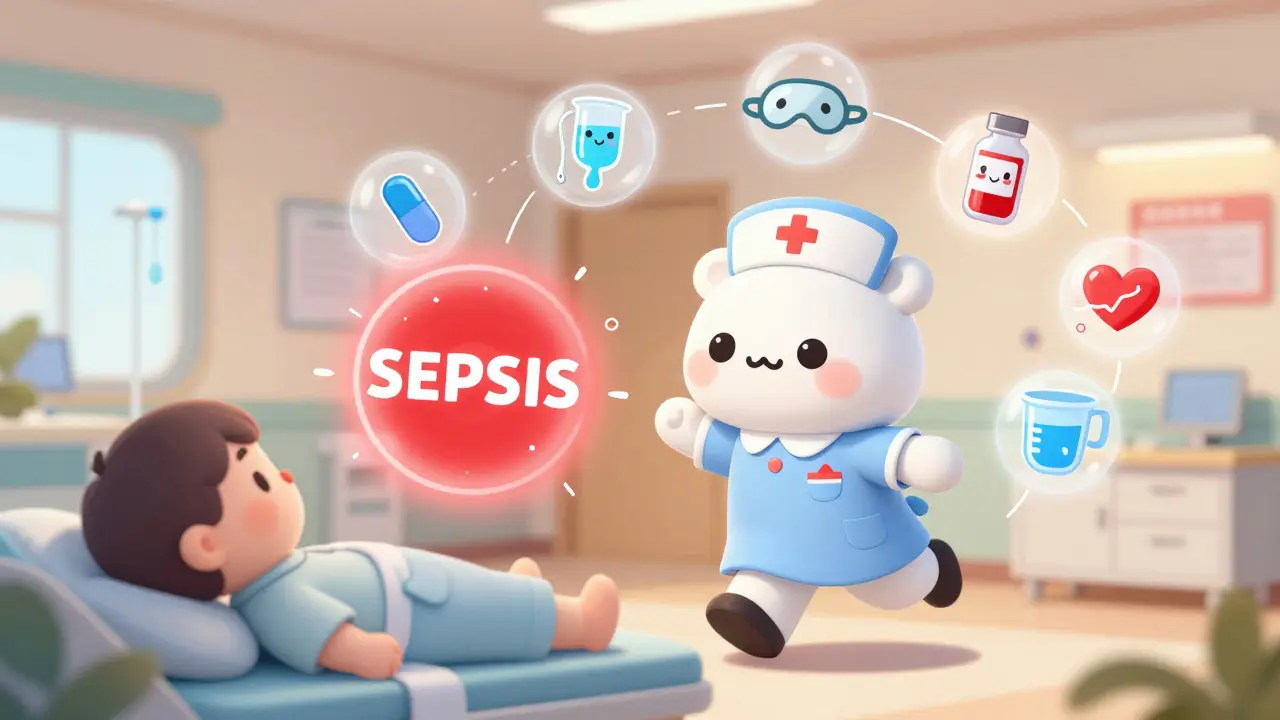
Once you’re in the emergency department, the clock starts ticking. The first hour - called the “golden hour” - is critical. Every minute counts. Hospitals in the UK and many other countries follow a protocol called the “Sepsis Six.” It’s six things that must be done within one hour of suspicion.
- Broad-spectrum antibiotics: You’ll get IV antibiotics immediately - usually piperacillin-tazobactam or meropenem. These attack a wide range of bacteria while doctors figure out exactly what’s causing the infection. Delaying antibiotics by even one hour increases your risk of death by 7.6%.
- Blood cultures: Before the antibiotics, they’ll draw at least two sets of blood cultures. This helps identify the exact bug causing the infection so they can switch to a targeted antibiotic later.
- IV fluids: You’ll get 30 milliliters of fluid per kilogram of body weight - that’s about 2 to 3 liters for most adults. This helps raise your blood pressure and keep your organs working.
- Serum lactate test: Lactate is a waste product that builds up when your cells aren’t getting enough oxygen. A level above 4 mmol/L means you’re in serious trouble and your mortality risk jumps by 40%.
- Oxygen therapy: If your oxygen saturation is below 94%, you’ll get oxygen through a mask or nasal prongs. The goal is to keep it between 94% and 98%.
- Urine output monitoring: A catheter will be placed to measure how much urine you’re producing. The target is at least 0.5 mL per kilogram per hour. Low urine output means your kidneys are failing.
If your blood pressure stays low even after fluids, you’ll be diagnosed with septic shock. That’s when doctors start vasopressors - drugs like norepinephrine - to squeeze your blood vessels and force blood to your vital organs. The goal is to keep your mean arterial pressure above 65 mmHg.
What Happens After the First Hour
The Sepsis Six is just the start. Within the next 6 to 12 hours, doctors will look for the source of the infection and remove it if possible. That might mean draining an abscess, removing a catheter, or taking out an infected gallbladder. You’ll also get glucose control - keeping your blood sugar between 140 and 180 mg/dL - because high sugar worsens inflammation.
If you’re still needing strong vasopressors after 24 hours, you might get hydrocortisone - a steroid - to help your body respond better to stress. Recent studies show it doesn’t lower death rates, but it does shorten how long you’re on machines and how long you stay in the ICU.
And now, there’s new hope. In 2023, the FDA approved the Accelerate PhenoTest BC Kit. This machine can identify bacteria and tell which antibiotics work against them in just 1.5 hours - instead of waiting 2 to 3 days. That means you get the right drug faster, reducing organ damage and improving survival.
What Survivors Face After the Hospital
Getting through sepsis doesn’t mean you’re out of the woods. About 60% of survivors still feel exhausted six months later. Many can’t walk up stairs without getting out of breath. Others have chronic pain, trouble sleeping, or memory problems. This is called post-sepsis syndrome.
One in four survivors is readmitted to the hospital within 30 days - often because of a new infection, breathing issues, or heart problems. The good news? Starting rehab within 72 hours of leaving the ICU cuts long-term disability by 22%. Physical therapy, breathing exercises, and mental health support aren’t luxuries - they’re essential parts of recovery.
And the cost? In the U.S., one sepsis hospital stay averages $18,000. Add on follow-up care, and it’s another $7,200 per year per person. In the UK, the NHS bears a similar burden. That’s why prevention and early action matter so much.
Why Speed Is Everything
Dr. Craig Coopersmith, a leading critical care expert, says sepsis is like a stroke or heart attack - time is tissue. The longer you wait, the more damage is done. A 2020 study showed that hospitals where staff followed the one-hour sepsis bundle 90% of the time cut deaths from 26.9% to 19.4%.
But here’s the hard truth: 56% of survivors waited at least 3 hours before getting antibiotics. And in the U.S., Black patients wait 18% longer than white patients - and are 23% more likely to die. That’s not just a medical issue. It’s a systemic failure.
Public awareness has improved - from 19% in 2010 to 57% in 2019 - but only 39% of people can name three sepsis symptoms. That means many still ignore the warning signs until it’s too late.
If you think you or someone else has sepsis - don’t wait. Don’t call your GP. Don’t wait to see if it gets better. Call 999. Say: “I think this is sepsis.” List the symptoms. Be specific. Your urgency could save a life.
What You Can Do Right Now
- Know the signs. Share them with your family.
- If you have an infection and feel worse, don’t assume it’s normal. Trust your gut.
- Keep a list of recent infections - cuts, UTIs, pneumonia - and tell doctors if you’ve had one in the last 30 days.
- Ask: “Could this be sepsis?” - especially if you’re over 65, pregnant, have diabetes, or have a weakened immune system.
Sepsis doesn’t announce itself with a siren. It whispers - through confusion, fatigue, pain, and breathlessness. But if you listen, and act fast, you can turn a death sentence into a second chance.
Can sepsis happen after a minor infection like a cut or UTI?
Yes. Sepsis can start from any infection - even a small cut, a urinary tract infection, a tooth abscess, or a mild case of pneumonia. It’s not about how big the infection is, but how your body reacts. That’s why it’s so unpredictable.
Is sepsis contagious?
No. Sepsis itself isn’t contagious. But the infection that causes it - like pneumonia or a skin infection - can be. You can’t catch sepsis from someone else, but you can catch the bacteria or virus that might lead to it.
What happens if sepsis isn’t treated?
Without treatment, sepsis progresses to septic shock - where blood pressure drops dangerously low, organs fail, and death becomes likely. Mortality rates jump from 15% in early sepsis to over 40% in septic shock. Every hour without antibiotics increases the risk of death.
Can sepsis come back after recovery?
Yes. About 33% of survivors have another infection within a year. Your immune system is weakened after sepsis, making you more vulnerable. That’s why follow-up care, vaccines (like flu and pneumonia shots), and avoiding exposure to illness are critical after recovery.
Are there any new treatments on the horizon?
Yes. The Accelerate PhenoTest BC Kit now cuts diagnosis time from days to hours. Researchers are testing drugs that calm the immune system’s overreaction - like interferon gamma, which showed a 15% reduction in organ failure in early trials. These could become standard in the next few years.
How can I help someone who might have sepsis?
Don’t wait. If someone has an infection and suddenly feels much worse - confused, pale, breathing fast, or saying they feel like they’re dying - call emergency services immediately. Say the word “sepsis.” Tell them the symptoms. Being loud and urgent saves lives.




Michael Bond
December 27, 2025My grandma had sepsis after a UTI. One day she was fine, the next she couldn't stand. We didn't know what was happening until the ER screamed "SEPSIS" and rushed her. She's alive because we listened.