
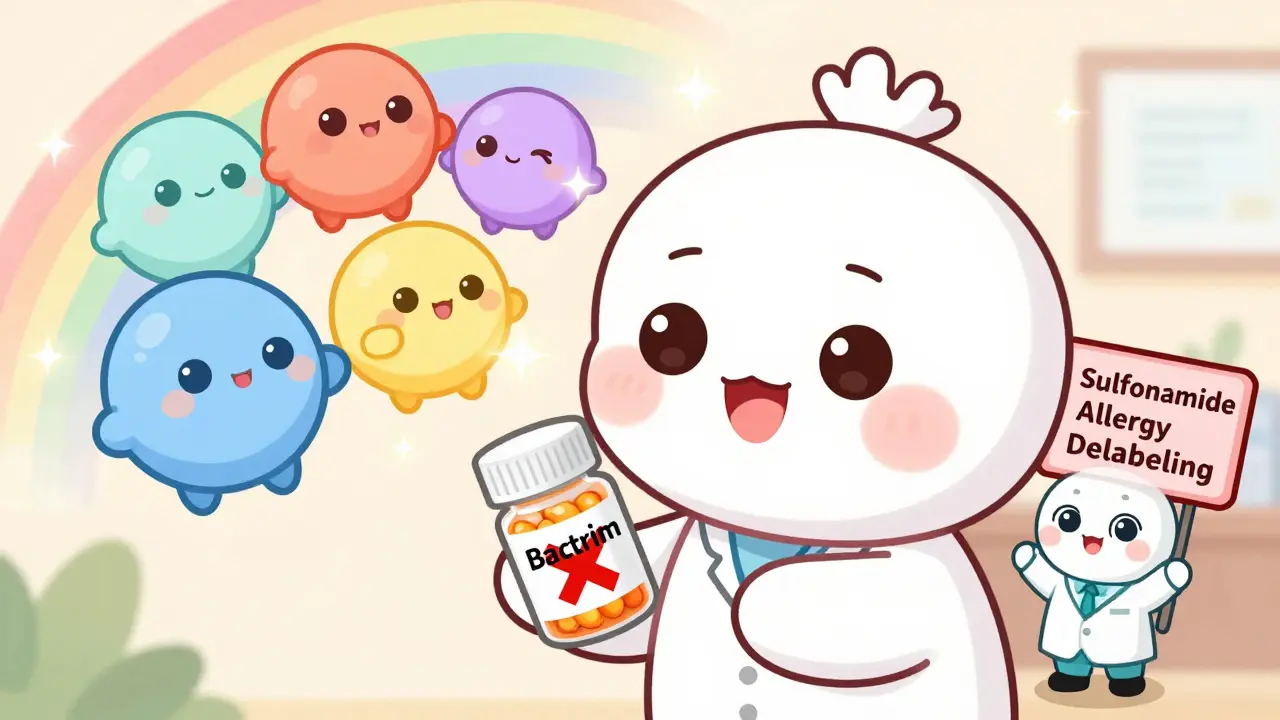
Sulfonamide Allergy Checker
Check Your Medication Safety
This tool helps you determine if your medication contains sulfonamide antibiotics (which should be avoided) or nonantimicrobial sulfonamides (which are generally safe for people with sulfonamide allergies).
People often hear "sulfa allergy" and assume it means they can't take any drug with "sulf" in the name. That’s not true. In fact, most people labeled with a sulfonamide allergy can safely take many common medications - including blood pressure pills, diuretics, and even some pain relievers. The confusion stems from a misleading label, not science. A 2022 study found that 3 to 12% of people report a sulfa allergy, but fewer than 0.5% actually have a true IgE-mediated reaction. The rest are often misdiagnosed, and that mistake has real consequences.
What Is a True Sulfonamide Allergy?
A true sulfonamide allergy is an immune response to specific antibiotics like sulfamethoxazole (in Bactrim), sulfadiazine, or sulfacetamide. These drugs share a key chemical feature: an arylamine group attached at the N4 position of the sulfonamide structure. This part of the molecule breaks down in the body into reactive metabolites that bind to proteins, triggering an immune reaction in susceptible people. Symptoms can include rash, fever, hives, or - in rare cases - life-threatening conditions like Stevens-Johnson syndrome.
But here’s what most people don’t know: not all drugs with "sulf" in the name are the same. The sulfonamide group (SO₂NH₂) is just one part of the molecule. Think of it like a car: two vehicles can both have four wheels, but one is a pickup truck and the other is a sports car. They’re built differently, and they behave differently. The same goes for sulfonamide drugs.
What You Can Actually Take
Nonantimicrobial sulfonamides - drugs used for conditions like high blood pressure, glaucoma, or heart failure - do not contain the arylamine group that causes allergic reactions. That means drugs like:
- Hydrochlorothiazide (a diuretic)
- Furosemide (Lasix)
- Acetazolamide (for glaucoma or altitude sickness)
- Celecoxib (Celebrex, for arthritis)
…are chemically different from sulfonamide antibiotics. Multiple large studies confirm this. A 2021 JAMA Internal Medicine study of over 10,000 patients found that those labeled with a sulfa allergy had a 1.3% chance of reacting to nonantimicrobial sulfonamides - the same rate as people without any allergy label. Another study in the Annals of Allergy, Asthma & Immunology showed a 96-98% negative predictive value: if you have a sulfonamide antibiotic allergy, you’re extremely unlikely to react to these other drugs.
Despite this, many patients are still denied these medications. One patient, a 68-year-old man with hypertension, was kept off hydrochlorothiazide for 15 years because of a childhood rash from sulfamethoxazole. He finally got tested by an allergist - and passed the challenge without a single symptom. He switched from a less effective, more expensive blood pressure pill and felt better within weeks.
What You Should Avoid
There are exceptions. The biggest one is dapsone. Used to prevent Pneumocystis pneumonia (especially in people with HIV), dapsone shares the same N4-arylamine structure as antibiotic sulfonamides. Studies show about 13% of people with a documented sulfonamide antibiotic allergy react to dapsone. If you’ve had a serious reaction like blistering skin or fever after taking sulfamethoxazole, you should not take dapsone without an allergist’s evaluation.
Also avoid other antimicrobial sulfonamides:
- Sulfamethoxazole-trimethoprim (Bactrim, Septra)
- Sulfadiazine
- Sulfacetamide (eye drops)
- Sulfasalazine (used for ulcerative colitis)
These are the only drugs you need to truly avoid if you have a confirmed IgE-mediated reaction. Even then, many people who think they’re allergic can be safely re-challenged under medical supervision.

Why the Confusion Exists
For decades, doctors wrote "sulfa allergy" on charts without details. A mild rash on day 5? That’s not an allergy - that’s a common, non-immune side effect. But the label stuck. Patients heard "don’t take sulfa drugs" and assumed it meant all drugs with sulfur. That’s wrong. Sulfur, sulfates, and sulfites are completely different chemicals. You can safely eat eggs (which contain sulfur), take magnesium sulfate for preeclampsia, or use sulfite-preserved wine - none of these have anything to do with sulfonamide allergies.
A 2020 survey found that 43% of primary care doctors mistakenly believed sulfites were dangerous for sulfa-allergic patients. That’s dangerous misinformation. It leads to unnecessary restrictions and worse outcomes. Patients end up on broader-spectrum antibiotics like fluoroquinolones - drugs with black box warnings for tendon rupture and aortic aneurysm - just because a doctor didn’t know the difference.
What You Should Do If You Have a Sulfa Allergy Label
Don’t assume you know what you’re allergic to. Ask yourself: What happened? When? How bad?
- If you had a mild rash days after taking Bactrim - you likely don’t have a true allergy.
- If you had swelling, trouble breathing, or blistering skin within hours - you may need evaluation.
For low-risk reactions, your doctor can do a simple oral challenge with a nonantimicrobial sulfonamide like hydrochlorothiazide. Studies show a 99.2% safety rate for this procedure in outpatient settings. For high-risk reactions, see an allergist. They can perform skin tests or graded challenges - and 95% of patients labeled with sulfa allergy pass them.
Also, update your medical records. Don’t write "allergic to sulfa." Write: "Maculopapular rash on day 6 of sulfamethoxazole-trimethoprim. No anaphylaxis. No severe reaction." This helps future doctors make better decisions.

The Bigger Picture
This isn’t just about avoiding a rash. Mislabeling sulfonamide allergies drives up healthcare costs by over $1.2 billion a year in the U.S. alone. It increases antibiotic resistance - because doctors give broader, less targeted drugs. The CDC reports that this mislabeling raises resistance rates in common bacteria like E. coli and Staphylococcus aureus by up to 13%.
Health systems are starting to fix this. Epic and other EHR platforms now include alerts that say: "Nonantimicrobial sulfonamides do not contain the structural elements associated with antibiotic sulfonamide allergies." The AAAAI and IDSA launched the Sulfonamide Allergy De-labeling Initiative in 2023 to standardize testing and remove false labels.
By 2025, most major hospitals will use automated tools to flag patients who can safely be re-challenged. You don’t need to live with an outdated label. You just need to ask the right questions.
What About Celecoxib and Other NSAIDs?
Some people with sulfonamide allergies worry about celecoxib (Celebrex). But celecoxib doesn’t have the arylamine group. A 2021 study in JAMA Internal Medicine showed no increased risk of reaction. There was one case report of a rash after taking celecoxib - but the patient was also taking ibuprofen, which can cause similar rashes. The real culprit? Likely the NSAID, not the sulfonamide structure.
Bottom line: If you’re allergic to sulfamethoxazole, you can still take celecoxib. Just make sure you’re not reacting to another drug you’re taking at the same time.
Final Takeaway
Having a "sulfa allergy" doesn’t mean you can’t take any drug with sulfur in the name. It means you might need to avoid a small group of antibiotics - and even then, many people can be safely retested. Nonantimicrobial sulfonamides are safe for almost everyone with a history of sulfonamide antibiotic allergy. The fear is outdated. The science is clear.
Don’t let a vague label keep you from the right treatment. Talk to your doctor. Ask if you’ve been mislabeled. Get tested if needed. Your health - and your wallet - will thank you.






Sumit Sharma
January 12, 2026Let me be crystal clear: the term 'sulfa allergy' is a medical myth perpetuated by lazy documentation. The arylamine group is the culprit-not sulfur, not sulfonamide as a functional group, not even the SO₂NH₂ moiety in isolation. If your chart says 'allergic to sulfa' without specifying the drug or reaction type, you’re not allergic-you’re mislabeled. This isn’t semantics; it’s clinical negligence that leads to inappropriate antibiotic use, higher costs, and increased resistance. Stop letting pharmacists deny you hydrochlorothiazide because of a childhood rash. Get tested. Demand specificity.