
Danshen & Heart Medication Interaction Checker
Check Your Medication Safety
This tool helps you understand if Danshen could interact dangerously with your heart medication.
Many people turn to herbal supplements like Danshen because they believe natural equals safe. But when you’re taking heart medications - especially blood thinners - Danshen can turn from a helpful herb into a silent danger. This isn’t theoretical. Real patients have ended up in emergency rooms with dangerously high INR levels, internal bleeding, and life-threatening complications after combining Danshen with their prescribed heart drugs.
What Is Danshen, Really?
Its active ingredients - tanshinones and salvianolic acids - work in multiple ways: they thin the blood, widen coronary arteries, and lower blood pressure. Sounds beneficial, right? But here’s the catch: these effects aren’t controlled, predictable, or measured. Unlike pharmaceutical drugs, Danshen supplements vary wildly in potency. One bottle might have 0.05% tanshinone; another might have 5.2%. That’s a 100-fold difference. You have no idea what you’re actually taking.
Why Danshen Is Dangerous With Blood Thinners
The biggest danger comes from mixing Danshen with anticoagulants. The most common and dangerous combination is with warfarin. Warfarin works by slowing down blood clotting. Doctors carefully adjust the dose based on regular blood tests (INR levels). A target INR of 2.0-3.0 is typical for most patients. Too high, and you risk bleeding. Too low, and you risk clots.
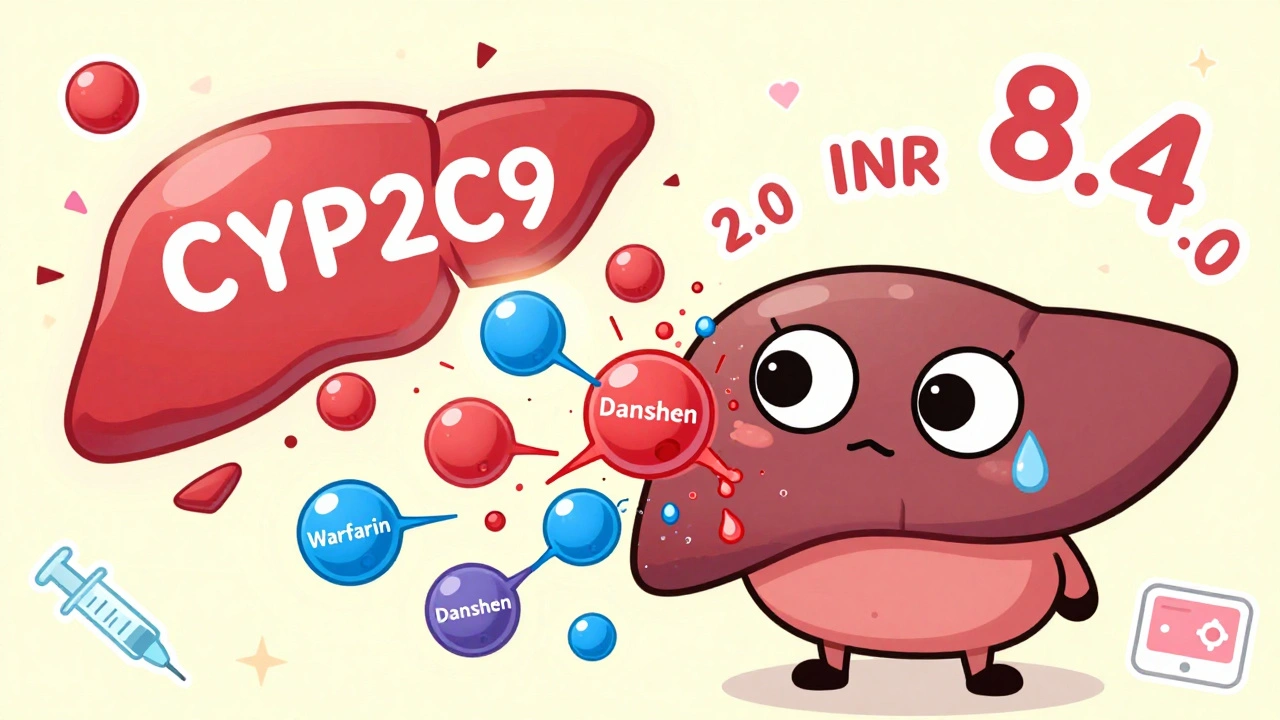
Danshen doesn’t just add to warfarin’s effect - it changes how your body processes it. Studies show Danshen inhibits the liver enzyme CYP2C9, which breaks down warfarin. When this enzyme is blocked, warfarin builds up in your system. One study found Danshen reduced CYP2C9 activity by 73%. That means your warfarin dose could become toxic without you changing anything.
Real cases prove this isn’t theoretical:
- A 62-year-old man on warfarin for a mechanical heart valve had an INR of 8.4 - more than double the safe upper limit - after taking Danshen for two weeks. His hemoglobin dropped to 7.6 g/dL, signaling severe internal bleeding.
- A 48-year-old woman’s INR jumped from 2.0 to 5.6 after taking Danshen every other day for a month. She needed to stop the supplement entirely to get back to safety.
- A 66-year-old man with a stomach bleed had an INR of 5.5 after taking Danshen for just three days - despite being stable on warfarin for a year.
These aren’t rare outliers. Between 2015 and 2019, 17 confirmed cases of Danshen-warfarin interactions were documented in Taiwan alone. INR levels rose from an average of 2.3 to 5.8 - a 150% increase. All patients required hospitalization.
It’s Not Just Warfarin - Newer Blood Thinners Are Also at Risk
Many people assume newer blood thinners like rivaroxaban (Xarelto), apixaban (Eliquis), or dabigatran (Pradaxa) are safer with herbs. They’re wrong.
Danshen doesn’t just affect warfarin. Research shows it also interferes with the metabolism of rivaroxaban. A 2022 NIH study found Danshen tablets strongly inhibited the liver enzymes that clear rivaroxaban from the body. That means the drug stays in your system longer, increasing bleeding risk.
Here’s the scary part: unlike warfarin, there’s no routine blood test to monitor rivaroxaban levels. You won’t know you’re at risk until you start bleeding internally - which can be silent until it’s life-threatening.
And there’s no antidote for Danshen. If you overdose on warfarin, you can take vitamin K. If you bleed on rivaroxaban, you can use andexanet alfa. But if Danshen causes a bleed? There’s no reversal agent. You’re stuck waiting for your body to clear it - which could take days.
Why People Don’t Realize They’re in Danger
Most patients don’t tell their doctors they’re taking herbal supplements. A 2019 JAMA study found only 28% of people who used herbs like Danshen mentioned it to their physician. Why? They think it’s harmless. They’re told it’s "natural." Or they don’t think their doctor needs to know.
This is especially common among older adults and immigrants from cultures where herbal medicine is routine. One 2021 survey found 41.7% of Chinese immigrants in the U.S. took Danshen regularly - but only 32.4% told their cardiologist.
Even worse, some TCM practitioners recommend Danshen alongside heart meds without understanding the risks. Patients assume their herbalist and doctor are on the same page. They’re not.
What the Experts Say
The warnings are loud and clear:
- WebMD: "Major interaction - Do not take this combination."
- Cleveland Clinic: "It is contraindicated to use warfarin and Danshen concurrently."
- Natural Medicines Comprehensive Database: "Major - Do not take this combination."
- Dr. Edward Phillips, Mayo Clinic: "Danshen can interact strongly with some heart medicines, such as blood thinners, and may raise your risk of bleeding."
- Dr. Jun Xu, Shanghai Institute: "The complexity of Danshen’s multi-component system creates unpredictable pharmacokinetic interactions that cannot be reliably anticipated."
The American College of Cardiology now recommends that all patients on anticoagulants be screened for Danshen use - especially those of Asian descent.
What You Should Do
If you’re taking any heart medication - especially a blood thinner - here’s what to do:
- Stop taking Danshen immediately. Even if you feel fine, the damage may already be happening.
- Tell your doctor. Don’t wait. Even if you think it’s harmless, your doctor needs to know. Bring the bottle with you.
- Get tested. If you’ve been taking Danshen with warfarin, ask for an INR test right away. If you’re on rivaroxaban or another newer anticoagulant, ask your doctor about bleeding risk and whether monitoring is needed.
- Don’t replace it with another herb. Many other supplements - like ginkgo, garlic, ginger, or fish oil - also thin the blood. Just because it’s "natural" doesn’t mean it’s safe.
There is no safe dose of Danshen when you’re on anticoagulants. Not 1 capsule. Not 1 tea bag. Not "just once a week." The variability in the product, the unpredictability of the interaction, and the lack of monitoring make any combination too risky.
What About the Benefits?
Danshen has real biological effects. It improves circulation. It reduces inflammation. It’s been used successfully in China for decades - but under strict medical supervision, with standardized injections, and in controlled settings.
What you’re buying in a health food store is not the same thing. It’s not regulated. It’s not tested. It’s not monitored. The risks far outweigh any unproven benefits, especially when you’re already on heart medication.
The American Heart Association says it plainly: "Natural does not mean safe." Danshen is a perfect example.
Final Word: Don’t Guess. Ask.
Heart medications are precise. They’re dosed based on science, not guesswork. Herbal supplements like Danshen are the opposite. They’re a black box with no labels, no warnings, and no safety net.
If you’re taking a blood thinner, your priority isn’t finding the next "miracle herb." It’s staying alive. That means avoiding anything that could interfere with your medication - no exceptions.
There’s no shame in asking your doctor: "Is this supplement safe with my heart pills?" The real shame is waiting until you’re bleeding inside and wondering why no one warned you.
Can I take Danshen if I’m not on blood thinners?
Even if you’re not on blood thinners, Danshen can still lower your blood pressure and affect heart rhythm. If you have heart disease, liver problems, or are preparing for surgery, it could still be risky. Always talk to your doctor before starting any new supplement - even if you think it’s "just for heart health."
Is there a safe herbal alternative to Danshen for heart health?
There’s no herbal substitute that’s proven safer or more effective than prescribed heart medications. Lifestyle changes - like a low-sodium diet, regular exercise, quitting smoking, and managing stress - are the most proven ways to support heart health. If you want supplements, stick to ones your doctor has reviewed, like omega-3s (in specific doses) or CoQ10 - and only if they don’t interfere with your meds.
How long does Danshen stay in my system?
There’s no clear answer. Because Danshen isn’t standardized, its components are metabolized differently in each person. Some compounds may clear in a few days; others could linger for weeks. If you’ve been taking it and are about to have surgery or start a new heart medication, stop it at least two weeks beforehand - and tell your doctor you did.
Can I take Danshen with aspirin or ibuprofen?
Aspirin and ibuprofen also thin the blood and increase bleeding risk. Combining them with Danshen multiplies that risk. Even over-the-counter painkillers can be dangerous with Danshen. Don’t assume they’re safe just because they’re not prescription drugs.
Why isn’t Danshen banned in the U.S. if it’s so dangerous?
The FDA can’t ban supplements unless they prove they’re unsafe after they’re already on the market. Danshen is classified as a dietary supplement, not a drug, so it doesn’t need FDA approval before sale. The FDA has issued warnings about unapproved Danshen products, but enforcement is slow. The burden is on you to know the risks.
If you’re on heart medication, your health is too important to gamble with unregulated herbs. Danshen isn’t a harmless addition to your routine - it’s a potential trigger for disaster. Don’t wait for a warning sign. Be proactive. Talk to your doctor. And choose safety over tradition when your life is on the line.






Mark Curry
December 5, 2025Wow. I had no idea this was such a big deal. I’ve been taking Danshen for my ‘heart health’ for months now. 😳 I’m gonna stop today and call my doc. Thanks for laying it out like this.