

Hypoglycemia Risk Assessment Tool
Assess Your Hypoglycemia Risk
This tool estimates hypoglycemia risk based on key factors from the article. Results show risk level and practical steps to reduce danger.
Your Risk Assessment
When blood sugar drops below 70 mg/dL, it’s called hypoglycemia. For most people, that means sweating, shakiness, or a racing heart-clear signals to grab a snack. But for older adults with diabetes, those warning signs often disappear. Instead, they might feel confused, dizzy, or just ‘off.’ By the time a family member notices something’s wrong, their blood sugar could already be below 40 mg/dL. This isn’t just inconvenient-it’s dangerous. In fact, older adults experience hypoglycemia more than twice as often as younger people with diabetes, and each episode raises their risk of falls, heart problems, and even death.
Why Older Adults Are at Higher Risk
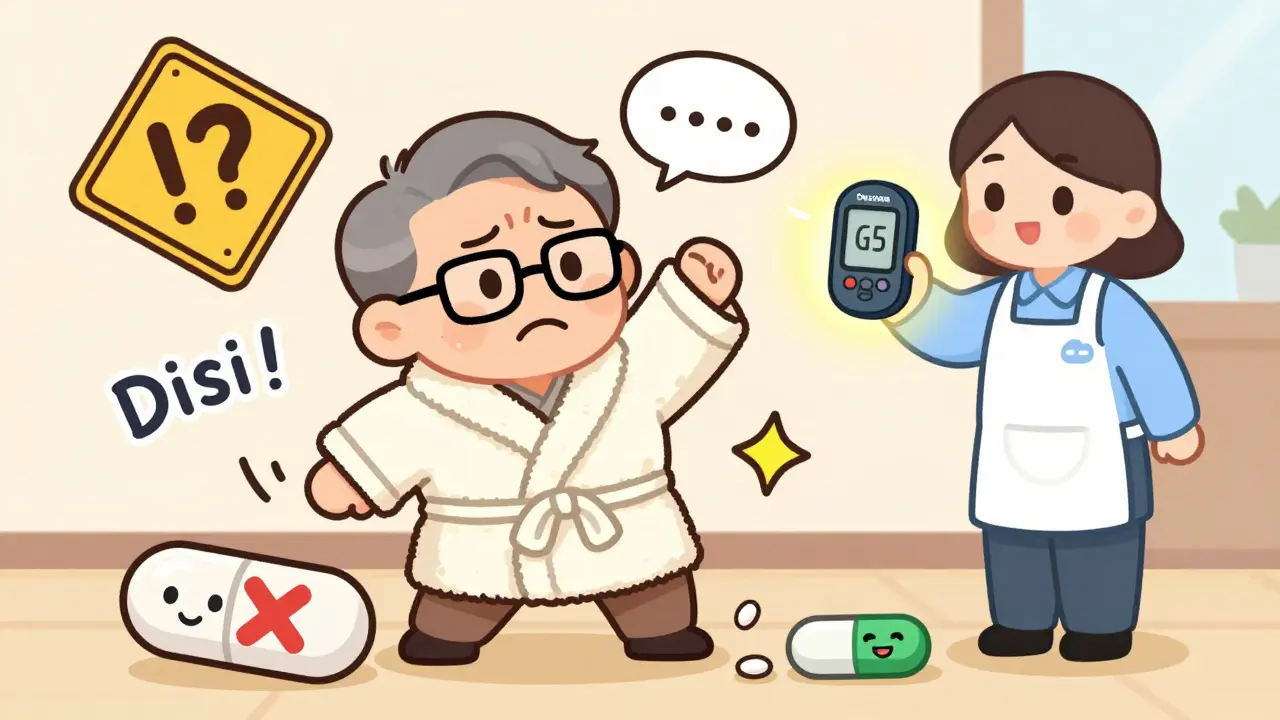
The body’s ability to fight low blood sugar weakens with age. When glucose drops, healthy adults release epinephrine and glucagon to raise it back up. In older adults, this response is blunted by 30-50%. That means their bodies don’t react fast enough-or sometimes not at all. Add to that the fact that 15-25% of older adults with diabetes lose the ability to feel low blood sugar altogether, and you’ve got a silent threat. Many older adults are also taking multiple medications. A 78-year-old with diabetes might also be on pills for high blood pressure, arthritis, heart failure, and depression. Some of those drugs, especially long-acting sulfonylureas like glyburide, can push blood sugar too low. Studies show glyburide increases severe hypoglycemia risk by 50% compared to safer alternatives like glipizide. The American Geriatrics Society lists glyburide as a potentially inappropriate medication for older adults-yet it’s still prescribed often. Kidney and liver function also decline with age. Since many diabetes drugs are cleared by the kidneys, reduced function means those drugs stay in the body longer, increasing the chance of a low. People with an estimated glomerular filtration rate (eGFR) below 60 mL/min have a 2.7 times higher risk of severe hypoglycemia than those with normal kidney function.What Hypoglycemia Looks Like in Older Adults
Forget the textbook symptoms. Older adults rarely sweat or shake when their blood sugar drops. Instead, hypoglycemia often shows up as:- Sudden confusion or disorientation
- Slurred speech or difficulty finding words
- Unusual irritability or aggression
- Weakness, dizziness, or stumbling
- Loss of consciousness or seizures
The Real Costs: Falls, Fractures, and Death
A single hypoglycemic episode in an older adult isn’t just a scare-it’s a medical event with lasting consequences. Each episode increases the risk of:- 40% higher chance of falling
- 25% higher chance of breaking a hip
- 30% higher chance of having a heart attack or stroke
Medication Risks: What to Watch For
Not all diabetes drugs are equal when it comes to hypoglycemia risk. Here’s what you need to know:- Sulfonylureas (glyburide, glimepiride): These force the pancreas to release more insulin, regardless of blood sugar levels. Glyburide is especially risky because it lasts too long in older bodies. Glipizide is a safer choice.
- Insulin: Long-acting insulins like glargine or detemir are better than older types, but dosing errors still happen. Many older adults take insulin without checking blood sugar regularly, leading to lows.
- GLP-1 agonists and SGLT2 inhibitors: These newer drugs rarely cause low blood sugar on their own and are often safer for older adults. They’re also weight-neutral or help with weight loss.
- Metformin: This is generally safe and doesn’t cause hypoglycemia unless taken with insulin or sulfonylureas.
Prevention Plan: What Actually Works
There’s no single fix, but a structured, personalized plan cuts hypoglycemia risk by nearly half. Here’s what works:- Set realistic blood sugar goals. For healthy older adults, aim for an A1c under 7%. For those with dementia, heart disease, or limited life expectancy, aim for 7.5-8.5%. Tight control isn’t worth the risk.
- Use continuous glucose monitoring (CGM). CGM devices like Dexcom G7 or FreeStyle Libre 3 alert users when blood sugar is dropping-even before they feel symptoms. But only 15% of older adults use them, mostly because doctors don’t recommend them or Medicare won’t cover them unless the person uses insulin.
- Teach caregivers how to respond. If someone can’t swallow, juice won’t help. Keep glucagon on hand. The new nasal glucagon (Baqsimi) is easy to use-just spray it in the nose. It works in seconds and doesn’t require an injection.
- Check blood sugar before driving, meals, and bedtime. Skipping meals or walking after insulin can cause lows. Always test if you feel off.
- Reduce or eliminate high-risk drugs. Studies show that reducing insulin or switching from glyburide to glipizide cuts severe lows by 46% in just six months-with almost no change in A1c.
What Families Can Do Right Now
You don’t need to be a doctor to help. Here’s what you can do today:- Keep fast-acting sugar (glucose tablets, juice boxes) in every room, the car, and your bag.
- Teach everyone in the house how to use nasal glucagon.
- Write down symptoms your loved one shows during lows-then share that list with their doctor.
- Ask: ‘Has anyone checked if my loved one is on glyburide?’ If yes, ask if it can be changed.
- Use the TRIM-HYPO survey (available online) to show how often lows are happening and how they affect daily life. This helps doctors take it seriously.
What’s Changing in 2026
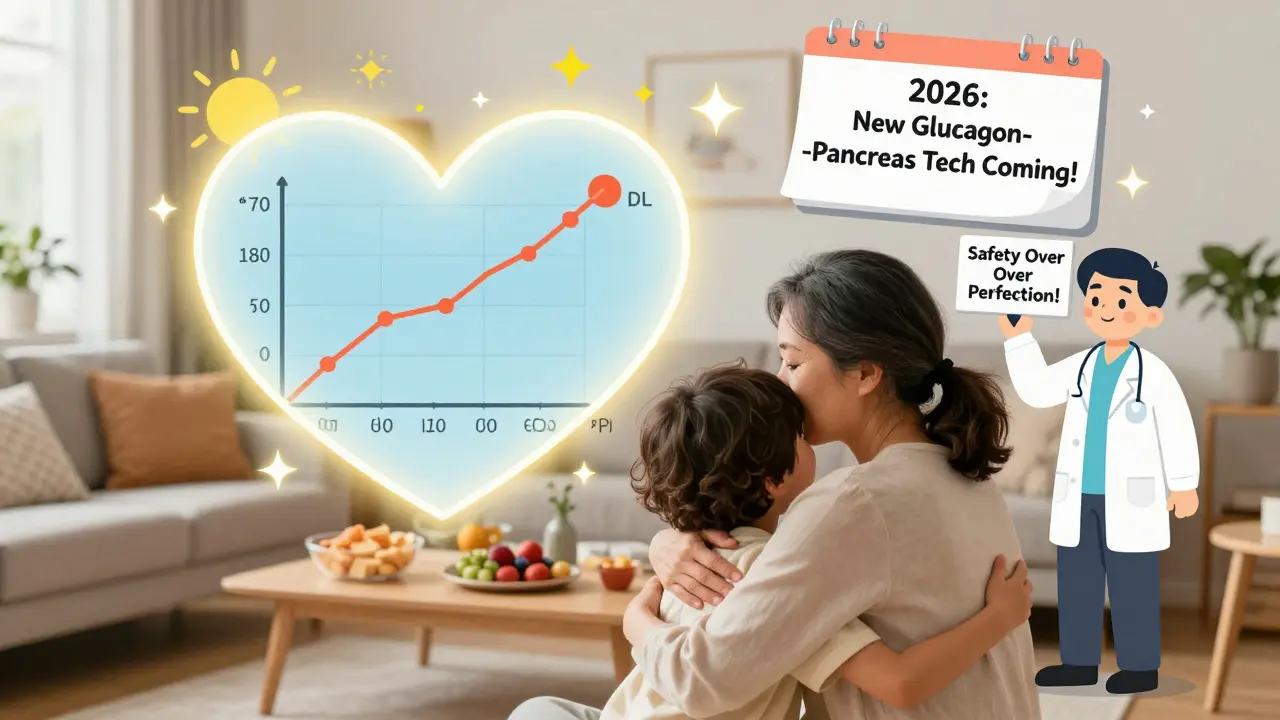
The field is shifting fast. The American Diabetes Association now says ‘time in range’-how long blood sugar stays between 70 and 180 mg/dL-is more important than A1c for older adults. They recommend spending at least half the day (12 hours) in that range, and less than 1% of the time below 54 mg/dL. Medicare is slowly expanding CGM coverage, but many older adults on sulfonylureas still can’t get it. New dual-hormone artificial pancreas systems (insulin + glucagon) are in clinical trials and may be available by 2026. But the biggest change isn’t technology-it’s mindset. Doctors are finally learning that for older adults, avoiding a low is more important than hitting a perfect A1c number.Final Thought: Safety Over Perfection
The goal isn’t to keep blood sugar perfectly normal. It’s to keep the person safe, independent, and out of the hospital. For older adults, that means fewer pills, simpler routines, and more awareness-not tighter control. A blood sugar of 150 mg/dL is far less dangerous than a low of 40 mg/dL. And if you’re caring for someone with diabetes, remember: a low blood sugar episode isn’t just a medical event-it’s a warning sign that the treatment plan needs to change.What are the most dangerous diabetes medications for older adults?
Long-acting sulfonylureas like glyburide are the most dangerous. They stay in the body too long, especially in older adults with reduced kidney function, and force the pancreas to release insulin even when blood sugar is already low. Glipizide and other shorter-acting sulfonylureas are safer. Insulin can also be risky if doses aren’t adjusted properly. Newer drugs like GLP-1 agonists and SGLT2 inhibitors rarely cause low blood sugar and are often better choices.
Can older adults stop taking diabetes meds if they have frequent lows?
Yes, and in many cases, they should. Studies show that reducing or eliminating insulin or sulfonylureas in older adults with frequent hypoglycemia cuts severe lows by nearly half, without significantly raising A1c. The goal isn’t to eliminate all medication-it’s to use the least risky amount needed to avoid dangerous lows. Always work with a doctor to adjust safely.
Why don’t older adults feel low blood sugar coming?
With age, the body’s stress response to low blood sugar weakens. Hormones like epinephrine and glucagon that normally trigger sweating, shaking, and hunger don’t release as strongly. Over time, the brain also stops recognizing these signals, leading to ‘hypoglycemia unawareness.’ This affects 15-25% of older adults with diabetes and is especially dangerous if they also have dementia.
Is continuous glucose monitoring (CGM) worth it for older adults?
Yes-if they can access it. CGM reduces hypoglycemia by 40% by alerting users before symptoms start. But Medicare only covers CGM for people who use insulin, leaving out many older adults on sulfonylureas who are at just as much risk. If you can afford it or get coverage, CGM is one of the most effective tools for prevention.
What should I do if my loved one has a severe low and can’t swallow?
Use nasal glucagon (Baqsimi). It’s a powder you spray into the nose-it works in minutes and doesn’t require an injection or swallowing. Keep it in the fridge or a cool, dark place. Make sure caregivers know where it is and how to use it. If you don’t have glucagon and the person is unconscious, call 911 immediately.
How often should older adults check their blood sugar?
It depends on their risk. Those on insulin or sulfonylureas should check before meals, at bedtime, and before driving or physical activity. If they’ve had a low before, check more often-especially if they’re sick, eating less, or more active than usual. People on safer medications like metformin may only need to check a few times a week. Always follow the doctor’s advice, but err on the side of checking more if in doubt.






Cam Jane
January 6, 2026My grandma was on glyburide for years-no one told us it was a ticking time bomb. She started zoning out at dinner, then fell twice in one month. Switched her to glipizide last year, and boom-no more ER trips. She’s back to gardening and even made her famous apple pie again. 😊