

Decongestant Safety Checker
Decongestant Safety Assessment
This tool calculates your risk of adverse effects when taking decongestants based on your blood pressure and heart condition status. According to medical studies, decongestants like pseudoephedrine can raise blood pressure by 2-5 mmHg, which can be dangerous for those with heart conditions.
If you have heart disease or high blood pressure, a stuffy nose isn’t just annoying-it could be dangerous. Over-the-counter decongestants like pseudoephedrine and phenylephrine might clear your nasal passages in hours, but they can also spike your blood pressure, trigger irregular heartbeats, or even bring on a heart attack. This isn’t speculation. It’s documented in medical journals, hospital case reports, and warnings from the American Heart Association. For people with heart conditions, these common cold meds aren’t harmless-they’re ticking time bombs.
How Decongestants Work (and Why That’s a Problem)
Decongestants work by narrowing blood vessels. That’s how they reduce swelling in your nose-you cut off the flow of blood to the inflamed tissue, and congestion goes down. But your nose isn’t the only place those blood vessels are. When you swallow a pill like Sudafed, the drug doesn’t stay put. It circulates through your whole body. Your nasal passages aren’t the only vessels that tighten. Your arteries do too. And that’s where the trouble starts.
Pseudoephedrine and phenylephrine are alpha-adrenergic agonists. That’s a fancy way of saying they mimic adrenaline. They tell your body to go into fight-or-flight mode. Your heart beats faster. Your blood vessels constrict. Your blood pressure rises. For a healthy person, this might feel like a slight buzz. For someone with heart disease, it’s like revving an engine that’s already struggling.
The Numbers Don’t Lie
A 2005 meta-analysis found that even standard doses of pseudoephedrine cause a small but real increase in systolic blood pressure-typically around 2 to 5 mmHg. That might sound minor. But if your blood pressure is already at 160/95, a 5-point jump could push you into a hypertensive crisis. In one documented case, a 5-year-old girl developed high blood pressure after taking recommended doses of phenylephrine for four days. Her pressure didn’t drop until the drug was stopped. No other cause was found. She wasn’t overweight. She didn’t have kidney problems. The decongestant did it.
Topical sprays like Afrin (oxymetazoline) aren’t much safer. A study of 100 patients showed their heart rates climbed steadily over the week they used the spray. And in a rare but terrifying case, a 40-year-old man developed life-threatening heart failure after overusing a nasal spray containing naphazoline. He didn’t take too much because he was careless-he took what the label said. But even at recommended doses, the drug triggered a cascade of events that led to cardiac arrest. He survived. Others haven’t.
Who’s at Highest Risk?
Not everyone with heart disease needs to avoid decongestants the same way. But if you fall into any of these groups, you should skip them entirely:
- Uncontrolled high blood pressure (140/90 or higher)
- History of heart attack or stroke
- Heart failure
- Arrhythmias (like atrial fibrillation or ventricular tachycardia)
- Prinzmetal’s angina (coronary artery spasms)
Dr. Al-Kindi from Houston Methodist Hospital says these five conditions are the red flags. Even if your blood pressure is “controlled” with medication, a decongestant can undo weeks of careful management. Harvard Health says the risk is minimal in controlled cases-but “minimal” doesn’t mean “safe.” And if your condition isn’t stable? The risk jumps from low to lethal.

Why Your Cold Makes It Worse
It’s not just the decongestant. It’s the cold itself. When you have a respiratory infection, your body is under stress. Your heart rate goes up. Inflammation spreads. Your blood thickens. Your immune system is working overtime. That’s already taxing your heart. Now you add a drug that forces your heart to pump harder against tighter arteries. It’s like revving your car while driving uphill in snow.
A 2017 study of nearly 10,000 heart attack patients found that those who took NSAIDs like ibuprofen while sick were more than three times as likely to have another heart attack within a week. Decongestants aren’t NSAIDs, but they do the same kind of damage: they add stress to an already overloaded system. The American Heart Association says this combo-illness plus medication-is one of the most dangerous situations for cardiac patients.
What’s on the Label? (And Why You Should Read It)
Every decongestant bottle, whether it’s in the pharmacy aisle or behind the counter, has the same warning: “Do not use if you have high blood pressure, heart disease, or thyroid problems.” That’s not fine print. That’s a red alert. And yet, many people ignore it because they think, “I just need to breathe.”
Pseudoephedrine is kept behind the counter in the U.S. and U.K. for a reason. Pharmacists are supposed to ask if you have heart disease, diabetes, or trouble urinating. They’re trained to catch the risks. But if you’re in a hurry, or if you don’t think your condition matters, you might skip that step. Don’t. Your pharmacist isn’t being nosy-they’re saving your life.
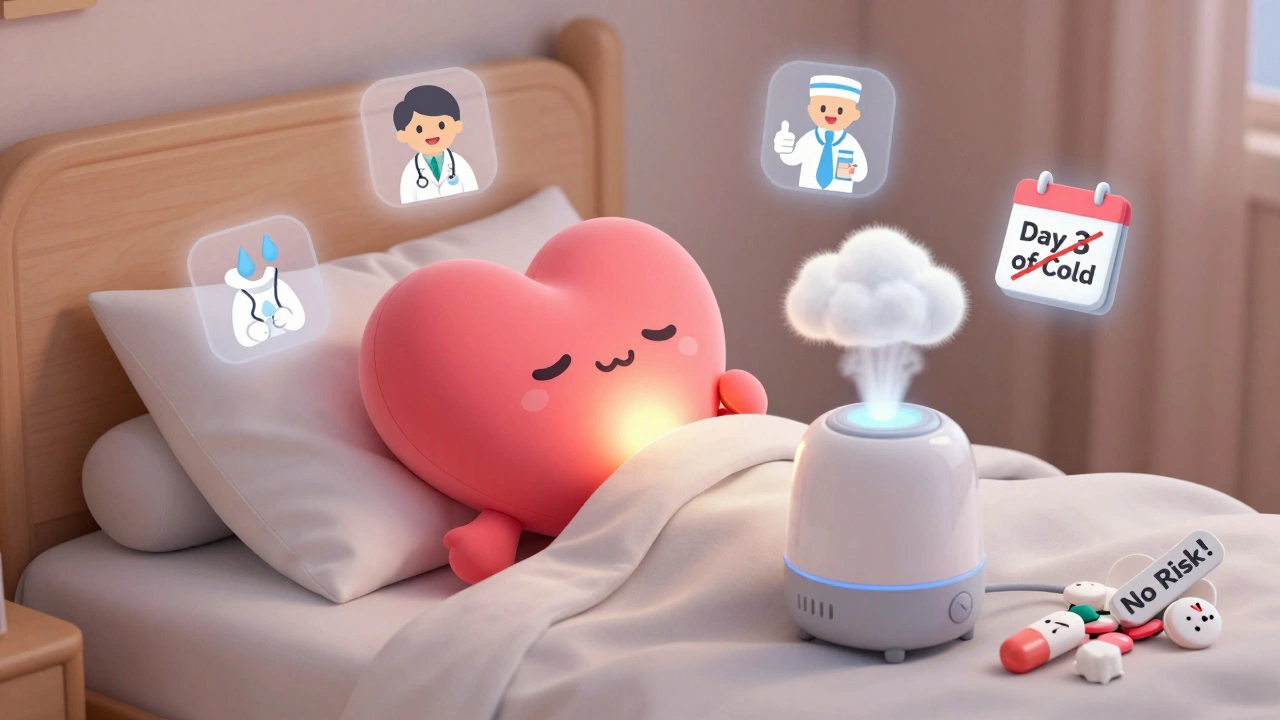
Safe Alternatives That Actually Work
You don’t need a decongestant to breathe better. Here’s what does work-without the risk:
- Saline nasal spray: Flushes mucus and irritants without affecting blood pressure. Safe for daily use.
- Steam inhalation: A bowl of hot water with a towel over your head opens nasal passages naturally.
- Humidifier: Moist air reduces swelling in nasal tissues. Especially helpful at night.
- Guaifenesin (Mucinex): Thins mucus so it drains easier. No vasoconstriction. No heart risk.
- Neti pot: Rinses sinuses with sterile salt water. Proven to reduce congestion for allergy and cold sufferers.
The European Journal of General Medicine says it plainly: “If symptoms are mild or moderate, not using these agents will be more wisely.” You don’t need to clear every bit of congestion. You just need to breathe. And you can do that without risking your heart.
When to Call Your Doctor
If you’ve taken a decongestant and feel any of these, stop immediately and get help:
- Chest pain or pressure
- Heart palpitations (fluttering, pounding, skipping beats)
- Sudden, severe headache
- Shortness of breath at rest
- Blurred vision or confusion
These aren’t side effects. They’re warning signs. A spike in blood pressure from a decongestant can lead to stroke or heart failure in minutes. Don’t wait to see if it passes.
The Bottom Line
Decongestants aren’t evil. They’re just not for people with heart disease. They’re designed for healthy people with a cold. For those with high blood pressure or heart conditions, they’re a gamble with your life. The relief they offer is temporary. The damage they can cause is permanent.
Read the label. Talk to your pharmacist. Ask your doctor. There are safer ways to get through a cold. And your heart will thank you.
Can I take pseudoephedrine if my blood pressure is controlled?
Even if your blood pressure is controlled with medication, pseudoephedrine can still cause dangerous spikes. Studies show it raises systolic pressure by 2-5 mmHg on average. That might seem small, but for someone with heart disease, even a slight increase can trigger arrhythmias or reduce blood flow to the heart. The American Heart Association recommends avoiding it entirely. Safer alternatives like saline spray or humidifiers are just as effective for mild symptoms.
Are nasal sprays safer than pills?
Not necessarily. While nasal sprays like oxymetazoline act more locally, they still get absorbed into your bloodstream. Studies show they can raise heart rate and, in rare cases, trigger severe hypertension or heart failure-even at recommended doses. One case report linked naphazoline spray directly to life-threatening heart decompensation. The risk is lower than with oral decongestants, but it’s not zero. If you have heart disease, avoid all decongestant sprays.
What about phenylephrine? I heard it’s weaker than pseudoephedrine.
Phenylephrine is often marketed as a “safer” alternative, but that’s misleading. While it may cause slightly less blood pressure rise than pseudoephedrine, it still acts as a strong vasoconstrictor. A case study showed a 5-year-old developed hypertension after standard doses. And because phenylephrine is now the main oral decongestant in many OTC products, it’s easier to accidentally overdose-especially if you’re taking multiple cold medicines. It’s not safer. It’s just more common.
Can I take decongestants if I had a heart attack years ago?
If you’ve had a heart attack-even years ago-your heart may still be vulnerable. Scar tissue doesn’t conduct electrical signals the same way. Blood vessels may be narrowed from plaque. Decongestants can trigger abnormal rhythms or reduce oxygen supply to damaged heart muscle. The American Heart Association says people with a history of heart attack should avoid decongestants completely. The risk isn’t worth the temporary relief.
Is it safe to take decongestants with my heart medication?
No. Decongestants can interfere with beta-blockers, ACE inhibitors, and diuretics. They can make your blood pressure meds less effective or cause dangerous spikes. Even if your doctor prescribed your heart meds, they didn’t prescribe decongestants-and they shouldn’t have to guess the interaction. Always check with your pharmacist or doctor before mixing any OTC drug with your heart medications. There’s almost always a safer option.







Doris Lee
December 12, 2025Hey everyone, just wanted to say thank you for this post-it’s a lifesaver. I’ve got hypertension and used to grab Sudafed like it was candy. Now I stick to saline sprays and steam. My BP’s never been better. You don’t need chemicals to breathe. Just patience and a humidifier. ❤️