

Every year, millions of people take blood thinners to prevent strokes, clots, or heart attacks. At the same time, just as many reach for ibuprofen or naproxen for a sore knee, headache, or back pain. It seems harmless-until it isn’t. Combining these two types of drugs doesn’t just raise the risk of bleeding. It can send you to the hospital, or worse.
What Happens When Blood Thinners Meet NSAIDs
Blood thinners, whether they’re warfarin, apixaban, rivaroxaban, or dabigatran, work by slowing down your body’s ability to form clots. That’s good if you have atrial fibrillation or a history of deep vein thrombosis. But when you add an NSAID-like ibuprofen, naproxen, or diclofenac-you’re adding another layer of risk. NSAIDs don’t just reduce pain and swelling. They also interfere with platelets, the tiny blood cells that plug leaks in damaged blood vessels. At the same time, they damage the stomach lining by blocking protective prostaglandins. So you’ve got one drug making it harder for clots to form, and another making it harder for your body to stop bleeding-even from a small cut or ulcer. This isn’t theoretical. A 2024 study of over 51,000 people in Denmark, published in the European Heart Journal, found that taking NSAIDs while on a blood thinner more than doubled the chance of being hospitalized for bleeding. The risk wasn’t just in the stomach. It showed up in the brain, lungs, kidneys, and urinary tract too.The Real Numbers Behind the Danger
Not all NSAIDs are created equal when mixed with blood thinners. The same Danish study broke it down:- Naproxen: 4.1 times higher risk of serious bleeding
- Diclofenac: 3.3 times higher risk
- Ibuprofen: 1.79 times higher risk
- 2.24 times higher risk of gastrointestinal bleeding
- 3.22 times higher risk of brain bleeding
- 1.57 times higher risk of urinary bleeding
- Nearly three times higher chance of developing anemia from hidden blood loss
It Doesn’t Matter What Kind of Blood Thinner You Take
Many people assume that newer blood thinners-called DOACs (direct oral anticoagulants)-are safer than older ones like warfarin. That’s true in some ways. But when it comes to mixing with NSAIDs, the risk is just as high. The Danish study confirmed: whether you’re on apixaban, rivaroxaban, or warfarin, adding an NSAID increases your bleeding risk by the same amount. There’s no "safe" blood thinner when paired with an NSAID. And it’s not just prescription NSAIDs. In Denmark, most ibuprofen is prescribed, so researchers could track it accurately. In the U.S., where ibuprofen is sold over the counter in bottles of 100 pills, the problem is likely much bigger. People don’t think of Tylenol or Advil as "medications"-they think of them as candy. But they’re not.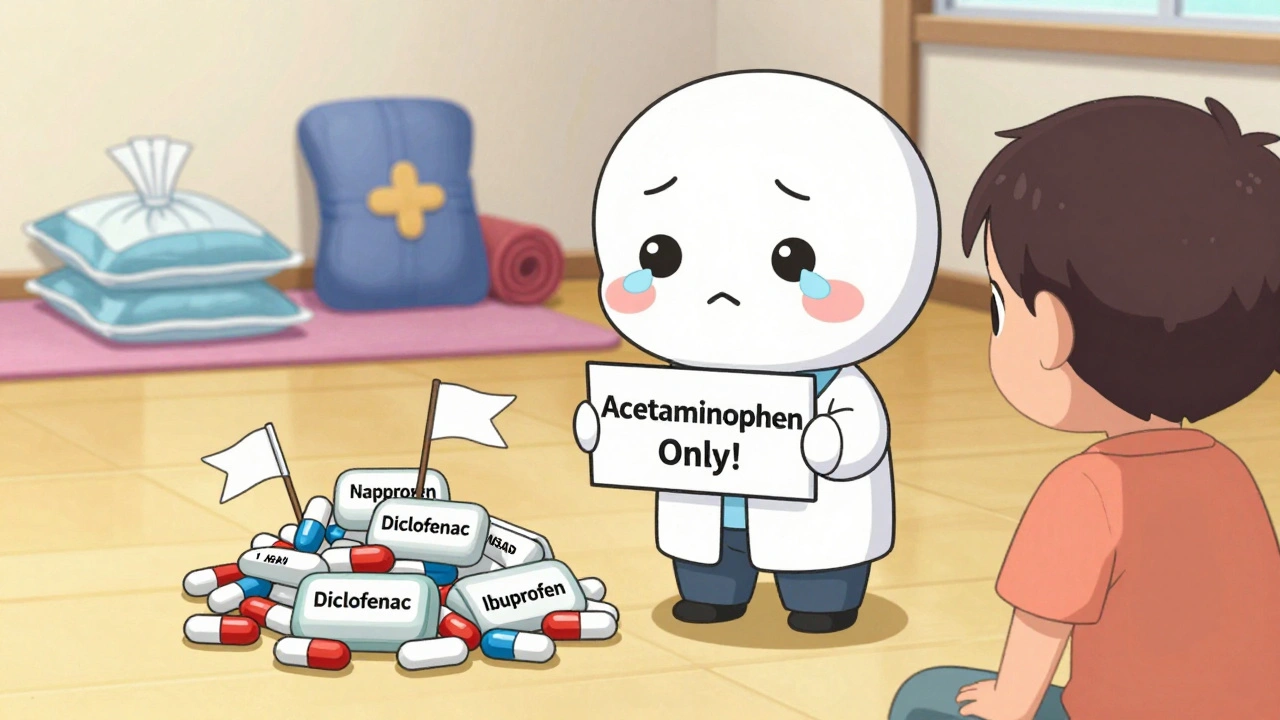
Why Acetaminophen Is the Only Safe Alternative
If you’re on a blood thinner and need pain relief, acetaminophen (Tylenol) is your best-and really, your only-first choice. Unlike NSAIDs, acetaminophen doesn’t affect platelets or stomach lining. It doesn’t increase bleeding risk. It’s not perfect-it can harm the liver if taken in huge doses-but at normal pain-relieving levels (no more than 3,000 mg per day), it’s safe for people on anticoagulants. Other options include:- Heat or ice packs for joint or muscle pain
- Physical therapy for chronic conditions like arthritis
- Topical creams with menthol or capsaicin for localized pain
- Low-impact exercise to reduce inflammation naturally
What You Should Do Right Now
If you’re on a blood thinner:- Check your medicine cabinet. Do you have any NSAIDs? Naproxen? Ibuprofen? Diclofenac gel? Even topical NSAIDs can be absorbed into your bloodstream.
- Look at your daily routine. Do you take an ibuprofen for your back pain every morning? Do you pop an Advil after walking? That’s not harmless-it’s dangerous.
- Ask your pharmacist or doctor: "Is this medication safe with my blood thinner?" Don’t assume they know you’re taking it. Many patients don’t mention OTC drugs unless asked directly.
- Switch to acetaminophen for pain. If it doesn’t work well enough, talk to your doctor about other options-not more NSAIDs.

Doctors Are Starting to Catch On
The American College of Cardiology now recommends that hospitals and clinics actively screen for this dangerous combination. They’re calling it "antithrombotic stewardship"-meaning systems should flag patients on blood thinners who are also prescribed NSAIDs, and help them switch to safer options. Electronic health records are starting to pop up alerts when a doctor tries to prescribe ibuprofen to someone on apixaban. But that only works if the system knows what you’re taking. If you’re buying OTC pills without telling your doctor, the alert won’t trigger. That’s why your role matters. You’re the one who knows what’s in your medicine cabinet. You’re the one who decides whether to take that Advil for your knee. Don’t wait for a warning. Be proactive.Why This Problem Keeps Growing
More people than ever are on blood thinners. Atrial fibrillation, deep vein clots, and mechanical heart valves are all on the rise, especially as the population ages. At the same time, millions of Americans take NSAIDs every day-30 billion OTC ibuprofen tablets sold annually in the U.S. alone. The perfect storm: aging bodies with chronic pain, on medications that stop clots, reaching for painkillers that make bleeding easier. It’s not a rare accident. It’s a predictable, preventable public health crisis. The good news? You can avoid it.Final Reality Check
You might think, "I’ve been taking ibuprofen with my blood thinner for years and I’m fine." But that’s like saying, "I’ve driven without a seatbelt for 10 years and never crashed." Luck isn’t a strategy. This interaction doesn’t always cause immediate harm. Sometimes, the bleeding is slow-hidden in your gut, slowly draining your iron, making you tired and pale. You might not feel anything until you collapse. The science is clear. The data is solid. The risk isn’t small. It’s massive. Stop mixing NSAIDs with blood thinners. Not someday. Not "if I can’t get acetaminophen." Now. Switch to acetaminophen. Talk to your doctor. Find non-drug ways to manage pain. Your life might depend on it.Can I take ibuprofen if I’m on warfarin?
No. Taking ibuprofen while on warfarin increases your risk of serious bleeding by nearly 80%. Even occasional use can be dangerous. Acetaminophen (Tylenol) is the safest pain reliever for people on warfarin. If you need stronger pain control, talk to your doctor about alternatives-not more NSAIDs.
Is naproxen worse than ibuprofen with blood thinners?
Yes. Naproxen increases bleeding risk by over four times when taken with blood thinners, compared to 1.79 times for ibuprofen. That’s because naproxen blocks the COX-1 enzyme more strongly, which plays a key role in protecting your stomach lining and helping platelets stick together. Diclofenac is also high-risk. Avoid both if you’re on anticoagulants.
Do newer blood thinners like Eliquis or Xarelto have less risk with NSAIDs?
No. A major 2024 study found that the bleeding risk from combining NSAIDs with blood thinners is just as high whether you’re on warfarin, apixaban (Eliquis), rivaroxaban (Xarelto), or dabigatran (Pradaxa). The type of anticoagulant doesn’t matter-NSAIDs are the problem. All of them increase bleeding risk.
What if I only take NSAIDs once in a while?
Even short-term use can be dangerous. The Danish study showed that bleeding risk spikes as soon as NSAIDs are taken, even for just a few days. There’s no safe "occasional" window. If you’re on a blood thinner, avoid NSAIDs entirely unless your doctor gives you a very specific, time-limited plan-and even then, it’s risky.
Can I use topical NSAIDs like diclofenac gel?
No. Topical NSAIDs like Voltaren gel are absorbed into your bloodstream, even if they’re applied to the skin. Studies show they can still increase bleeding risk in people on anticoagulants. Don’t assume they’re safer. Stick to acetaminophen or non-drug therapies like heat and physical therapy.
What should I do if I’ve been taking NSAIDs with my blood thinner?
Stop taking the NSAID immediately. Switch to acetaminophen for pain. Then, schedule a visit with your doctor or pharmacist to review all your medications-prescription and over-the-counter. Bring your medicine cabinet with you. Tell them everything you take, even if you think it’s "not a real drug." Your safety depends on full disclosure.
Are there any NSAIDs that are safe with blood thinners?
No. All NSAIDs-whether prescription or over-the-counter, oral or topical-increase bleeding risk when combined with anticoagulants. This includes celecoxib (Celebrex), meloxicam, ketoprofen, and others. There is no safe NSAID for someone on a blood thinner. Acetaminophen is the only recommended alternative.
Can I take aspirin with my blood thinner?
Aspirin is an NSAID and also a blood thinner. Taking it with another anticoagulant doubles the bleeding risk. Even low-dose aspirin (81 mg) should only be used with blood thinners if your doctor specifically prescribes it-for example, after a heart stent. Never take aspirin for pain while on anticoagulants without medical approval.







Lara Tobin
December 15, 2025I had no idea topical NSAIDs could be dangerous too... I’ve been using Voltaren gel for my arthritis and thought I was being smart. 😣 Thanks for the wake-up call. Switching to Tylenol today.