

In the world of medicine, a Drug Safety Signal is information from one or more sources suggesting a new or potentially causal association between a medicine and an event. Essentially, it's a lead that requires further investigation to determine if the drug is actually causing the problem or if it's just a coincidence.
Key Takeaways: Understanding Safety Signals
- Signals aren't conclusions: A signal is a hypothesis, not a proven fact. It triggers an investigation, not an immediate recall.
- Clinical vs. Statistical: Signals can come from a single case report (clinical) or from analyzing massive datasets (statistical).
- The "Rare Event" Gap: Clinical trials often lack the size and diversity to catch side effects that occur in 1 in 10,000 people.
- Triangulation: The gold standard for validation is seeing the same risk appear across three independent data sources.
Where Risks Hide: The Gap Between Trials and Real Life
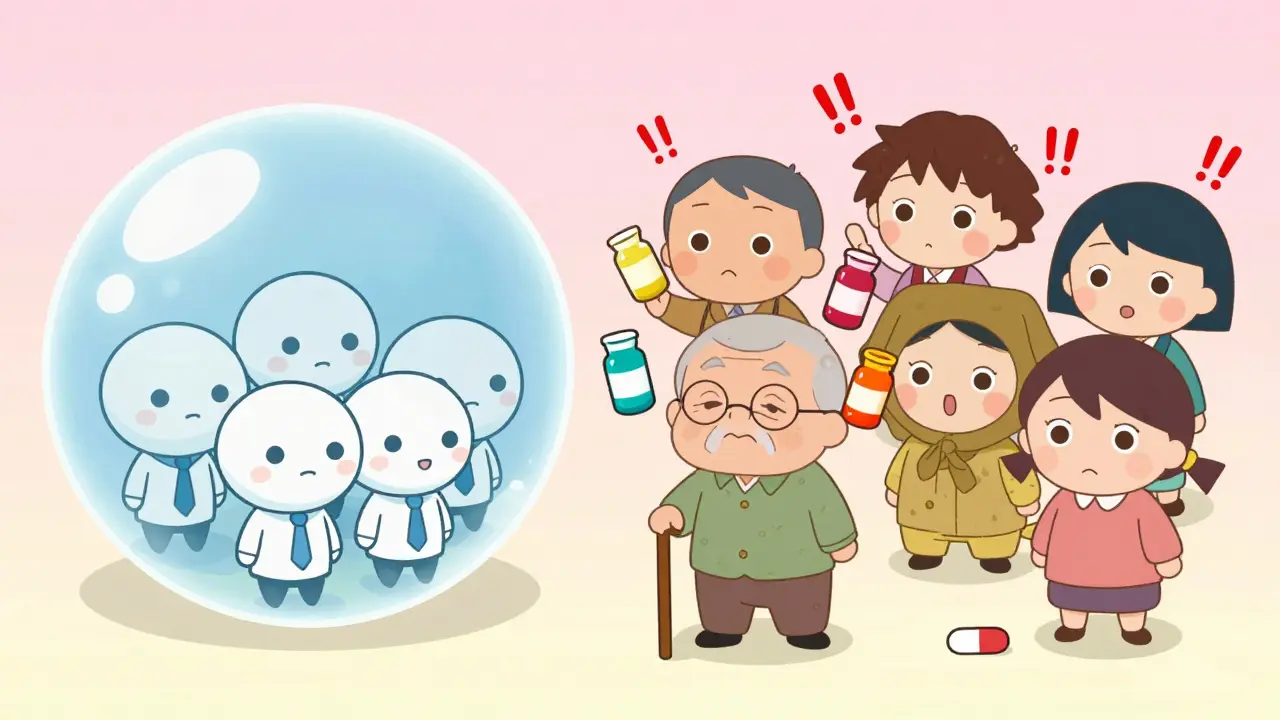
Why do risks emerge after a drug is approved if it was already tested in Clinical Trials? The answer comes down to scale and diversity. Most pre-approval trials enroll between 1,000 and 5,000 patients. While that sounds like a lot, it's a drop in the bucket compared to millions of people taking a drug daily. Moreover, trials often exclude elderly patients, people with multiple comorbidities, or those taking five other medications.
In the real world, patients are messy. They have kidney issues, they forget to take their pills on time, and they take supplements that might interact with the drug. This is why Pharmacovigilance-the science of detecting and preventing adverse effects-doesn't stop at the end of a trial. It actually enters its most critical phase once the drug is on the market.
How Signals Are Actually Detected
Regulators and drug companies don't just wait for a phone call; they use a systematic process to fish for signals. These generally fall into two buckets: clinical and quantitative.
Clinical signals usually start with a Spontaneous Report. This is when a doctor or patient reports a side effect. While these reports are often incomplete, they provide a "story"-the timeline of when the drug was taken and when the symptom started. Quantitative signals, on the other hand, are found using math. By using tools like the Proportional Reporting Ratio (PRR), analysts can see if a specific side effect is appearing more often with Drug A than with all other drugs in the database.
| Method | Primary Source | Main Strength | Major Weakness |
|---|---|---|---|
| Clinical Review | Individual Case Reports | Rich detail on patient history | High subjectivity |
| Quantitative Analysis | Aggregate Databases (FAERS/EudraVigilance) | Can detect very rare patterns | High false-positive rate (60-80%) |
| Epidemiological Studies | Population Health Records | Can establish a control group | Time-consuming and expensive |
The Journey from a "Hunch" to a Warning Label
Not every signal leads to a change in the drug's manual. In fact, most are dead ends. To move from a signal to a verified risk, experts look for specific markers. A 2018 study showed that evidence replication across multiple sources is the strongest predictor of a label update. If a signal appears in a spontaneous report, a scientific paper, and a patient registry, the risk is likely real.
The process usually follows these steps:
- Signal Generation: A statistical spike is noticed in a database like the FDA Adverse Event Reporting System (FAERS).
- Validation: Experts check if the data is high quality and if the event is plausible.
- Prioritization: Is this a mild rash or a heart attack? Serious events get fast-tracked.
- Assessment: The "causality" phase. Does the drug's mechanism explain the side effect?
- Action: The regulator mandates a label change, a "Black Box" warning, or in extreme cases, pulls the drug from the market.
Real-World Successes and Failures
Signal detection isn't perfect. Take the case of canagliflozin. Initially, there was a strong signal in FAERS suggesting the drug was linked to lower-limb amputations. The reporting odds ratio was high, causing alarm. However, a subsequent controlled trial (the CREDENCE trial) showed the risk was much lower than the spontaneous reports suggested, proving that data noise can sometimes create a false alarm.
On the flip side, the system works beautifully when it catches "class effects." For example, when rosiglitazone was linked to myocardial infarction, the signal wasn't just one report; it was a wave of data across multiple sources that forced a reassessment of an entire class of diabetes medications. More recently, the European Medicines Agency (EMA) identified a link between dupilumab and ocular surface disease, which directly improved how ophthalmologists manage their patients.

The Future: AI and Real-Time Monitoring
The old way of waiting for a doctor to mail in a report is dying. We are moving toward "active surveillance." The FDA's Sentinel Initiative now integrates electronic health records from millions of patients, allowing regulators to see side effects as they happen in real-time.
Artificial intelligence is also entering the fray. The EMA has started using AI algorithms to sift through EudraVigilance data, cutting the time to generate a signal from two weeks down to just 48 hours. This means we can catch dangerous risks months or years faster than we could a decade ago.
What is the difference between a side effect and a safety signal?
A side effect is a known reaction to a drug. A safety signal is a *hint* that a new or previously unknown side effect might exist. Every side effect listed on a label started as a signal that was eventually proven to be true.
Why are some signals called "false positives"?
Quantitative tools look for patterns. If many people happen to report the same symptom while taking a drug-even if the drug didn't cause it-the math will flag it as a signal. Because spontaneous reports often lack a control group, it's common for 60-80% of statistical signals to be unrelated to the drug.
Can a drug be recalled based on a single signal?
Rarely. A single report usually triggers an investigation. Recalls generally happen when the signal is validated across multiple patients, shows a clear causal link, and the risk outweighs the benefit of the drug.
How does the FDA and EMA differ in signal detection?
The FDA tends to be more aggressive with quantitative (math-based) screening of its FAERS database. The EMA relies more heavily on systematic case series analysis and a network of national competent authorities to validate signals across Europe.
Who is responsible for monitoring drug safety after approval?
It is a shared responsibility. The company that makes the drug (the marketing authorization holder) is legally required to monitor signals. Government agencies like the FDA, EMA, and the UK's MHRA provide the oversight and final regulatory decisions.
Next Steps for Patients and Providers
If you are a healthcare provider, the best way to help this system is through detailed reporting. A report that says "patient felt dizzy" is far less useful than one that describes the exact timing, the patient's other medications, and what happened when the drug was stopped. For patients, always keep a log of new symptoms when starting a new medication; your observation might be the clinical signal that protects thousands of other people.






Sam Hayes
April 4, 2026Actually worked in a clinic for years and the reporting process is still way too clunky for most docs to handle during a busy shift. It would be great if the EHRs could just auto-flag these things and send them to the FDA without us having to fill out a mountain of paperwork every single time