
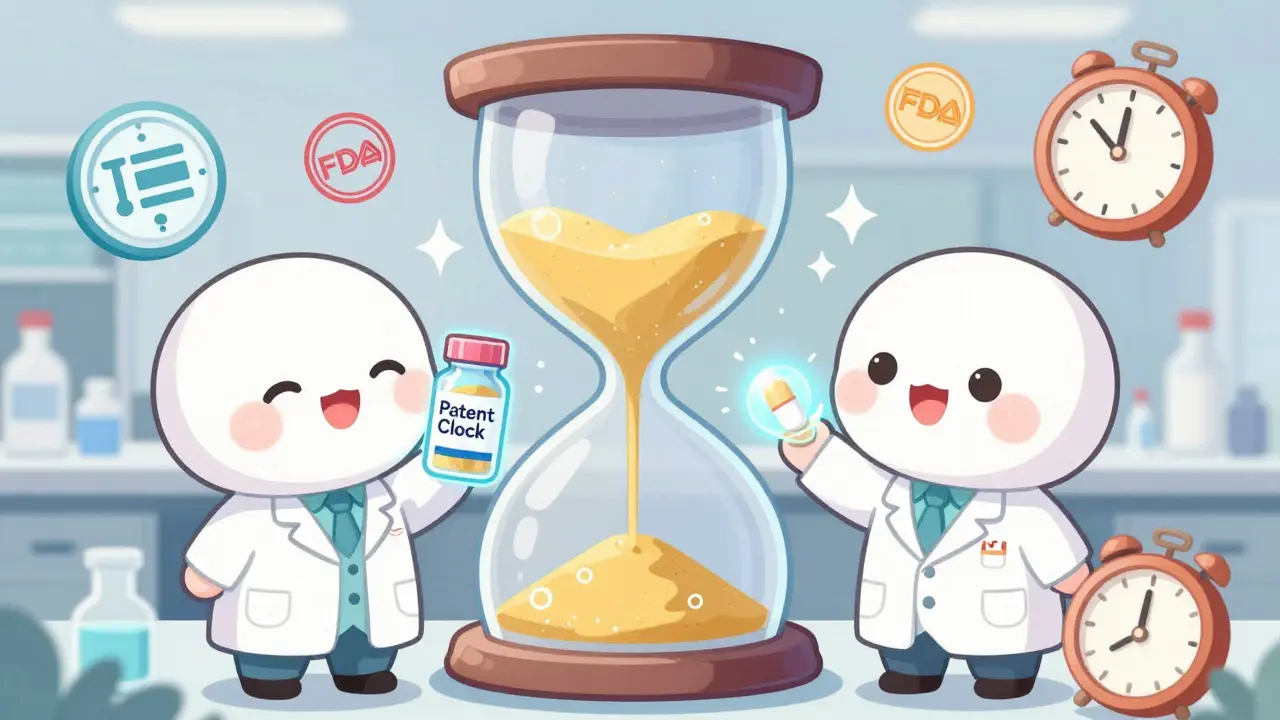
Most people assume that when a pharmaceutical company gets a patent on a new drug, they have 20 years to make money from it. That’s not how it works. In reality, by the time a drug hits the market, half of that patent clock has already run out. The effective patent life-the actual time a company has to sell a drug without competition-is often just 10 to 13 years. And sometimes, it’s even less.
Why the 20-Year Patent Doesn’t Mean 20 Years of Sales
A patent for a new drug is filed as soon as the molecule is discovered-often years before it’s tested in humans. That means the 20-year countdown starts during early lab research, long before the drug has passed safety checks, clinical trials, or FDA approval. The average drug takes between 8 and 12 years to go from lab to pharmacy shelf. By the time it’s approved, the patent might only have 8 to 12 years left. That’s not enough to recoup the $2.6 billion it typically costs to develop a single medication.
This isn’t a flaw in the system-it’s built in. The U.S. patent law, set by 35 U.S.C. § 154(a)(2), gives exactly 20 years from the filing date. But the real problem is timing. The clock ticks while the drug is being studied, tested, and reviewed. Patients aren’t getting the medicine. The company isn’t making sales. And the patent is still burning through its term.
The Hatch-Waxman Act: A Compromise That’s Been Strained
In 1984, Congress passed the Drug Price Competition and Patent Term Restoration Act-better known as the Hatch-Waxman Act. It was meant to balance two things: giving drug makers enough time to profit from their innovation, and letting generics enter the market quickly to lower prices.
The solution? Patent Term Extension (PTE). If a drug spent years stuck in regulatory review, the company could get up to five extra years of patent protection. But there’s a catch: the total market exclusivity can’t exceed 14 years from the date the FDA approved the drug. So even if a drug took 10 years to get approved, the company can’t get more than 14 years of exclusive sales time after approval.
For example: a drug filed in 2010, approved in 2020, gets a 4-year patent extension. That pushes the patent expiration to 2026 (2010 + 20 years = 2030; minus 10 years of development = 2020; plus 4 years extension = 2024). But because of the 14-year cap from approval, the patent expires in 2034, not 2030. That’s still only 14 years of exclusivity after approval. And that’s the ceiling.
Regulatory Exclusivities: The Hidden Layers of Protection
Patents aren’t the only shield. The FDA gives out separate exclusivity periods that don’t depend on patents at all. These are like bonus locks on the door:
- New Chemical Entity (NCE) Exclusivity: 5 years of market protection for a drug with an active ingredient never sold before.
- New Clinical Investigation Exclusivity: 3 years for new uses, new formulations, or new patient groups.
- Orphan Drug Exclusivity: 7 years for drugs treating rare diseases (under 200,000 patients in the U.S.).
- Pediatric Exclusivity: An extra 6 months added to any existing patent or exclusivity period.
These aren’t optional. They’re automatic. A drug might have a patent expiring in 2028, but if it got NCE exclusivity, no generic can enter until 2033-even if the patent is gone. This is why some drugs stay monopoly-priced for longer than their patent suggests.
The Evergreening Game: Secondary Patents and Patent Thickets
Here’s where things get strategic-and controversial. Companies don’t just file one patent. They file dozens.
After a drug is approved, manufacturers often file new patents on minor changes: a new tablet coating, a different dosage form, a combination with another drug, or a new way to deliver it. These are called secondary patents. They don’t protect the molecule itself. They protect the packaging, the delivery, or the use.
A study by the R Street Institute found that blockbuster drugs-those making over $1 billion a year-average 20 to 30 patents each. These create what experts call “patent thickets.” Generic companies can’t launch until they’ve challenged every single patent. And each challenge costs millions.
It’s not illegal. It’s legal strategy. And it works. Nearly 91% of drugs that get patent extensions still keep their market monopoly past the expiration date because of these secondary patents. The original 20-year term? It’s just the beginning. The real game is played in the years after approval.
The 30-Month Stay: A Legal Delay Tactic
When a generic company applies to sell a cheaper version, they must notify the brand-name company. If the brand company sues for patent infringement within 45 days, the FDA is legally required to delay final approval of the generic for 30 months. That’s a built-in pause button.
Some companies use this to their advantage. They file weak or borderline patents just to trigger the 30-month stay. Even if they lose the lawsuit later, they’ve bought two and a half years of extra time. By then, the brand drug’s sales have already slowed, and the generic has lost its first-mover advantage.
This tactic is especially common for high-revenue drugs. For drugs making less than $100 million a year, lawsuits are rare. For those making billions? Legal battles are standard.
International Differences: It’s Not Just the U.S.
The U.S. system is unique, but other countries have their own versions:
- Canada: Offers a Certificate of Supplementary Protection (CSP), giving up to 2 years of extra protection after patent expiry.
- Japan: Allows up to 5 years of patent term extension for regulatory delays-same as the U.S., but with different rules.
- European Union: Has Supplementary Protection Certificates (SPCs), which can extend protection by up to 5 years, plus 6 months for pediatric studies.
But even with these extensions, the core problem remains: the patent clock starts too early. No country has solved the timing mismatch between patent filing and drug approval.
What Happens When Exclusivity Ends?
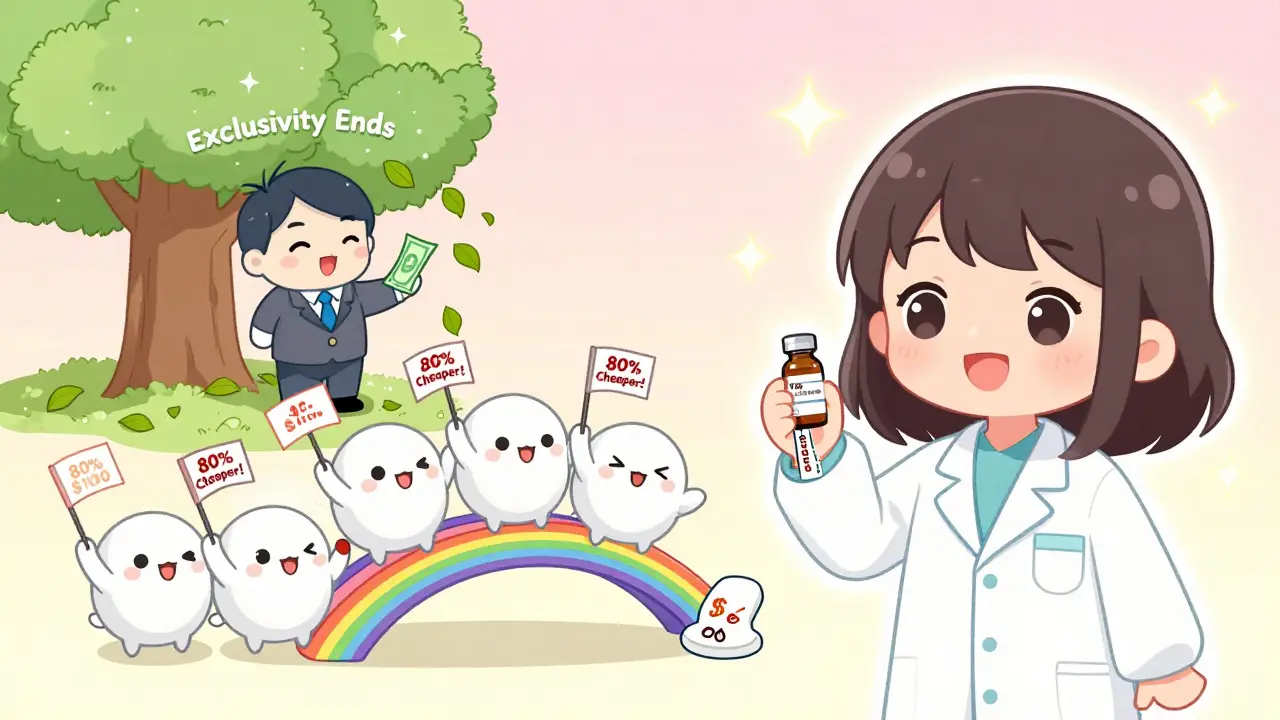
When the last patent or exclusivity expires, the market shifts fast. Within the first year, generic versions can cut the original drug’s price by 80% to 90%. Revenue for the brand-name company can drop from billions to tens of millions overnight.
That’s why companies plan years ahead. They shift marketing budgets. They launch new versions. They acquire smaller firms with pipeline drugs. They restructure entire business models. Loss of exclusivity isn’t just a legal event-it’s a financial earthquake.
By 2025, over $250 billion in global drug sales will be at risk from expiring patents. Companies that don’t prepare for this will collapse. Those that do will survive by moving fast: new formulations, new indications, new delivery systems-all protected by new patents.
Who Wins? Who Loses?
Patients lose when prices stay high longer than necessary. Insurers and government programs like Medicare pay more. Taxpayers foot the bill.
Pharmaceutical companies win-until they don’t. They make billions during exclusivity, but they’re under constant pressure to replace lost revenue. That’s why innovation is tied to patent life. No patent, no investment.
Generics and biosimilars win after exclusivity ends. They bring down prices, increase access, and save the healthcare system billions.
The real question isn’t whether patents should exist. It’s whether the current system-designed in 1984-is still working in 2025. The rules haven’t changed. The costs have. The strategies have. The stakes are higher than ever.
Is There a Better Way?
Some experts suggest tying patent terms to approval date instead of filing date. Others propose capping the number of secondary patents per drug. A few call for shorter exclusivity periods with higher upfront rewards for innovation.
But none of these ideas have gained real traction. The system is complex, profitable for some, and politically sticky. Until there’s a major shift in policy, the reality will stay the same: effective patent life is short. And the race to extend it is just getting started.
What is the average effective patent life for a new drug in the U.S.?
The average effective patent life for a new drug in the U.S. is about 13.35 years. This is the time between FDA approval and patent expiration, after accounting for the 8 to 12 years spent in development and regulatory review. Even with patent term extensions, most drugs have between 10 and 15 years of market exclusivity after approval.
Can a drug have more than one patent?
Yes. Most drugs have multiple patents. The original patent protects the molecule. Secondary patents protect formulations, delivery methods, new uses, or combinations with other drugs. A single blockbuster drug can have 20 to 30 patents, creating what’s called a patent thicket that delays generic competition.
What’s the difference between a patent and regulatory exclusivity?
A patent is granted by the U.S. Patent Office and protects the invention itself. Regulatory exclusivity is granted by the FDA and protects the drug from competition based on its approval history-not its patent status. Exclusivity can last longer than a patent and doesn’t require a lawsuit to enforce.
How does the Hatch-Waxman Act affect generic drug entry?
The Hatch-Waxman Act lets generic companies file applications before a patent expires. But if the brand company sues within 45 days of notification, the FDA must delay approval for 30 months. This gives innovators time to defend their patents, even if the claims are weak. It’s a legal delay tactic that slows generic entry.
Why do pharmaceutical companies file so many patents after approval?
Because the original patent is running out. Filing new patents on minor changes-like extended-release forms or new dosing schedules-lets companies extend market exclusivity without developing a new drug. This strategy, called evergreening, is common for high-revenue drugs and is a key reason why effective patent life often exceeds the nominal 20-year term.
Does the U.S. have the longest drug exclusivity in the world?
Not necessarily. The U.S. allows up to 14 years of market exclusivity after FDA approval, which is similar to the EU’s SPC system. Japan allows up to 5 years of patent term extension. Canada’s CSP offers up to 2 years. But the U.S. is unique in allowing aggressive use of secondary patents and multiple overlapping exclusivities, which can extend protection far beyond legal limits.
What happens to drug prices after exclusivity ends?
Drug prices typically drop by 80% to 90% within the first year after generics enter the market. The first generic manufacturer often gets a 6-month exclusivity period to sell without competition, allowing them to capture a large share of the market. After that, prices fall further as more generics join.




Martin Spedding
December 17, 2025so basically pharma companies are playing chess while we're playing checkers?? lmao