
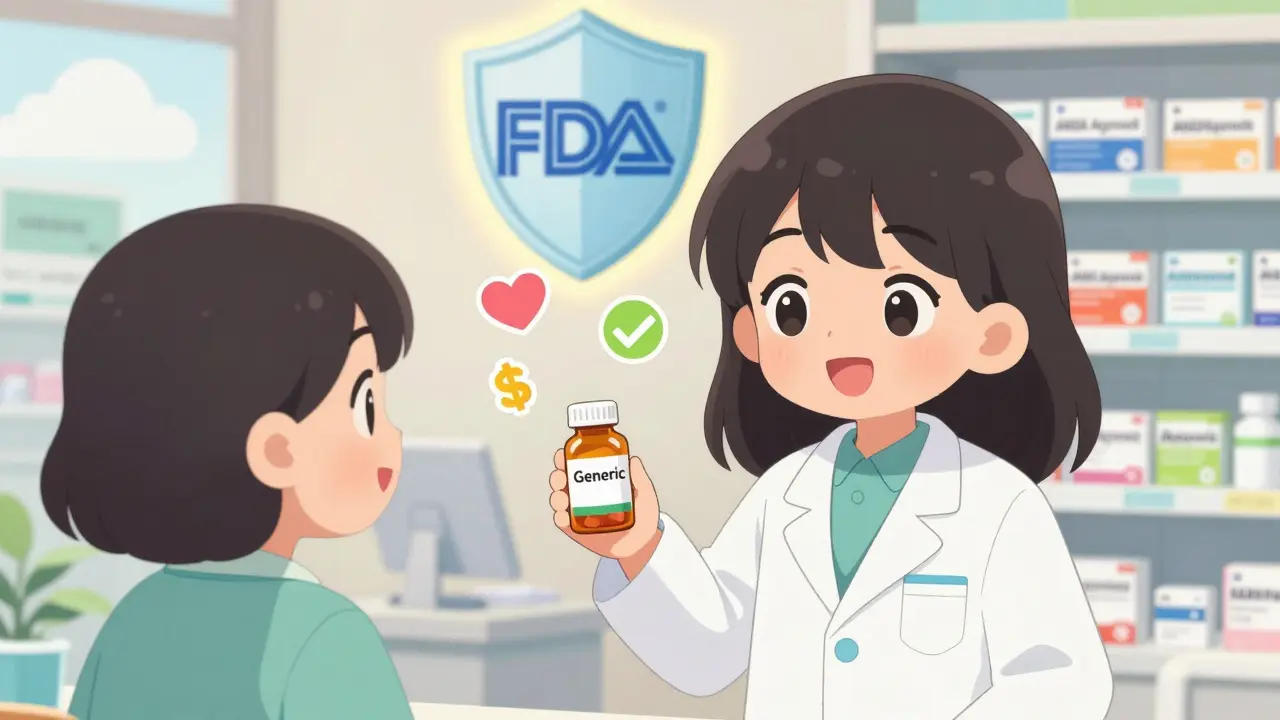
When you pick up a prescription at the pharmacy, there’s a 90% chance it’s a generic drug. That’s not luck - it’s the result of a carefully designed system called the Abbreviated New Drug Application (ANDA) process. This is how generic drug makers get FDA approval without repeating every single clinical trial done by the original brand-name company. It’s the backbone of affordable medicine in the U.S., saving patients and the healthcare system billions every year.
What Exactly Is an ANDA?
An ANDA is a regulatory submission to the U.S. Food and Drug Administration that lets a company sell a generic version of a brand-name drug. The word “abbreviated” doesn’t mean it’s easy - it means it’s shorter because it doesn’t need to prove the drug works from scratch. Instead, the generic maker only has to show their version is the same as the original in every way that matters: active ingredient, strength, dosage form, how it’s taken, and how it behaves in the body. The original brand-name drug is called the Reference Listed Drug (RLD). The FDA already approved it years ago, and it’s been used safely by millions. The ANDA process lets generic companies skip the expensive and time-consuming clinical trials that proved the RLD was safe and effective. They just need to prove their version matches it.How the ANDA Process Works Step by Step
Getting an ANDA approved isn’t a quick form-filling exercise. It’s a multi-year, multi-discipline effort. Here’s how it breaks down:- Submission: The company files the ANDA electronically through the FDA’s Electronic Submission Gateway. They include detailed data on chemistry, manufacturing, labeling, and bioequivalence. The filing team checks if everything’s there - if not, the application gets rejected before review even starts.
- Discipline Reviews: A team of FDA scientists reviews the application in chunks. Chemists check the drug’s composition. Manufacturing experts inspect the facility and production methods. Microbiologists test for contamination. Labeling reviewers compare the generic’s package insert to the brand’s. And bioequivalence experts analyze the data showing the generic absorbs into the bloodstream at the same rate and amount as the original.
- Information Requests: If something’s unclear or incomplete, the FDA sends an Information Request (IR). This is where most delays happen. One company reported getting 17 IRs across different teams, stretching their review by over a year.
- Final Decision: If everything checks out, the FDA gives a Final Approval. But if there’s a patent or exclusivity blocking the drug from being sold yet, the FDA gives a Tentative Approval. The company can’t sell the drug until that legal barrier expires - but they’re ready to go the moment it does.
Why ANDA Is So Much Cheaper Than a New Drug Application
Developing a brand-new drug (called an NDA) costs around $2.3 billion and takes 10 to 15 years. That’s because you have to prove the drug works in animals, then in thousands of people, over years of testing. An ANDA? It costs between $1 million and $5 million. Why? Because you’re not starting from zero. You’re building on something the FDA already approved. You only need to prove bioequivalence - usually through a small study with 24 to 36 healthy volunteers. You measure how fast and how much of the drug gets into the blood. If the numbers match the brand-name drug within strict limits, you pass. This cost difference is why generics are priced at about 15% of the brand-name version within a year of launch. That’s not a coincidence - it’s the whole point of the ANDA system.What Happens When It’s Not Simple?
Not all drugs are created equal. A pill you swallow is easy to copy. But what about a cream you rub on your skin? Or an inhaler you breathe in? Or an injection you get in your vein? These are called “complex generics.” They’re harder to replicate because the way the drug is delivered matters as much as the ingredient itself. A generic inhaler might have the same active drug, but if the propellant or nozzle design is slightly off, the medicine won’t reach your lungs the same way. The FDA now has over 2,000 product-specific guidances to help companies navigate these tricky cases. Still, 35% of Complete Response Letters - the FDA’s official rejection notices - cite problems with bioequivalence studies for complex products. One company spent $1.2 million and three tries just to get their topical cream approved.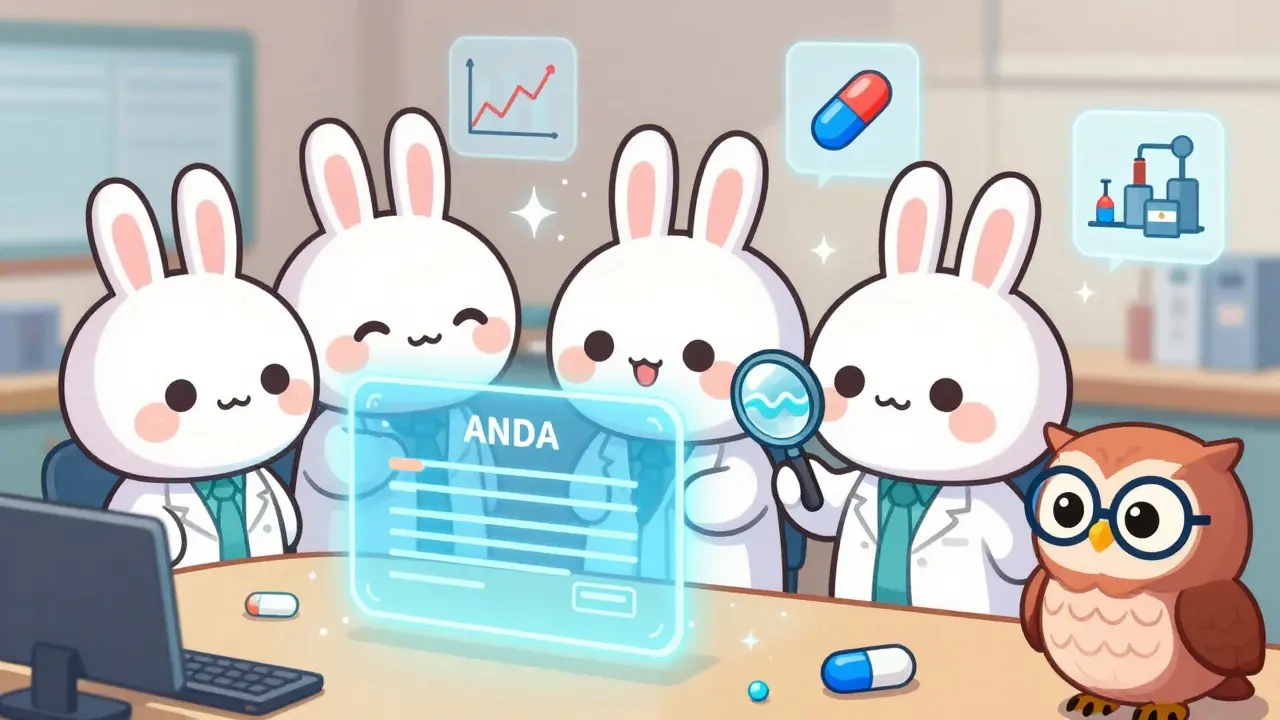
Who’s Running This Process?
The Office of Generic Drugs (OGD), part of the FDA’s Center for Drug Evaluation and Research, handles every ANDA. In 2022, they reviewed 1,102 original applications and approved 91% on the first try. They’re not working alone. Since 2012, generic drug makers have paid user fees under the Generic Drug User Fee Amendments (GDUFA). These fees fund more reviewers, faster timelines, and better technology. Under GDUFA III, which took effect in October 2022, the FDA aims to review 90% of original ANDAs within 10 months. The system isn’t perfect. Delays still happen - especially when the FDA needs to inspect a manufacturing plant overseas. Or when patent disputes delay approval. But the structure is designed to be predictable. Companies that file multiple ANDAs learn the system. Teva Pharmaceuticals, one of the biggest generic makers, says after their tenth approval, they hit GDUFA timelines 92% of the time.Patents, Exclusivity, and Legal Hurdles
One of the biggest challenges isn’t science - it’s law. When a brand-name drug is approved, it gets patent protection. Sometimes, multiple patents cover different aspects: the formula, how it’s made, how it’s used. This is called a “patent thicket.” Generic companies must certify one of four things about each patent:- The patent doesn’t exist
- The patent has expired
- The patent will expire on a certain date
- The patent is invalid or won’t be enforced
Who Benefits From the ANDA System?
The biggest winners? Patients. In 2021 alone, generic drugs saved the U.S. healthcare system $373 billion. That’s money that goes back into people’s pockets, insurance premiums, or hospital budgets. Prescription drug spending in the U.S. is around $400 billion a year. Generics make up 90% of prescriptions but only 23% of the cost. That’s because they’re priced low and widely available. The market is dominated by a few big players: Teva, Viatris (formerly Mylan), and Sandoz. But there are hundreds of smaller companies too. In 2022, 75% of ANDA submissions came from companies with five or more approved products. The system rewards experience.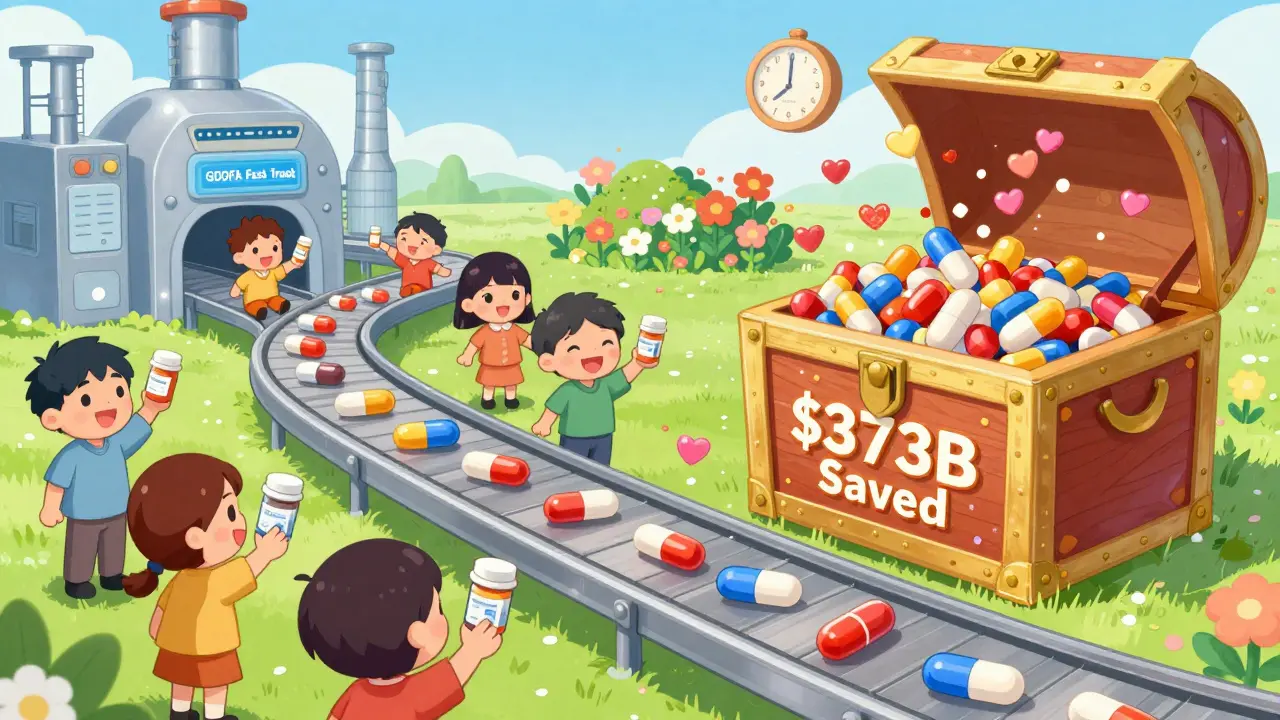
What’s Next for the ANDA Process?
The FDA is investing in new tools. AI is now used by 78% of reviewers to help analyze chemistry data. Real-world evidence from electronic health records might soon help prove equivalence for complex drugs without needing more human trials. The agency is also pushing for more international alignment. The International Council for Harmonisation (ICH) is working to standardize requirements across the U.S., Europe, and Japan. That could make it easier for generic companies to enter multiple markets at once. But challenges remain. Patent thickets, REMS restrictions (safety programs that limit distribution), and manufacturing delays still block access to some generics. Still, the core system - proven since 1984 - continues to deliver on its promise: safe, affordable medicine for everyone.How Companies Prepare for an ANDA Submission
Preparing an ANDA isn’t a one-person job. It takes a team of 10 to 15 people - chemists, regulatory specialists, bioequivalence experts, legal advisors, and quality control staff. Together, they spend 5,000 to 10,000 hours on one application. Most successful companies start with a pre-ANDA meeting. They meet with the FDA to get feedback before spending millions on studies. About 78% of approved ANDAs had one of these meetings. They also use Quality by Design (QbD) principles - building quality into the manufacturing process from the start, not just testing for it at the end. This reduces the chance of facility inspection failures, which cause 28% of rejections.Common Mistakes and How to Avoid Them
The biggest reasons ANDAs get rejected:- Bad bioequivalence studies (35% of rejections): Too few participants, poor sampling times, or flawed statistical analysis.
- Manufacturing issues (28%): Facilities don’t meet cGMP standards. Outdated equipment, poor documentation, or contamination risks.
- Labeling errors (22%): Minor differences in wording, font size, or warnings compared to the brand-name drug.
What’s the difference between an ANDA and an NDA?
An NDA is for brand-name drugs and requires full clinical trials proving safety and effectiveness. An ANDA is for generics and only needs to prove bioequivalence to an already approved drug. The NDA process costs billions and takes over a decade. The ANDA process costs millions and takes a few years.
Can a generic drug be different from the brand-name version?
Legally, yes - but only in ways that don’t affect safety or effectiveness. Generics can have different inactive ingredients (like fillers or dyes), different shape or color, and different packaging. But the active ingredient, strength, dosage form, route of administration, and how it works in the body must be identical. The FDA requires bioequivalence testing to confirm this.
Why do some generics take longer to get approved than others?
Complex generics - like inhalers, injectables, or topical creams - are harder to replicate and require more data. Patent disputes, facility inspections overseas, or incomplete submissions also cause delays. The FDA’s goal is 10 months for a standard ANDA, but complex cases can take 30 months or more.
What is Tentative Approval?
Tentative Approval means the FDA has found the generic drug scientifically equivalent to the brand-name version, but it can’t be sold yet because of an active patent or exclusivity period. The company can start manufacturing and preparing for launch, but they must wait until the legal barrier expires before selling.
How do I know if my generic drug is safe?
All FDA-approved generics must meet the same strict standards as brand-name drugs. They use the same active ingredient, work the same way in the body, and are made in facilities that pass the same inspections. The FDA monitors reports of side effects from both brand and generic versions - and finds no meaningful difference in safety or effectiveness.



Jenci Spradlin
January 9, 2026man i had no idea generics were this complex. thought it was just copying pills but damn, bioequivalence studies and facility inspections? that’s wild. my prescription costs 5 bucks now, didn’t think about all the science behind it.