

For decades, leukemia and lymphoma were treated the same way: harsh chemotherapy that attacked fast-growing cells-cancerous or not. Patients lost hair, felt sick for weeks, and often faced relapse. But since 2001, everything has changed. Today, doctors don’t just bombard the body with drugs. They target the exact molecular flaws driving each patient’s cancer. And in some cases, they reprogram the patient’s own immune cells to hunt down cancer like a living drug. This isn’t science fiction. It’s standard care in 2025.
What Are Targeted Therapies?
Targeted therapies are drugs designed to block specific proteins or signals that cancer cells rely on to grow and survive. Unlike chemo, which hits everything, these drugs are like precision keys that only fit one lock-the faulty one in the cancer cell. For chronic lymphocytic leukemia (CLL) and small lymphocytic lymphoma (SLL), two of the most common blood cancers, the biggest breakthroughs came from two classes of drugs: BTK inhibitors and BCL-2 inhibitors. BTK inhibitors, like ibrutinib (Imbruvica) and acalabrutinib (Calquence), stop a protein called Bruton’s tyrosine kinase. This protein is like a relay switch in B-cells. When it’s stuck in the “on” position, it tells cancer cells to keep dividing. Blocking it slows or stops tumor growth. Patients take these as daily pills. No hospital stays. No IV lines. Many live for years with minimal side effects. Then there’s venetoclax (Venclexta), a BCL-2 inhibitor. BCL-2 is a protein that keeps cancer cells from dying naturally. Venetoclax flips that switch, forcing the cancer cells to self-destruct. It’s usually given in combination with a monoclonal antibody like obinutuzumab. Together, they can push patients into deep remission-sometimes lasting years. A 2025 study showed patients on this combo had a median progression-free survival of over 5 years, compared to under 2 years with older chemo regimens. These drugs don’t cure everyone. Resistance can develop, especially in patients with TP53 or del(17p) mutations. But for most, they’ve turned a fatal diagnosis into a manageable condition.Cellular Therapies: Rewiring the Immune System
If targeted therapies are precision tools, CAR T-cell therapy is like giving the immune system a GPS and a weapon. Here’s how it works: First, doctors take a sample of the patient’s blood and pull out T-cells-the body’s natural cancer fighters. These cells are sent to a lab, where scientists add a synthetic receptor called a chimeric antigen receptor (CAR). This CAR is designed to recognize CD19, a protein found on the surface of most B-cell lymphomas and leukemias. The modified T-cells are grown in huge numbers-billions of them-and then infused back into the patient. Once inside, these engineered cells multiply and hunt down any cell with CD19. They don’t just kill cancer cells-they remember them. In some patients, this leads to lasting remission-or even a cure. Three CAR T-cell therapies are FDA-approved as of 2025: tisagenlecleucel (Kymriah), axicabtagene ciloleucel (Yescarta), and lisocabtagene maraleucel (Breyanzi). Each targets CD19. Yescarta, for example, showed a 42.6% four-year survival rate in patients with large B-cell lymphoma who had failed two prior treatments-something nearly impossible with chemo alone. Newer versions are already in development. Kite, a Gilead company, is testing dual-target CAR T-cells that go after both CD19 and CD20. In early trials, these therapies achieved a 63.6% complete remission rate in patients who had exhausted all other options. Why? Because cancer cells sometimes lose CD19 to escape treatment. Hitting two targets at once makes that harder.How Do They Compare?
Targeted therapies and CAR T-cell therapy aren’t rivals-they’re tools used at different points in a patient’s journey.| Feature | Targeted Therapies (e.g., Ibrutinib, Venetoclax) | CAR T-Cell Therapy (e.g., Yescarta, Kymriah) |
|---|---|---|
| Administration | Oral pills, daily | Single IV infusion |
| Duration of Treatment | Continuous (often lifelong) | One-time, with lasting effect |
| Time to Start | Days | 3-5 weeks (manufacturing delay) |
| Typical Use | First-line or relapsed disease | Relapsed/refractory disease |
| Key Side Effects | Bleeding, infection, fatigue | Cytokine release syndrome, neurotoxicity |
| Cost (2025) | $15,000-$25,000/month | $373,000-$475,000 per treatment |
| Potential for Cure | Unlikely | Possible in 30-50% of eligible patients |

Who Benefits Most?
Not every patient gets the same treatment. Decisions depend on cancer type, genetics, age, and overall health. For newly diagnosed CLL patients without high-risk mutations, venetoclax plus obinutuzumab is now a standard first-line option. It’s time-limited-usually 12 months-and often leads to undetectable minimal residual disease (MRD). That means no cancer can be found even with the most sensitive tests. For patients who relapse after chemo or targeted drugs, CAR T-cell therapy is often the next step. In mantle cell lymphoma, a rare but aggressive form, CAR T-cells have shown response rates above 80% in trials. One 2025 study reported a 100% overall response rate with a new CAR T-cell therapy called LV20.19. But there’s a catch. CAR T-cell therapy requires specialized centers. Only 89% of National Cancer Institute-designated cancer centers offer it. In community hospitals, that number drops to 32%. Many patients must travel hundreds of miles. And even then, they need to stay nearby for weeks to manage side effects like cytokine release syndrome-a dangerous immune overreaction that can cause high fever, low blood pressure, and organ failure.Challenges and Real-World Barriers
The science is impressive. But access isn’t equal. Cost is the biggest hurdle. While insurance covers most of the $400,000 price tag for CAR T-cell therapy, patients still face $15,000-$25,000 in out-of-pocket costs per month for targeted drugs. For elderly patients on fixed incomes, that’s impossible. Manufacturing delays are another issue. It takes 3 to 5 weeks to make a patient’s CAR T-cells. Some patients get sicker waiting. In aggressive lymphomas, that delay can be fatal. Then there’s resistance. Patients on BTK inhibitors often relapse after 3-5 years. When that happens, switching to another BTK inhibitor or venetoclax might help-but not always. Those with TP53 mutations respond poorly to nearly all targeted drugs. Doctors are now testing combinations: BTK inhibitors with venetoclax, or even CAR T-cells after targeted therapy fails. Early data suggest these sequences can extend survival. But long-term outcomes are still unknown.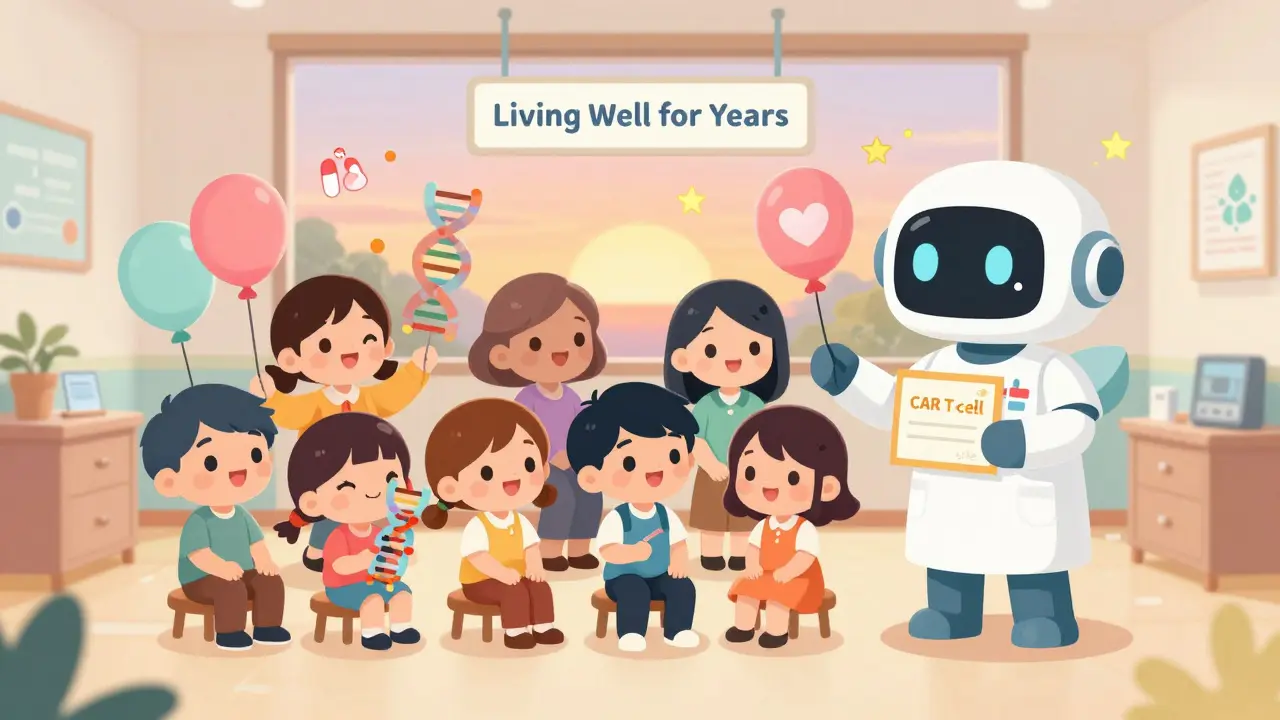
The Future: Earlier Use and New Frontiers
The biggest shift coming? Using CAR T-cell therapy sooner-not as a last resort, but as a first-line option for high-risk patients. A 2025 ASCO survey found 68% of hematologists believe CAR T-cell therapy will become standard for young patients with aggressive lymphomas within five years. Clinical trials are already testing this. For example, ZUMA-7 showed Yescarta outperformed standard chemo in second-line large B-cell lymphoma, leading to better survival and fewer relapses. New therapies are also emerging. Bispecific antibodies-lab-made proteins that grab both T-cells and cancer cells-are being tested as “off-the-shelf” alternatives to CAR T-cells. They don’t require custom manufacturing. They work faster. And they’re cheaper. Researchers are also exploring CAR T-cells that target other antigens, like CD22 or CD30, for patients whose cancer loses CD19. And for brain-involved lymphomas, early trials show CAR T-cells can cross the blood-brain barrier-a breakthrough for primary CNS lymphoma.What Patients Should Know
If you or someone you love has leukemia or lymphoma, here’s what matters now:- Genetic testing is essential. Mutations like TP53 or del(17p) change your treatment path.
- Ask about MRD testing. Undetectable disease means better long-term outcomes.
- Don’t assume chemo is the only option. Targeted drugs and CAR T-cells may be better.
- Find a center with experience. CAR T-cell therapy requires specialized teams.
- Ask about clinical trials. Many of the most promising therapies aren’t FDA-approved yet.
Are targeted therapies better than chemotherapy for leukemia and lymphoma?
Yes, for most patients with CLL, SLL, and many types of lymphoma. Targeted therapies like BTK and BCL-2 inhibitors are more effective, cause fewer side effects, and can be taken orally at home. They’ve replaced chemo as the standard first-line treatment for many patients. Survival rates have improved, and quality of life is significantly better.
What is CAR T-cell therapy, and how does it work?
CAR T-cell therapy is a personalized treatment that uses a patient’s own immune cells. Doctors collect T-cells from the blood, genetically modify them in a lab to recognize cancer cells, multiply them, and infuse them back into the patient. These engineered cells then hunt down and destroy cancer cells. It’s a one-time treatment with the potential to cure patients who have failed all other options.
How much does CAR T-cell therapy cost?
In 2025, CAR T-cell therapy costs between $373,000 and $475,000 per treatment. Most insurance plans cover it, but patients may still face $15,000-$25,000 in out-of-pocket expenses for related care, travel, and time off work. Targeted therapies cost $15,000-$25,000 per month and are often taken long-term, leading to high cumulative costs.
Can CAR T-cell therapy cure lymphoma?
Yes, in some cases. For patients with relapsed or refractory large B-cell lymphoma, about 30-50% achieve long-term remission after CAR T-cell therapy. Some remain cancer-free for over 10 years. It’s not a guarantee, but for patients with no other options, it’s the best chance at a cure.
Why isn’t CAR T-cell therapy used for everyone?
Because it’s complex and risky. It requires specialized centers with ICU capabilities to manage side effects like cytokine release syndrome and neurotoxicity. Manufacturing takes 3-5 weeks, which can be too long for aggressive cancers. It’s also expensive and not widely available outside major cancer centers. For many patients, targeted therapies are safer, easier, and effective enough.
What are the side effects of targeted therapies and CAR T-cell therapy?
Targeted therapies can cause fatigue, bleeding, diarrhea, and increased infection risk. BTK inhibitors may raise the risk of irregular heartbeat. Venetoclax can trigger tumor lysis syndrome early in treatment, requiring hospital monitoring. CAR T-cell therapy causes cytokine release syndrome (fever, low blood pressure) in up to 70% of patients and neurotoxicity (confusion, seizures) in 20-40%. These are serious but manageable with expert care.






srishti Jain
December 30, 2025This is why I hate how they market these 'miracle cures'-everyone acts like it’s free and easy. My aunt spent her entire savings just to get the first infusion. Then the side effects nearly killed her. No one talks about the real cost.