
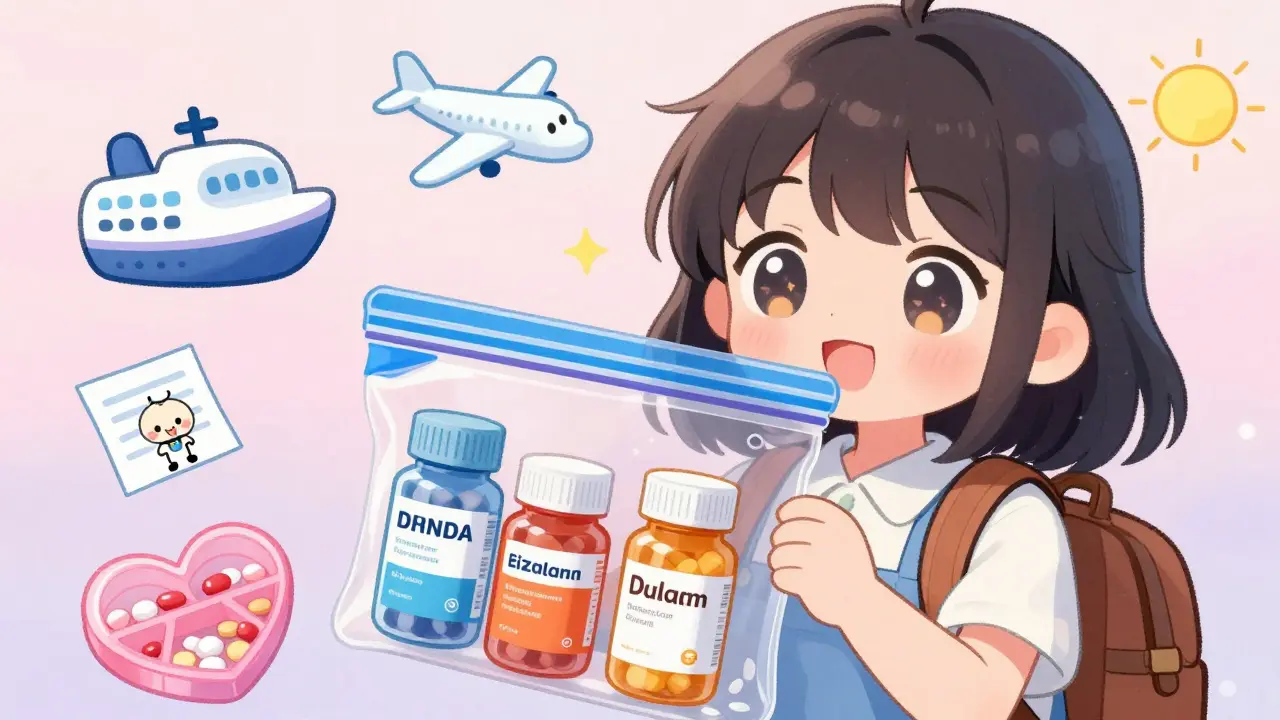
Running out of medication halfway through a road trip or stuck on a cruise ship with no access to your pills is one of those avoidable nightmares that can turn a vacation into a medical emergency. It doesn’t have to happen. Whether you’re driving across state lines or sailing through international waters, packing your meds the right way isn’t just smart-it’s often required by law.
Why Original Containers Matter
Never transfer your pills into unlabeled containers, no matter how convenient it seems. Cruise lines like Royal Caribbean and Norwegian require all medications to stay in their original pharmacy-labeled bottles. The label must show your full name, the drug name, dosage, and prescribing doctor’s information. Why? Because customs agents, ship doctors, and even TSA officers need to verify what you’re carrying. In 2023, over 200 travelers were denied boarding or faced delays at ports because their meds were in pill organizers without labels. One woman in Florida lost her entire month’s supply of antidepressants when she packed them in a plastic bag. She couldn’t prove they were hers. Her cruise was delayed by two days while she waited for a replacement. The same rule applies to road trips. In 13 U.S. states, even legally prescribed medications can be confiscated if they’re not in original containers. That includes ADHD meds, painkillers, and sleep aids. The American Automobile Association found that 67% of medication issues during cross-state travel happened because of improper packaging.Bring Extra-A Lot More Than You Think
Plan for delays. Flights get canceled. Ships dock late. Traffic jams stretch for hours. The average international flight experiences a delay or cancellation in about 23% of cases, according to OAG Aviation’s 2023 report. For road trips, pack at least one extra day’s supply. For cruises, pack two extra days. But here’s the real tip: if you’re going to a country with strict drug laws-like the Caribbean, Southeast Asia, or parts of Europe-pack three extra days. Some countries ban common medications you’d never think twice about, like pseudoephedrine (found in cold pills) or even certain anti-anxiety drugs. A 2024 report from the International Association for Medical Assistance to Travellers found that 42% of commonly used medications require special permits in at least one popular cruise destination. That includes things like codeine, melatonin, and even some OTC sleep aids. Don’t assume your pharmacy knows this. Call your doctor and ask: “Is this drug legal in Mexico, Jamaica, or the Bahamas?”How to Organize Your Meds Like a Pro
You don’t need fancy gadgets. But you do need a system. Start with your original bottles. Put them in a clear, quart-sized Ziploc bag. That’s TSA’s requirement for liquids-and yes, your pills count as liquids if they’re in bottles. Keep this bag easily accessible in your carry-on. Never check it. For daily use, use one of these approved methods:- Daily blister packs (like those from CVS or Walgreens)-they’re pre-labeled and approved by most airlines and cruise lines.
- Pill minders (the ones with compartments for morning, noon, night)-but only if you tape them shut and label each side clearly with your name, date, and time.
- Pill envelopes-folded paper envelopes labeled with drug name, dosage, and time to take. No scribbles. No abbreviations.
Documents You Can’t Afford to Forget
Your prescriptions aren’t enough. You need backup. Carry a printed copy of your prescription or a letter from your doctor. The letter should include:- Your full name (must match your passport)
- Each medication name (brand and generic)
- Dosage and frequency
- Reason for use (e.g., “treatment for hypertension”)
- Doctor’s contact info
Cruise vs. Road Trip: Key Differences
Cruises are stricter. Road trips are more unpredictable. On a cruise, you’re dealing with international laws. A drug legal in the U.S. might be illegal in the Bahamas or Mexico. Some cruise lines require you to declare controlled substances (like opioids or stimulants) 30 days before sailing. Carnival requires a doctor’s note for any medication containing codeine. Norwegian asks for a signed form for ADHD meds. On a road trip, the problem is state laws. Medical marijuana is legal in 38 states-but still illegal in 13. Even if you have a prescription, crossing into one of those states with it in your car can lead to arrest. The same goes for certain painkillers. In Texas, even a small amount of oxycodone without the original bottle can trigger a felony charge. Bottom line: If you’re driving, check each state’s drug laws before you go. If you’re cruising, check each port’s rules. The World Health Organization says 18% of common medications face restrictions in at least one country travelers visit.Special Cases: Insulin, EpiPens, and Biologics
Some meds need extra care. Insulin? Always carry it in your carry-on. Keep it cool. Use a small insulated bag with a cold pack. Don’t let it freeze. The FDA says 41% of biologic medications (like insulin, rheumatoid arthritis drugs, or cancer treatments) can lose effectiveness if exposed to extreme heat or cold. EpiPens? Don’t pack them in checked luggage. They’re life-saving devices. TSA allows unlimited EpiPens in carry-ons. Put them in the same clear bag as your other meds. If you’re flying, bring a doctor’s note-even if it’s not required. It saves time. For temperature-sensitive meds, consider a UV-protective travel case. Companies like MedKits and Cold Chain Tech now make cases that keep meds at safe temps for up to 72 hours. CVS and Walgreens offer them for free if you ask.What to Do If You Lose Your Meds
It happens. You leave your bag on a bus. Your suitcase gets lost. Your meds get stolen. If you’re on a cruise: Go straight to the ship’s medical center. They can often refill prescriptions for common drugs like blood pressure meds or antibiotics. But they can’t give you controlled substances without paperwork. That’s why you need the doctor’s letter. If you’re on a road trip: Call your pharmacy. Most can fax a new prescription to a local pharmacy within hours. 90% of Americans live within five miles of a pharmacy. Use Google Maps to find the nearest one. Bring your ID and doctor’s contact info. Pro tip: Always know your pharmacy’s phone number and the name of your prescribing doctor. Write it down. Don’t rely on your phone.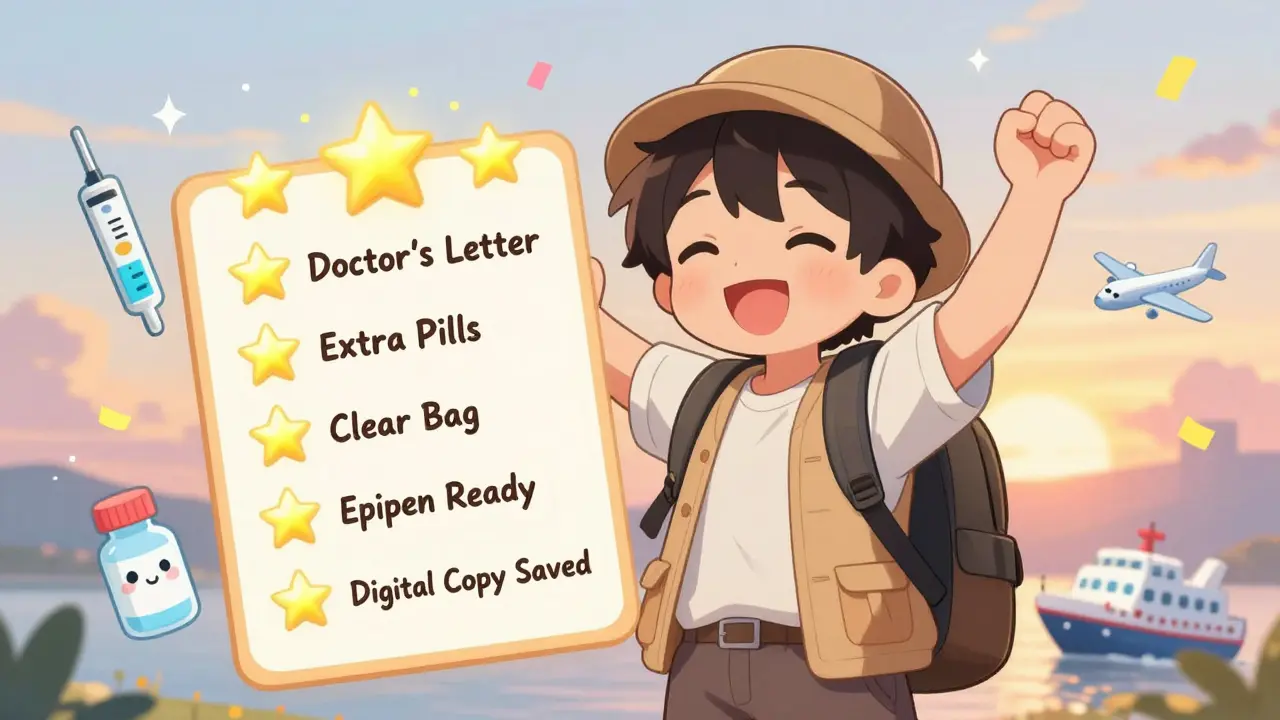
Final Checklist: 5 Things to Do Before You Leave
- 30 days out: Talk to your doctor. Confirm all meds are legal in every destination. Get extra refills. Ask for a letter.
- 14 days out: Order extra days’ supply. Get your meds in original containers. If your pharmacy offers free travel packaging, use it.
- 7 days out: Make a digital copy of your meds list. Email it to yourself and a trusted person at home.
- 2 days out: Pack your meds in your carry-on. Put them in a clear bag. Add your doctor’s letter and prescriptions.
- Day of travel: Double-check your bag. Make sure nothing’s missing. Don’t forget your EpiPen, insulin, or daily pills.
What Not to Do
- Don’t put meds in checked luggage-even if you think you’ll be fine.
- Don’t use unlabeled containers, even for “just a few days.”
- Don’t assume your insurance covers emergency refills abroad.
- Don’t skip the doctor’s letter because “it’s just a short trip.”
- Don’t rely on airport pharmacies-they might not have your drug.
Traveling with meds isn’t about being paranoid. It’s about being prepared. The difference between a smooth trip and a crisis is often one label, one extra pill, one printed page.
Can I bring my medications in a pill organizer on a plane?
Yes, but only if the organizer is clearly labeled with your name, the drug name, dosage, and time of day. TSA allows pill organizers, but they may ask you to show the original prescription. It’s safer to keep meds in original bottles and use the organizer only as a secondary tool.
Do I need a doctor’s note for over-the-counter meds?
Usually not, unless they’re restricted in your destination. For example, pseudoephedrine (in Sudafed) is banned in some countries. Melatonin is controlled in Australia and the UK. If you’re unsure, bring a note. It takes 5 minutes to write and can save you hours of trouble.
Can I mail my medications ahead to my cruise destination?
No. Cruise lines do not accept mailed medications. They can’t verify the contents, and customs rules prohibit it. Always bring your meds with you in your carry-on.
What if I run out of my medication while on a cruise?
Cruise ship medical centers can refill most common prescriptions like blood pressure, diabetes, or antibiotics. But they can’t refill controlled substances without your original prescription and doctor’s note. That’s why bringing extra and documentation is critical.
Are there apps to help manage travel meds?
Yes. The CDC’s Travelers’ Health site offers a free Medication Travel Checklist with QR codes linking to country-specific rules. Royal Caribbean and Carnival also have apps where you can upload your meds list before sailing. Many pharmacies like CVS and Walgreens offer digital refill reminders and travel alerts.





Linda O'neil
January 29, 2026Just got back from a 10-day cruise and this is 100% spot on. I packed my anxiety meds in a pill organizer without labeling it-thought I’d be fine. Got questioned at the first port. Had to show my prescription on my phone while standing in the sun for 20 minutes. Never again. Now I use the clear bag, original bottles, and a printed doctor’s note. Simple. No drama.
Also, bring extra insulin cold packs. My friend’s fridge broke mid-trip and hers started failing. Thank god she had a backup cooler.