

For decades, the rule of thumb in healthcare was simple: brand-name drugs cost more and often require a fight for coverage, while generic medications are lower-cost alternatives that are typically covered automatically by insurance plans. If your doctor prescribed a generic, you picked it up at the pharmacy, paid a small copay, and moved on. That era is ending. Today, requiring prior authorization is an administrative process where an insurance company must approve a medication before it is covered for generic drugs is no longer the exception-it’s becoming the norm. This shift has turned what used to be a quick trip into a bureaucratic maze, causing delays that can worsen health outcomes.
You might wonder why insurers are adding hurdles to the cheapest options. The answer lies in changing utilization management strategies, where Pharmacy Benefit Managers (PBMs) and insurers use prior authorization not just to steer patients away from expensive brands, but to enforce specific treatment protocols even for low-cost generics. Understanding this landscape is critical for patients and providers alike. This guide breaks down why this happens, how the process works, and exactly what you can do to get your medication approved without unnecessary delay.
The Shift: Why Generics Now Require Prior Authorization
To understand the current frustration, we have to look at the data. Historically, prior authorization was designed primarily for high-cost specialty drugs or brand-name medications when a cheaper alternative existed. However, recent industry trends show a dramatic expansion of this practice. According to a 2024 analysis by the Generic Pharmaceutical Association, between 15% and 20% of generic prescriptions now face prior authorization requirements. This is a massive jump from just 5% in 2018.
Why the change? Insurers and PBMs are increasingly using prior authorization as a tool for step therapy is a coverage requirement that mandates patients try one or more lower-cost medications before the insurer will cover a prescribed drug. Even if two generics are chemically identical, an insurer might argue that one is preferred based on internal formularies or rebates they receive from manufacturers. For example, while both Brand A Generic and Brand B Generic treat hypertension, the insurer may only cover Brand A unless you provide clinical justification for Brand B.
This trend is particularly pronounced in specialty generics. Oncology generics, for instance, require pre-approval in 35% of cases, compared to just 12% for cardiovascular generics. The logic from the insurer’s perspective is risk management; they want to ensure the most clinically appropriate treatment is used, regardless of whether the drug is cheap or expensive. However, critics argue this undermines the primary benefit of generics: accessibility.
How the Prior Authorization Process Works for Generics
When your provider prescribes a generic that requires prior authorization, the workflow changes significantly. You cannot simply hand the prescription to the pharmacist. Instead, the provider must submit clinical documentation to prove medical necessity. Here is the typical sequence:
- Submission: The provider submits the request via electronic platforms, fax, or phone. Electronic submission through services like CoverMyMeds is increasingly standard.
- Documentation: The request must include specific ICD-10 diagnostic codes, lab results, and notes explaining why alternative generics or treatments failed or are inappropriate.
- Review: The insurance carrier or PBM reviews the clinical evidence against their formulary guidelines.
- Decision: The insurer approves or denies the request. If approved, the authorization typically lasts for 12 months, though this varies by carrier.
Timeframes vary wildly. Cigna states decisions usually come within 5-10 business days. Mayo Clinic notes it can range from a few days to a few weeks. For urgent needs, providers can request "urgent" status. Cigna processes these within 72 hours, but other carriers may still take several days. This variability creates uncertainty for patients who need immediate relief.
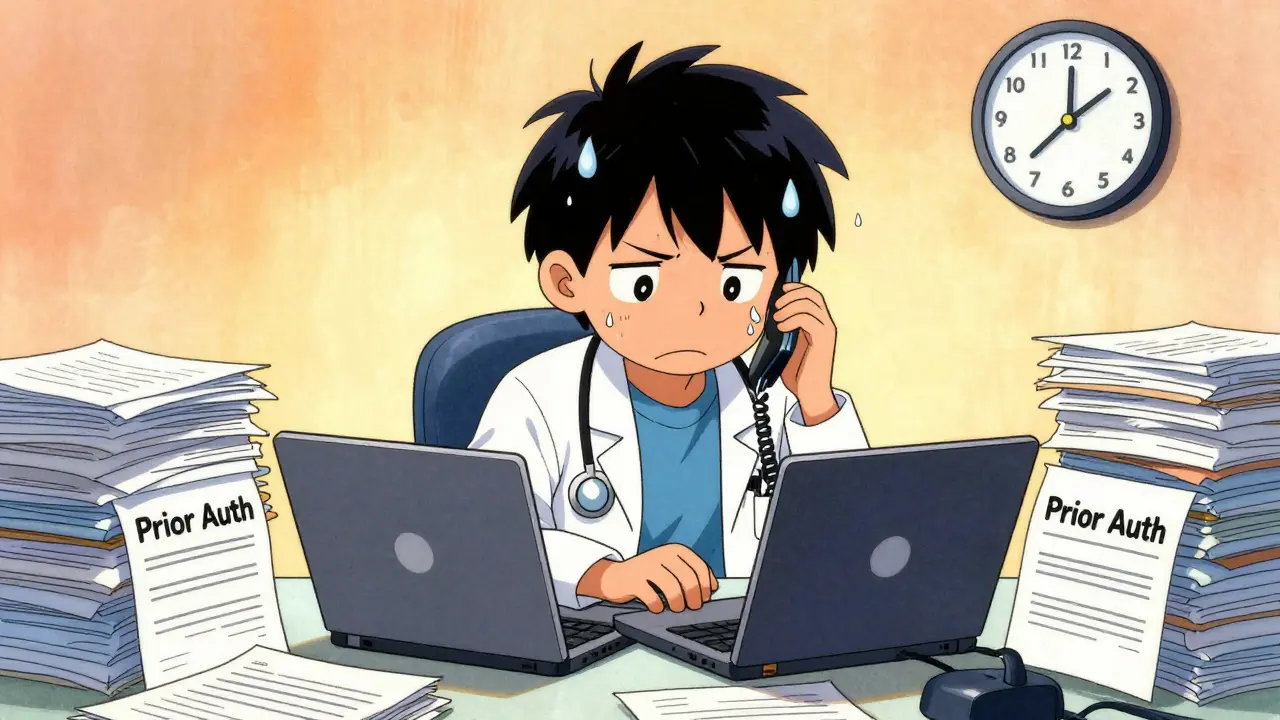
The Human Cost: Delays and Health Risks
The administrative burden of prior authorization extends beyond paperwork. It directly impacts patient health. The American Medical Association’s June 2023 survey found that 93% of physicians report prior authorizations lead to treatment delays. More alarmingly, 24% stated they have witnessed serious adverse events-including hospitalizations-directly attributable to these delays.
Consider a real-world scenario documented by the Kaiser Family Foundation in June 2024. A patient with type 2 diabetes faced a 14-day delay accessing generic metformin due to prior authorization requirements. During those two weeks, the patient’s HbA1c levels rose from 6.8% to 8.2%. While this might seem like a small number, it represents significant uncontrolled blood sugar, increasing the risk of complications.
Providers are also struggling. The CoverMyMeds 2022 survey revealed that healthcare practices complete an average of 43 prior authorizations per physician each week, with 38% involving generics. One verified healthcare provider noted on Reddit that their clinic spends 17.3 hours weekly just on prior auths for generics-time that could otherwise be spent on patient care. This administrative drag contributes to provider burnout and reduces the overall efficiency of the healthcare system.

Navigating the System: Strategies for Patients and Providers
If you or your provider encounter a prior authorization requirement for a generic, there are concrete steps to streamline the process and improve the chances of approval.
For Providers
Efficiency starts with how the request is submitted. A 2024 study in the Journal of the American Pharmacists Association found that providers using electronic platforms like CoverMyMeds reduce approval times by 32% compared to fax or phone submissions. Ensure your documentation includes:
- Precise Diagnostic Codes: Match ICD-10 codes exactly to the medication indication.
- Evidence of Failure: If step therapy applies, document why previous first-line generics failed (e.g., side effects, lack of efficacy).
- Clinical Notes: Provide clear reasoning for why the specific generic is necessary over alternatives.
For Patients
Your role is advocacy and record-keeping. Keep a log of all communications regarding your prior authorization. If a denial occurs, don’t accept it immediately. The Crohn's & Colitis Foundation reports that 67% of denials can be successfully appealed with additional clinical documentation. Ask your provider to file an appeal highlighting any unique aspects of your medical history that justify the prescribed generic.
In time-sensitive situations, explicitly ask your provider to mark the request as "urgent." While this doesn’t guarantee instant approval, it prioritizes your case in the insurer’s queue. If you experience a significant delay, contact your insurer’s member services department to inquire about emergency supply policies, which some plans offer for chronic conditions.
Regulatory Changes and Future Outlook
The tide may be turning. Recognizing the counterproductive nature of prior authorization for cost-saving generics, regulators are stepping in. The Improving Seniors' Timely Access to Care Act, signed into law in December 2023, mandates electronic prior authorization for Medicare Advantage plans by 2026 and requires decisions within 72 hours for expedited requests.
State-level actions are also gaining momentum. California’s SB 1024, effective January 2025, prohibits prior authorization for medications on the state’s Essential Drug List, including 47 commonly prescribed generics. As of 2024, 34 states restrict prior authorization for certain generic medication classes. Additionally, major insurers including UnitedHealthcare, Aetna, and Humana agreed in June 2025 to streamline processes, eliminating prior authorization for 12 common generic classes like ACE inhibitors and statins by January 2026.
Despite these reforms, the Congressional Budget Office projects that prior authorization requirements for generics will only decrease by 40% by 2028. This means patients and providers must remain vigilant and prepared to navigate these systems for the foreseeable future.
| Feature | Generic Medications | Brand-Name Medications |
|---|---|---|
| Frequency of PA Requirement | 15-20% of cases (up from 5% in 2018) | ~75% of cases when generics are available |
| Primary Reason for PA | Step therapy, formulary restrictions, specialty classification | Cost containment, steering toward generics |
| Average Approval Time | 5-10 business days (standard), 72 hours (urgent) | 5-10 business days (standard), 72 hours (urgent) |
| Appeal Success Rate | 67% with additional clinical documentation | Varies, often higher due to clear cost-benefit arguments |
| Impact on Treatment | Delays in first-line treatments, potential worsening of chronic conditions | Delays in specialized therapies, high out-of-pocket costs if denied |
Why does my insurance require prior authorization for a generic drug?
Insurers use prior authorization for generics primarily to enforce step therapy protocols or formulary preferences. Even if a generic is cheap, the insurer may want to ensure you’ve tried their preferred brand of generic first, or they may restrict access to specialty generics until certain clinical criteria are met. This is part of utilization management to control costs and ensure clinical appropriateness.
How long does prior authorization for a generic medication take?
Standard prior authorization requests typically take 5 to 10 business days. However, this can vary by insurer and complexity. For urgent medical needs, providers can request expedited review, which many insurers like Cigna process within 72 hours. Always ask your provider to mark the request as urgent if timely treatment is critical.
What should I do if my prior authorization for a generic is denied?
Do not give up. Approximately 67% of denials can be overturned with an appeal. Work with your provider to gather additional clinical documentation, such as detailed notes on why alternative medications failed or caused adverse reactions. Submit this new evidence formally to the insurer. If the appeal is denied, you may have the right to an external review by an independent third party.
Are there laws limiting prior authorization for generic drugs?
Yes, regulations are evolving. Federally, the Improving Seniors' Timely Access to Care Act mandates faster decision times for Medicare Advantage plans. At the state level, laws like California’s SB 1024 prohibit prior authorization for essential generic drugs. As of 2024, 34 states have implemented restrictions on prior authorization for certain generic classes, aiming to reduce administrative burdens and improve patient access.
Can I switch to a different generic to avoid prior authorization?
In some cases, yes. If your insurer prefers a specific generic manufacturer due to rebate agreements or formulary tier placement, switching to that preferred generic might bypass the need for prior authorization. Discuss this option with your doctor and pharmacist. They can check your plan’s formulary to see if an equivalent generic is available without pre-approval requirements.