

When a drug can cause serious harm - like birth defects, life-threatening infections, or organ failure - the FDA doesn’t just slap on a warning label and call it a day. For some medications, the risks are too high to leave to chance. That’s where REMS programs come in. These aren’t suggestions. They’re legally required safety systems that control who can prescribe, dispense, and take certain drugs. Think of them as a safety net designed to keep dangerous medications from causing more harm than good.
What Exactly Is a REMS Program?
REMS stands for Risk Evaluation and Mitigation Strategy. It’s a formal program the U.S. Food and Drug Administration (FDA) can require for prescription drugs that carry serious safety risks. The goal? Let patients get access to life-saving or life-improving medicines - while making sure those risks are managed as tightly as possible.
REMS became official in 2007 under the Food and Drug Administration Amendments Act (FDAAA). Before that, the FDA had to rely on patchwork systems for drugs like thalidomide (which caused severe birth defects in the 1960s) or isotretinoin (Accutane), which also carries a high risk of fetal harm. Those early efforts laid the groundwork for what’s now a standardized, enforceable framework.
As of late 2024, there are about 120 active REMS programs covering 185 different drugs. That’s roughly 5.7% of all prescription medications in the U.S. But it’s not evenly spread. Nearly one-third of all REMS programs are for cancer and blood disorder drugs - like lenalidomide (Revlimid) and pomalidomide (Pomalyst) - where side effects can be deadly if not monitored closely.
The Four Key Parts of a REMS Program
Not every REMS is the same. But they all include at least one of these components - and many include several.
- Medication Guides: These are printed handouts given to patients when they pick up their prescription. They explain the risks in plain language - like how a drug can cause bone marrow failure or serious allergic reactions. About 78% of REMS programs require these guides.
- Communication Plans: These are messages sent to doctors and pharmacists. They might come as letters, emails, or training modules. The goal? Make sure prescribers know exactly what to watch for and how to respond. Around 62% of REMS programs include these.
- Elements to Assure Safe Use (ETASU): This is the strictest layer. It’s used in about 45% of REMS programs and adds real barriers to access. For example: doctors must be certified before prescribing; pharmacies must be specially registered; patients must enroll in a registry; and sometimes, the drug can only be given in a hospital. For drugs like Lemtrada (for multiple sclerosis), patients must be monitored for hours after infusion because of the risk of severe immune reactions.
- Implementation Systems: These are the behind-the-scenes tools - online portals, certification databases, enrollment forms - that make the whole thing work. Manufacturers build and maintain these systems at their own cost.
Some REMS are simple. Others are like a maze. Take the Revlimid REMS for multiple myeloma. To get it, your doctor must be certified, you must sign a form agreeing to use birth control, you must get monthly pregnancy tests if you’re female and able to become pregnant, and your pharmacy must be registered with the program. All of that takes time - and paperwork.
How REMS Programs Get Created
The FDA doesn’t wake up one day and say, “Let’s make a REMS.” It’s a process.
It starts when the FDA sees a pattern of serious side effects - either during clinical trials or after the drug hits the market. If the benefits still outweigh the risks, but the danger is too high to ignore, they’ll ask the drugmaker to design a REMS. The company has 120 days to submit a proposal. That proposal has to include:
- What specific risk they’re trying to prevent
- Exactly what steps prescribers, pharmacists, and patients must take
- How they’ll measure if the program is working
- How they’ll update it if needed
The FDA reviews it using a benefit-risk lens. Does the program actually reduce harm? Or does it just make things harder without adding safety? If approved, the REMS goes live - and the manufacturer is responsible for running it.
But it doesn’t stop there. Every year, the company must report back to the FDA on how well the REMS is working. If it’s not helping - or if it’s causing more problems than it solves - the FDA can modify or even remove it. Since 2007, only three REMS have been fully discontinued. The most recent was for Zeposia, a multiple sclerosis drug, in March 2023.

Who Pays the Price - and the Bill
REMS programs aren’t free. They cost money - a lot of it.
Drugmakers spend an average of $2.7 million per year to run each REMS. That includes building portals, training staff, printing materials, and hiring compliance officers. The total cost to the healthcare system? Around $1.2 billion annually.
But here’s the twist: those costs are partly offset. The FDA estimates REMS programs have prevented about $8.4 billion in healthcare expenses by stopping severe side effects - hospitalizations, emergency visits, long-term care.
Still, the burden falls hardest on frontline providers. A 2023 survey by the American Society of Hematology found that 68% of hematologists spend more than five hours a week just managing REMS paperwork for drugs like Revlimid. Pharmacists report delays of 15 to 20 minutes per prescription just to verify certifications online. One pharmacist on Reddit said, “The Entyvio REMS adds 15-20 minutes per prescription verification due to the mandatory online portal checks and documentation requirements.”
And patients? About 42% of those prescribed a REMS drug say they’ve experienced delays in getting their medication - sometimes because their doctor isn’t certified, or their pharmacy doesn’t carry it, or they missed a required blood test.
Why REMS Makes Generic Drugs Harder to Launch
One of the biggest criticisms of REMS is how it blocks generic competition.
For a generic drug to be sold, the maker must get a sample of the brand-name drug to prove it works the same. But if that brand-name drug has a REMS, the manufacturer can legally refuse to share samples unless the generic company agrees to follow the same strict REMS rules - even before their drug is approved.
A 2024 Health Affairs study found that 78% of generic manufacturers say REMS delays their entry into the market by an average of 14.3 months. That’s over a year of patients paying higher prices because there’s no cheaper option.
The 21st Century Cures Act Reauthorization (2022) tried to fix this by requiring the FDA to create a standard for evaluating REMS effectiveness by December 2025. One proposed fix? Give generic companies a 90-day window to get samples without jumping through the same hoops.
What’s Changing in REMS - And What’s Next
The FDA knows REMS can be clunky. That’s why they launched the REMS Modernization Initiative in 2023.
Here’s what’s coming:
- Electronic verification: Replacing paper forms and phone calls with digital systems that auto-check prescriber certification and patient enrollment.
- Standardized templates: One format for certification, one for patient consent - instead of 120 different versions.
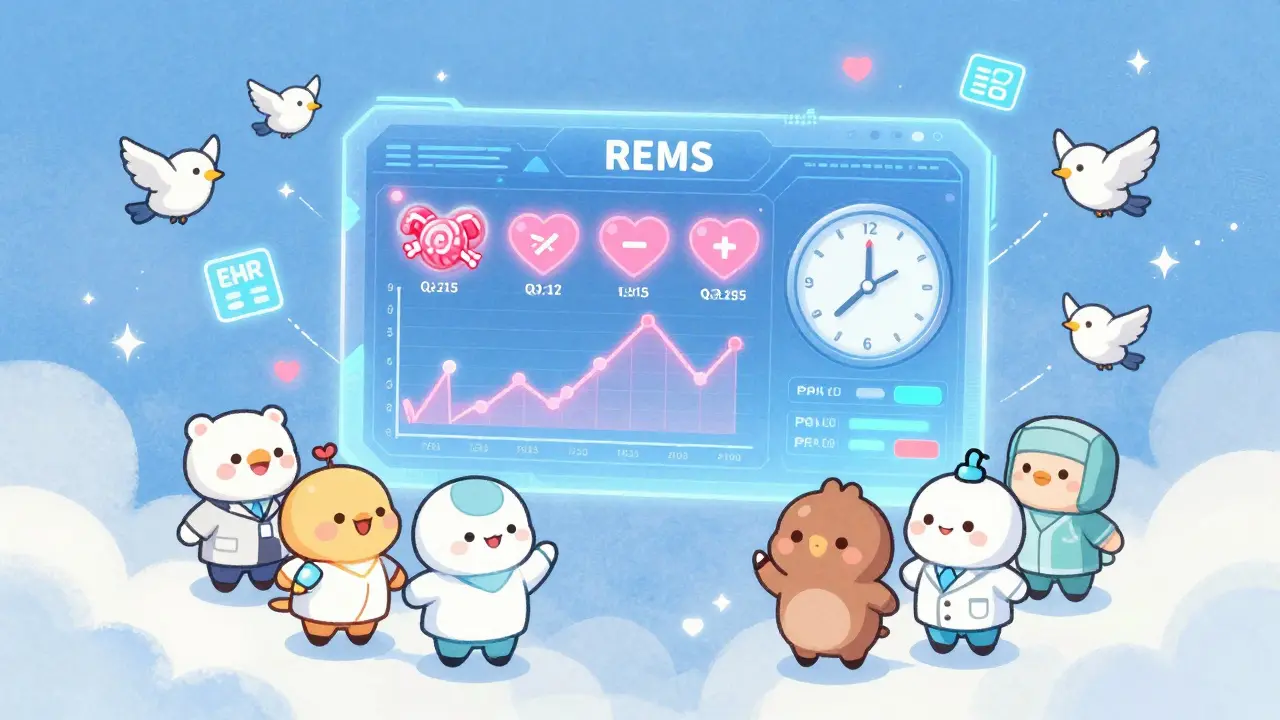
- A REMS Dashboard: By Q3 2025, the FDA plans to launch a public dashboard showing real-time data on how many patients are enrolled, how many prescriptions are denied, and where delays are happening.
- Integration with EHRs: Future REMS may link directly to electronic health records, so a doctor’s certification shows up automatically when they write a prescription.
Experts like Dr. Rachel Sherman, former FDA deputy commissioner, believe the future of REMS lies in real-world data - using pharmacy records, hospital discharge reports, and even wearable devices to monitor patients remotely instead of forcing them into clinics for every checkup.
The goal isn’t to remove REMS. It’s to make them smarter, faster, and less painful for everyone involved.
What You Need to Know If You’re Prescribed a REMS Drug
If your doctor prescribes a medication with a REMS, here’s what to expect:
- You’ll get a Medication Guide - read it. It’s not just paperwork.
- Your doctor may need to register or get certified. Ask them if they’re already enrolled.
- Your pharmacy might be restricted. Not every pharmacy can dispense REMS drugs. Ask if your local pharmacy handles it.
- You might need to sign forms, get blood tests, or join a registry. Don’t ignore these - delays happen fast.
- If you’re denied the drug, ask why. It could be a simple fix - like your doctor’s certification expired.
REMS isn’t meant to stop you from getting treatment. It’s meant to make sure you get it safely. But it’s only effective if everyone - doctors, pharmacists, patients - understands how it works.
Are REMS programs only in the U.S.?
No, REMS programs are specific to the U.S. Food and Drug Administration. Other countries have similar systems - like the European Medicines Agency’s Risk Management Plans (RMPs) - but they’re not called REMS and don’t follow the same structure. The U.S. REMS framework is unique in its legal enforceability and detailed requirements for prescribers and pharmacies.
Can I refuse to participate in a REMS program?
You can refuse to meet REMS requirements - but you won’t get the medication. REMS rules are mandatory for the drug to be dispensed. If you can’t or won’t complete the certification, pregnancy testing, or registry enrollment, your doctor or pharmacist cannot legally give you the drug. In some cases, there may be alternative treatments without REMS requirements.
How do I know if my drug has a REMS?
Check the FDA’s REMS@FDA website, which lists all active programs. Your prescription label may also say “REMS Required.” Your pharmacist will know - they’re required to verify REMS status before dispensing. If you’re unsure, ask your doctor or pharmacist directly. Most REMS drugs are high-risk medications used for cancer, autoimmune diseases, or severe neurological conditions.
Do REMS programs actually make drugs safer?
Yes - but not always equally. For drugs like thalidomide and isotretinoin, REMS programs have nearly eliminated fetal exposure. For others, like certain cancer drugs, the evidence is mixed. Studies show that while REMS reduce some adverse events, they don’t always prevent them - and sometimes create access delays that hurt patients more than they help. The FDA admits REMS need improvement, which is why modernization is now a top priority.
Why do some pharmacies refuse to fill REMS prescriptions?
Many community pharmacies don’t have the staff, time, or systems to handle REMS requirements. Drugs with Elements to Assure Safe Use (ETASU) often require special training, online verification, inventory tracking, and patient counseling that go far beyond normal pharmacy work. As a result, 89% of REMS drugs are only available through specialty pharmacies - which are equipped for these complex programs. If your local pharmacy says no, ask for a referral to a specialty pharmacy.





Peter sullen
December 26, 2025REMS programs represent a paradigmatic shift in pharmacovigilance architecture, wherein the FDA has institutionalized a risk-mitigation framework that integrates regulatory enforceability with pharmacoeconomic accountability. The ETASU components, in particular, constitute a non-negotiable compliance hierarchy that ensures adherence to safety protocols through certified prescriber networks, centralized patient registries, and pharmacy-level verification protocols. The cost-benefit analysis, while substantial, demonstrates a net positive societal return, with an estimated $8.4B in avoided healthcare expenditures versus $1.2B in operational costs. The integration of EHRs and real-time data telemetry will further enhance predictive safety modeling, reducing human error and procedural latency.